The December 31 Milestone Inspection Deadline: What Happens After the Report
Buildings turning 30 this year must complete a milestone inspection by December 31, 2026. If Phase 2 finds damage, repairs have to start within 365 days.
By Luigi Basile
President
If your building reached 30 years of age in 2026, its milestone inspection is due by December 31 of this year. Most of what has been written about that deadline explains the inspection itself — who performs it, what it costs, which form gets filed.
This is about the part that comes after: what a board or a property manager actually has to do once the report is in hand, and the second deadline that starts running the moment it is filed.
We should be plain about our position here. Basile Contractors does not perform milestone inspections. Those are performed by a licensed engineer or architect, and they should be — the person who identifies the damage should not be the person who profits from repairing it. We are a building restoration contractor. We do the work the report calls for. Everything below is written from that side of the process.
What the law requires, in short
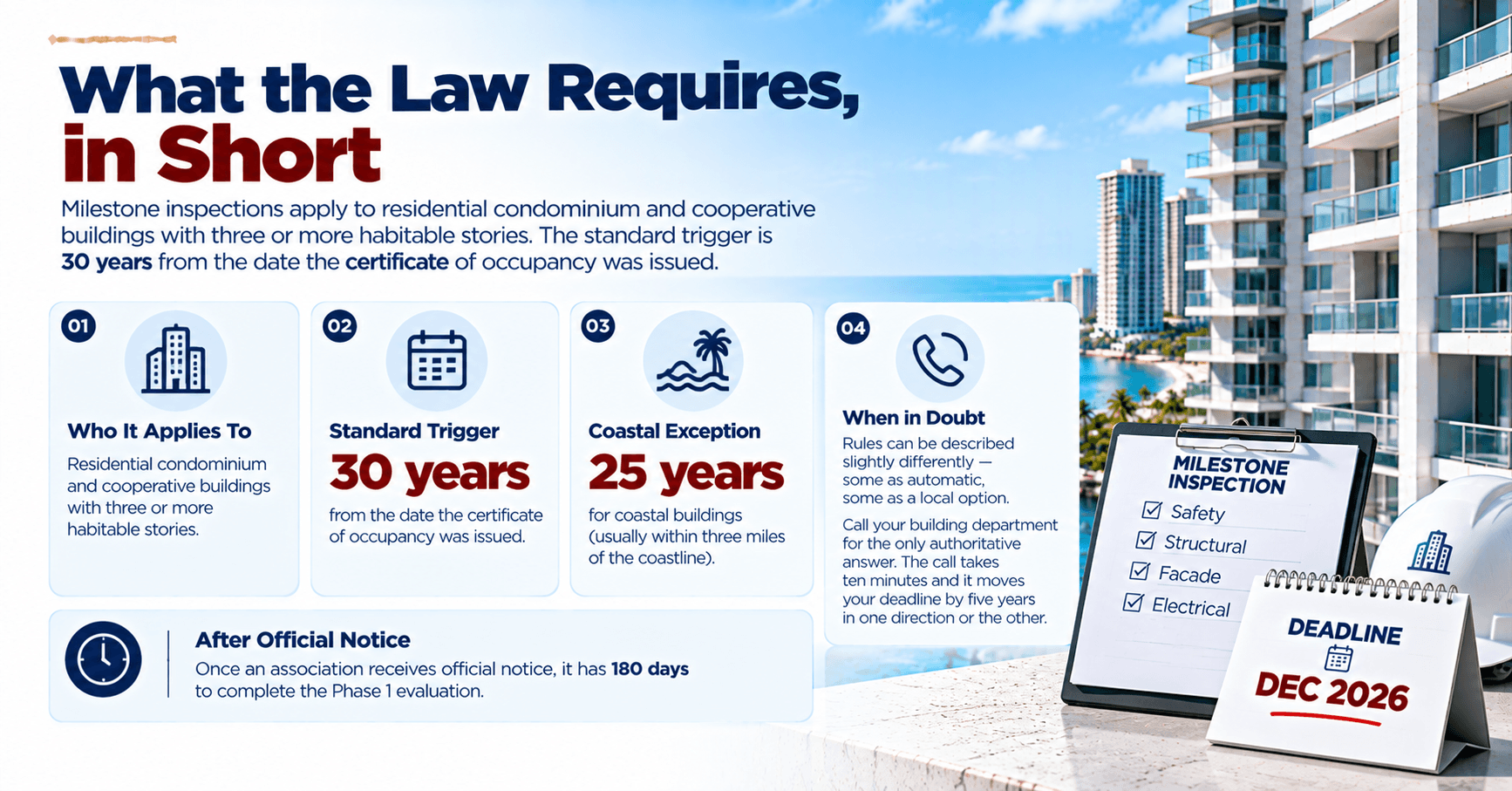
Milestone inspections apply to residential condominium and cooperative buildings with three or more habitable stories. The standard trigger is 30 years from the date the certificate of occupancy was issued.
There is an important exception for coastal buildings, which are commonly described as those within three miles of the coastline: those can fall under a 25-year threshold instead. In our three counties that covers a great many buildings. Sources describe this rule slightly differently — some as automatic, some as a local option — so treat your building department as the only authoritative answer. The call takes ten minutes and it moves your deadline by five years in one direction or the other.
Once an association receives official notice, it has 180 days to complete the Phase 1 evaluation.
| Phase 1 | Phase 2 | |
|---|---|---|
| What it is | Visual inspection of the structure by a licensed engineer or architect | Detailed testing and engineering analysis of the areas of concern |
| When it happens | Within 180 days of official notice | Required when Phase 1 finds substantial structural deterioration |
| What it produces | A report stating whether substantial structural deterioration exists | A report defining the extent of damage and the repairs required |
| What follows | If nothing is found, the process closes until the next cycle | Repairs must begin within 365 days of the local agency receiving the report |
That last row is the one that changes a board's year.
The 365-day clock
A Phase 2 report is not a recommendation. Once the local enforcement agency receives it, repairs must begin within 365 days.
For a board, a year sounds generous until you lay out what has to fit inside it: review the report, define the scope with your engineer, solicit and compare bids, secure funding — which for most associations means a special assessment or a loan, and a membership vote — permit the work, and mobilize a contractor who may be booked months out. Buildings that treat the 365 days as a year of runway routinely discover they had about four months of actual slack.
For a property manager running several buildings, the arithmetic is worse, because the reports do not arrive politely spaced apart.
The practical answer is to start the scope conversation while the engineer is still writing, not after the report lands.
What a Phase 2 report usually means in concrete terms
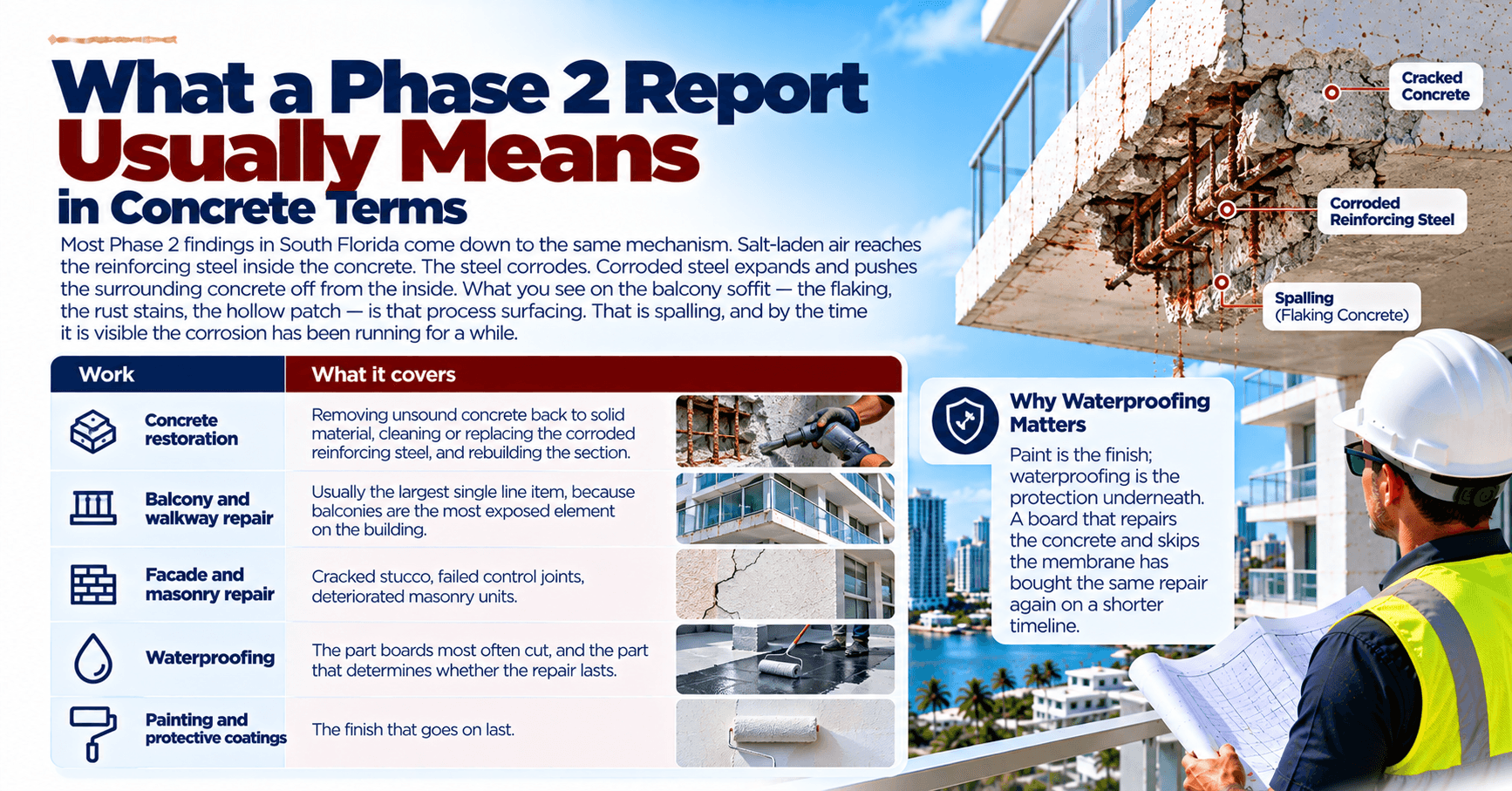
Most Phase 2 findings in South Florida come down to the same mechanism.
Salt-laden air reaches the reinforcing steel inside the concrete. The steel corrodes. Corroded steel occupies more volume than sound steel, so it expands and pushes the surrounding concrete off from the inside. What you see on the balcony soffit — the flaking, the rust stains, the hollow patch that sounds different when you tap it — is that process surfacing. That is spalling, and by the time it is visible the corrosion has been running for a while.
The repair scope that follows typically covers some combination of the following.
| Work | What it covers |
|---|---|
| Concrete restoration | Removing unsound concrete back to solid material, cleaning or replacing the corroded reinforcing steel, and rebuilding the section |
| Balcony and walkway repair | Usually the largest single line item, because balconies are the most exposed element on the building |
| Facade and masonry repair | Cracked stucco, failed control joints, deteriorated masonry units |
| Waterproofing | The part boards most often cut, and the part that determines whether the repair lasts |
| Painting and protective coatings | The finish that goes on last |
That waterproofing line deserves a note. Paint is the finish; waterproofing is the protection underneath. A board that repairs the concrete and skips the membrane has bought the same repair again on a shorter timeline. Doing the work in the right order is most of what separates a fifteen-year repair from a five-year one.
Not sure which repair your building needs?
Walk the building with a licensed restoration contractor before you write a scope.
What HB 913 changed for contractors
The 2025 legislation adjusted several things — annual reporting obligations for local agencies, more flexibility in how associations fund major repairs, and options for temporarily reducing reserves where an inspection was recently completed.
The change worth a board's attention is the conflict-of-interest disclosure requirement, which applies to engineers and contractors alike.
We think that requirement is correct, and we would suggest boards use it as a screening question rather than a form to file. Ask any firm bidding on your milestone repairs whether it has a relationship with the engineer who wrote the report, and ask the engineer the same question in reverse. A contractor who finds that question uncomfortable has told you something useful.
What to ask a restoration contractor
Boards are not contractors. You are volunteers being asked to approve six- and seven-figure structural work, defend an assessment to your neighbors, and make sure the building is safe. These are the questions that separate bids that look similar on the cover page.
| Ask | What a good answer contains |
|---|---|
| How is this priced? | A line-item scope, not a lump sum, so the board can see what it is approving and defend the assessment to owners |
| How do you handle unknowns? | Concrete repair quantities are estimates until the surface is opened. A defined unit price for additional repair area, agreed before work starts |
| Do residents have to leave? | No, on almost every project. Ask specifically how — phasing by elevation and stack, walkway protection, access coordination with management |
| How do you reach the upper floors? | Rope access and swing stage work avoids standing scaffolding across your entrances for months |
| Who coordinates with our engineer? | The contractor should work directly with your engineer of record through sign-off, not leave the board to relay between them |
| What does the board get during the work? | Photo documentation and progress reporting your property manager can forward straight to the board packet |
| Any relationship with our engineer? | A direct answer, per the HB 913 disclosure requirement |
A note on SIRS
The Structural Integrity Reserve Study is a separate requirement, and the two get conflated constantly.
The primary SIRS deadline was December 31, 2025. Associations whose milestone inspection is due by December 31, 2026 may coordinate their SIRS completion with that same date.
The distinction that matters operationally: the milestone inspection tells you what condition the building is in right now. The SIRS tells you what you should have been setting aside to pay for it. A board that reads both documents together — rather than treating them as two compliance chores — has the full picture of what the next decade costs. That is an uncomfortable picture for many associations, and it is better seen in advance than discovered mid-project.
If your report has already landed
Three things are worth doing in the first month, in this order.
Confirm in writing what date starts your 365 days. It is tied to the Phase 2 report, but the exact trigger — the date it was submitted, or the date the local enforcement agency received it — is worth pinning down with your building department rather than assumed. It is not the date the board first read it.
Get the scope walked before you bid it. A report defines what is wrong. It does not always define the repair sequence, the access method, or the phasing — and those are what make the bids comparable. Walking the building with a restoration contractor before the scope goes out usually saves more time than it costs.
Start the funding conversation in parallel, not after. Bids inform the assessment, but the vote, the notice period, and the lending timeline run on their own schedule.
Turning a report into a scope
If you are holding a milestone or Phase 2 report and need it turned into a scope your board can price and defend, we will walk the building at no cost and give you a written, line-item scope. No obligation, and no number over the phone — what the repair costs depends on what is on the wall.
Tell us about your building. We'll come look at it, and tell you honestly what it needs.
Repairs after a recertification or milestone report follow each county’s rules. See our Miami-Dade and Broward pages, and our milestone inspection repairs service.
Not sure which repair your building needs?
Walk the building with a licensed restoration contractor before you write a scope.
Frequently asked questions
Updated: October 16, 2026