Commercial Roof Leak Repair: Common Causes, Solutions & Prevention
A practical guide to commercial roof leak repair: what causes leaks, how to find the source, how leaks are repaired, and how to prevent recurring water damage.
By Luigi Basile
President
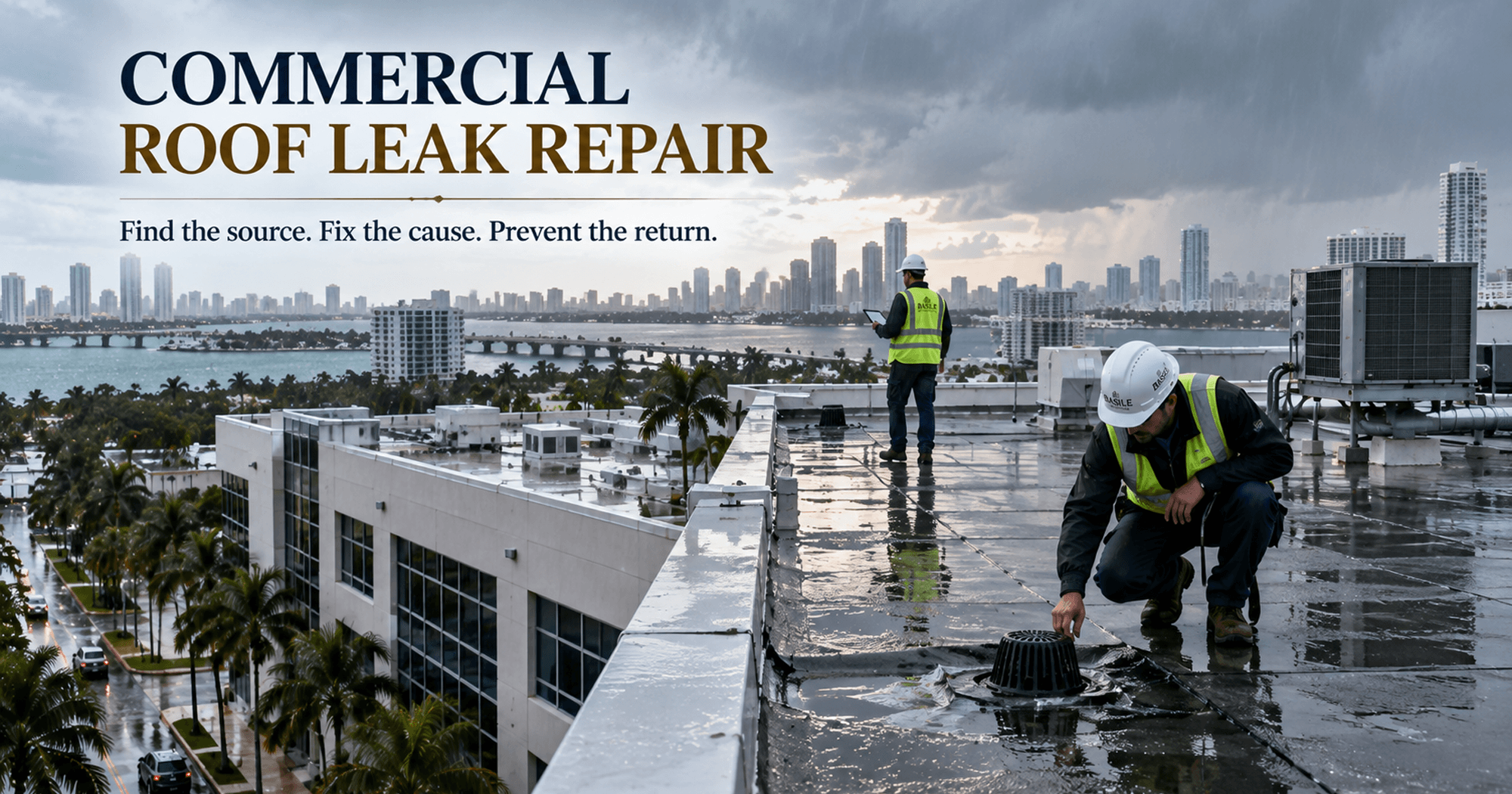
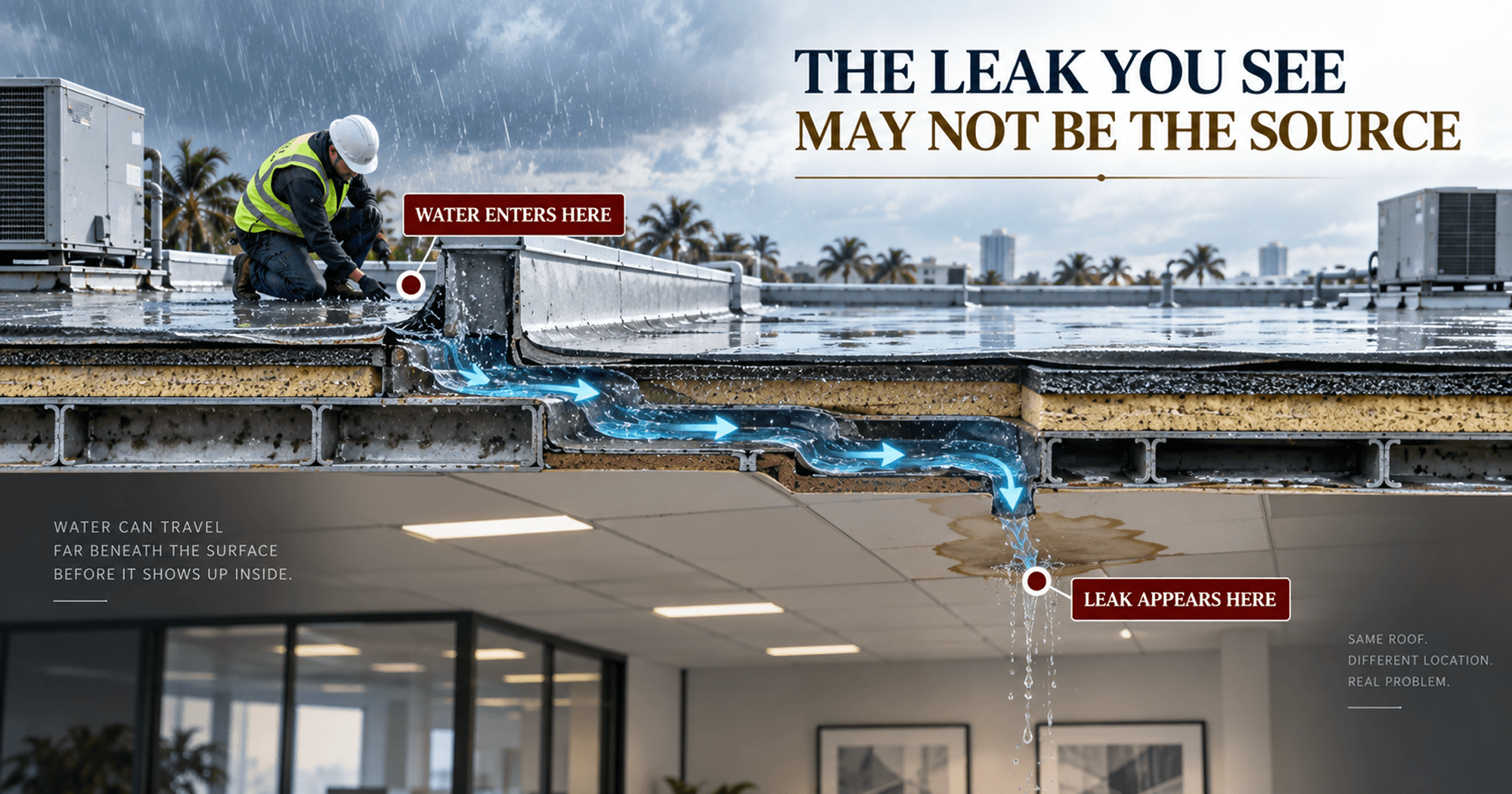
A commercial roof leak rarely announces itself politely. By the time water is dripping onto a floor or staining a ceiling tile, it has usually been traveling through the roofing system for a while — and the spot where it appears inside is often nowhere near where it entered. That gap between symptom and source is exactly why commercial roof leak repair is more than patching a hole: it is finding the true point of entry, understanding what caused it, and fixing the roofing system so the leak does not simply come back. This guide covers what causes commercial roof leaks, how professionals locate and repair them, the warning signs to watch for, and how preventative maintenance keeps them from recurring.
The most important thing a property owner can do is act quickly. A small leak is cheap to fix and a warning worth heeding; ignored, that same leak spreads through insulation, ceilings, walls, and equipment, and often signals a larger roofing-system problem underneath. Commercial roof repair done early protects the building's interior, its contents, and the roof itself.
Why Are Commercial Roof Leaks a Serious Problem?
It is tempting to treat a minor roof leak as a nuisance rather than an emergency. That is a costly mistake. Water that gets past a commercial roof causes interior water damage — stained and sagging ceilings, damaged walls, and ruined insulation. It creates the damp conditions that lead to mold and persistent moisture problems, and it can reach electrical systems, equipment, and inventory, turning a roofing issue into a safety hazard and a financial loss. For many businesses, the resulting disruption — closed areas, displaced operations, cleanup — costs more than the roof repair itself.
Beyond the immediate mess, unaddressed leaks drive structural deterioration and steadily increase repair costs as the damage spreads, and they tend to recur if the underlying cause is never fixed. A small roof leak is frequently the visible tip of a larger roofing-system problem — an aging membrane, failing seams, or a drainage issue affecting the whole roof. Prompt commercial roof leak repair addresses the water intrusion before it becomes an interior-restoration project.
What Causes Commercial Roof Leaks?
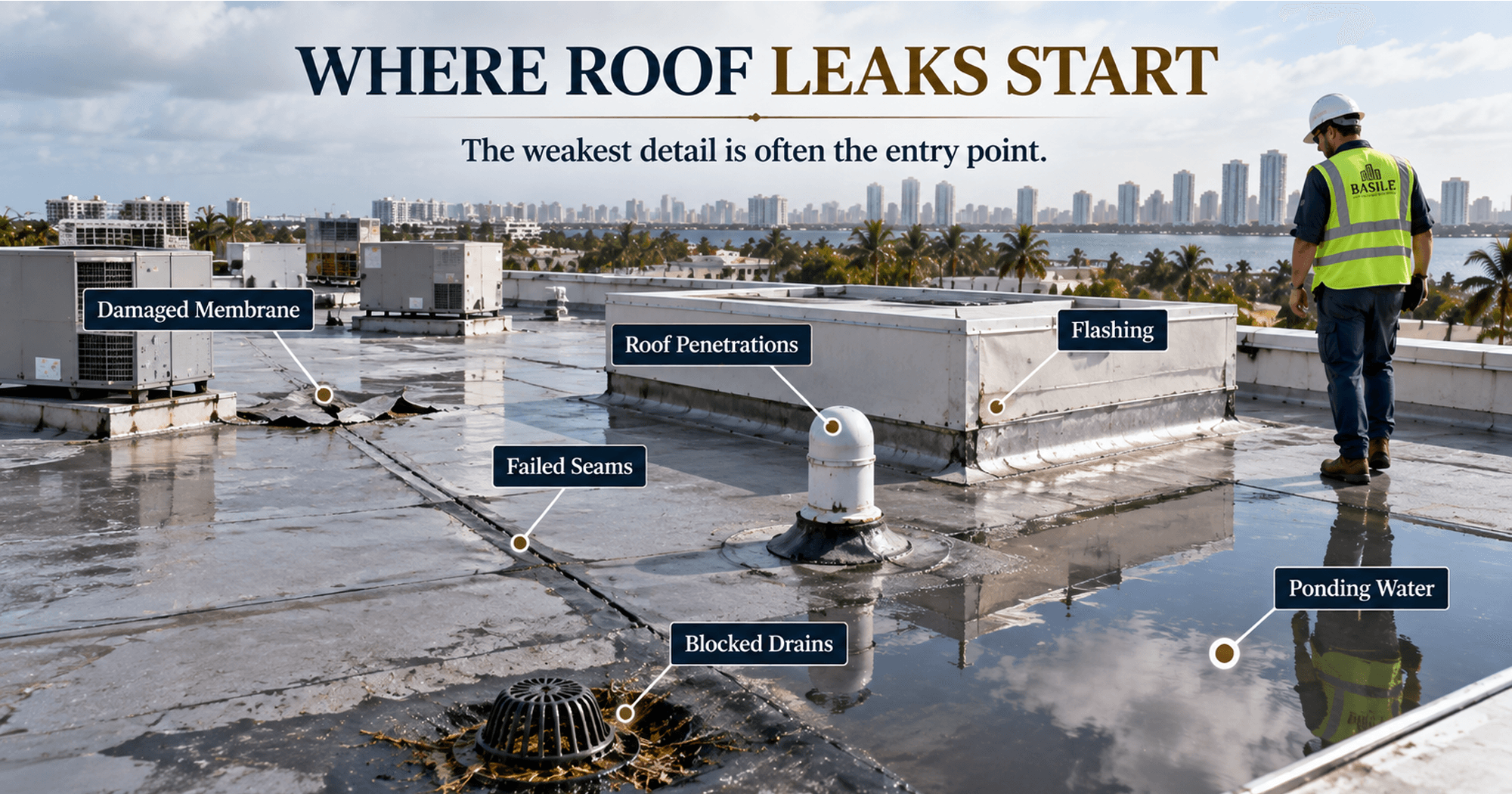
Most commercial roof leaks trace back to a handful of common sources. Knowing them helps owners understand what a professional is actually looking for.
Damaged Roofing Membranes
The membrane is the roof's primary waterproof layer, and tears, punctures, cracks, and general deterioration all compromise it. Weather-related damage and simple aging make the material brittle and permeable, and once the membrane is breached, water penetrates the roofing system beneath it.
Failed Roof Seams
Seams are where sheets of membrane are joined, and they are among the most vulnerable points on any commercial roof. Separation at seams, improperly sealed joints, aging seam materials, and the constant movement of thermal expansion and contraction all open pathways for water to enter through the seam.
Damaged Flashing
Flashing seals the roof's transitions — roof-to-wall, edge flashing, counterflashing, and the flashing around penetrations. When these details crack, loosen, or their sealants deteriorate, water follows the edges straight into the building. Flashing failures are one of the most common sources of commercial roof leaks.
Roof Penetrations
Every HVAC unit, pipe, vent, skylight, drain, and piece of mechanical equipment interrupts the roof surface, and each interruption must be sealed. Improperly sealed penetrations create direct pathways for water, which is why they are among the first places a professional inspects.
Clogged or Damaged Roof Drains
Drains are the roof's escape route for water. When they clog with debris or fail, water backs up, standing water and overflow conditions develop, and poor drainage puts constant pressure on the roofing system — a frequent contributor to recurring roof leaks.
Ponding Water
Ponding water is water that remains on a flat or low-slope roof more than 48 hours after rain, usually because of drainage problems or low spots. Prolonged standing water degrades the membrane beneath it and accelerates roof deterioration, making proper drainage essential to keeping a commercial roof watertight.
Storm and Wind Damage
Heavy rainfall, high winds, and flying debris damage roofs directly — puncturing the membrane, tearing or lifting flashing, and opening seams. Because storm damage is often not visible from the ground, post-storm roof inspections are an important precaution after any significant weather event.
Aging Roofing Systems
Finally, time itself causes leaks. As roofing materials age they deteriorate, lose flexibility, crack, and their seals fail, and an aging roof demands more frequent maintenance and repair to stay watertight.
What Are the Signs of a Commercial Roof Leak?
Roofs usually give warning before a leak becomes severe. Property owners and facility managers should watch for these signs.
Water Stains on Ceilings and Walls
Brown rings, discoloration, or damp patches on ceilings and upper walls are classic early evidence that water has entered the building.
Dripping or Visible Water
Active dripping or pooling water inside is an unmistakable, urgent sign that the roof is leaking and needs immediate attention.
Damp Insulation
Wet or compressed insulation — often discovered in ceiling spaces or mechanical areas — indicates water is moving through the assembly, and wet insulation loses much of its value.
Musty Odors or Persistent Moisture
A persistent musty smell or lingering dampness signals trapped moisture, even when no water is visibly dripping.
Blistering or Bubbling Roofing Materials
Blisters or bubbles in the roofing surface indicate trapped moisture within the roofing system and a compromised membrane.
Cracked or Deteriorated Sealants
Failed sealants around penetrations, flashing, and seams are both a warning sign and a common leak source.
Damaged Flashing
Loose, cracked, corroded, or lifting flashing is a visible indicator that one of the roof's most vulnerable details has failed.
Standing Water on the Roof
Water that lingers on the roof after rain points to drainage problems and accelerates the deterioration that leads to leaks.
Unexplained Interior Water Damage
Water damage that appears with no obvious source is a particular warning — because the visible location of water inside the building may not correspond directly with the actual leak source on the roof. Water travels along the underside of the deck and structure before it drops, which is exactly why finding the true source takes expertise.
How to Find the Source of a Commercial Roof Leak
Locating a commercial roof leak is often the hardest part of the repair, precisely because the entry point and the interior symptom can be far apart. A systematic inspection is what tracks the water back to its origin.
Inspect the Interior
The search starts inside: examining ceiling stains, walls, and insulation, checking attic or roof-space areas where applicable, reviewing mechanical areas, and following the signs of water migration to narrow down where the water is traveling.
Inspect the Roof Surface
On the roof, the inspection looks for membrane damage, open seams, punctures, cracks, damaged flashing, failed sealants, and ponding water — the physical breaches where water gets in.
Inspect Roof Penetrations
Because penetrations are such common culprits, HVAC units, pipes, vents, skylights, and equipment supports each get checked for failed seals and damaged flashing.
Inspect Drainage Systems
Finally, the drainage system — roof drains, gutters, scuppers, downspouts, and drainage pathways — is examined, since backed-up or failed drainage is a frequent source of recurring leaks. When the source is not obvious from these steps, professional leak detection is often necessary to pinpoint it without unnecessary tear-up.
How to Fix a Commercial Roof Leak
The right way to fix a commercial roof leak depends on the roof type, the leak source, the extent of the damage, and the condition of the roofing system — there is no single method that fits every roof. A sound repair follows a clear sequence.
Step 1: Inspect and Identify the Leak
Both an interior inspection and a roof inspection are used to identify the water entry points and determine whether the leak is isolated or part of a widespread problem.
Step 2: Determine the Cause
Before repairing, the professional identifies the underlying cause — membrane damage, failed seams, flashing, penetrations, drainage problems, storm damage, or aging materials — because a repair that ignores the cause will fail.
Step 3: Prepare the Damaged Area
The area is cleaned, loose materials removed, the affected area dried where appropriate, and the surface prepared so the repair can bond properly.
Step 4: Repair the Roofing System
The actual repair is matched to the problem: patching damaged membrane, repairing seams, replacing damaged flashing, resealing penetrations, repairing roof drains, or replacing localized damaged materials.
Step 5: Inspect and Test the Repair
Finally, the repaired areas are checked, seals verified, surrounding roofing components inspected, drainage confirmed, and the repair monitored after rainfall where appropriate — ensuring the leak is truly resolved rather than just hidden.
Commercial Roof Leak Repair Methods
Professionals draw on several repair methods, matched to the specific failure.
Roof Membrane Patching
When membrane damage is localized, patching the affected area restores the waterproof layer without the cost of replacing a larger section.
Seam Repair
Open seams, failed adhesives, and deteriorated sealants are re-sealed and, where required, reinforced, closing one of the most common leak pathways.
Flashing Repair
Damaged, loose, or failed flashing joints are resealed or replaced, restoring the watertight detail at the roof's transitions.
Roof Penetration Repair
The seals and flashing around HVAC units, pipes, vents, skylights, and equipment supports are repaired so water can no longer track down the penetration.
Drainage Repair
Drain cleaning and repair, gutter repair, scupper maintenance, and correcting drainage issues remove the standing water that drives recurring leaks.
Localized Roofing Material Replacement
Where a section of roofing is too damaged to patch, the damaged material is removed and replaced locally, restoring that area without a full re-roof.
Commercial Roof Repair vs. Roof Replacement
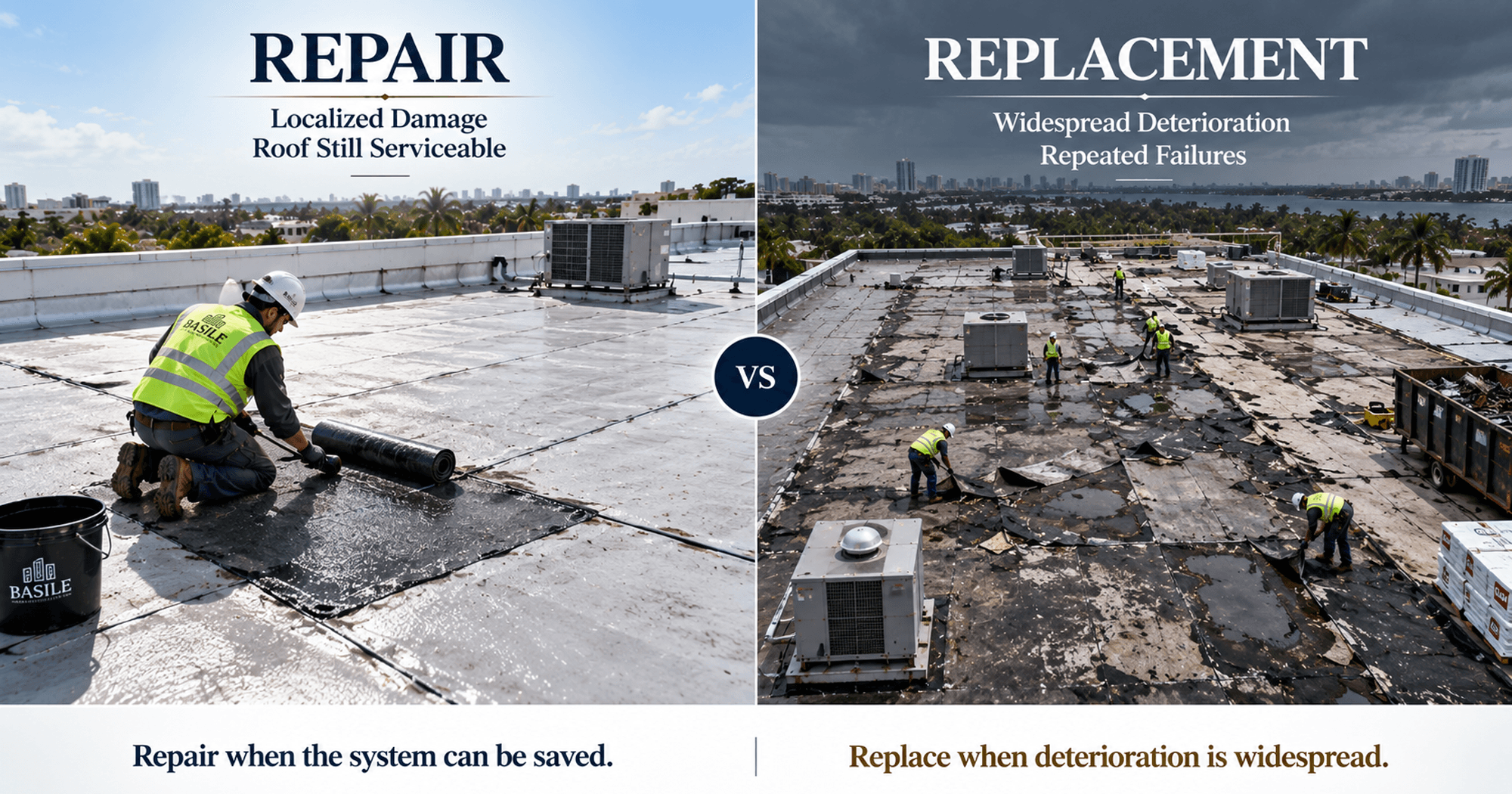
Repair is not always the answer, and replacement is not always necessary. The table below shows the difference at a glance.
| Factor | Commercial Roof Repair | Commercial Roof Replacement |
|---|---|---|
| Damage | Usually localized | Usually extensive |
| Scope | Targeted | Comprehensive |
| Cost | Generally lower upfront | Generally higher upfront |
| Disruption | Often less | Usually greater |
| Existing roof | Remains largely in place | Existing system is replaced |
| Best for | Isolated damage | Severely deteriorated systems |
Repair is appropriate when the damage is localized and the existing roofing system remains serviceable — which describes most single leaks caught early. Commercial roof replacement becomes necessary when there is widespread deterioration, repeated failures, or significant underlying damage that repairs cannot resolve. For most leaks, a targeted repair is the right and far less costly solution.
Can a Commercial Roof Leak Be Repaired or Does It Need Replacement?
The line between repair and replacement comes down to the roof's overall condition, not just the leak. The factors that determine the appropriate solution include the age of the roof; the extent of the damage; the number of leaks and how often repairs have been needed; the condition of the membrane and the roof deck; whether moisture is trapped beneath the roofing system; the previous repair history; the structural condition; and the roof's remaining useful life. The general rule is straightforward: localized damage means repair is likely appropriate, while widespread deterioration means a more extensive restoration or replacement may be necessary. A professional inspection is what determines which side of that line a specific roof falls on.
How Weather Can Cause Commercial Roof Leaks
In South Florida, the climate is relentless on commercial roofs, and several conditions in particular drive leaks.
Heavy Rainfall
Frequent, intense rain overwhelms drainage and tests every seam, penetration, and flashing detail, finding any weakness in the roof.
High Winds
Strong winds lift edges and flashing and drive rain into openings that a gentle rain would never reach.
Hurricanes and Tropical Storms
Hurricanes and tropical storms combine wind, wind-driven rain, and flying debris, causing both immediate damage and hidden weaknesses that leak later.
High Humidity
Constant humidity keeps roofing assemblies damp, accelerating material aging and contributing to trapped-moisture problems.
Intense Heat and UV Exposure
Florida's sun degrades sealants and membranes and drives the thermal expansion and contraction that opens seams and cracks over time.
Salt Air and Coastal Conditions
Near the coast, salt air accelerates the corrosion of metal flashing and fasteners and speeds up weathering across the roof. Together these conditions contribute to sealant deterioration, membrane aging, flashing damage, moisture intrusion, and the material expansion and contraction that make recurring leaks so common on South Florida roofs.
How to Prevent Commercial Roof Leaks
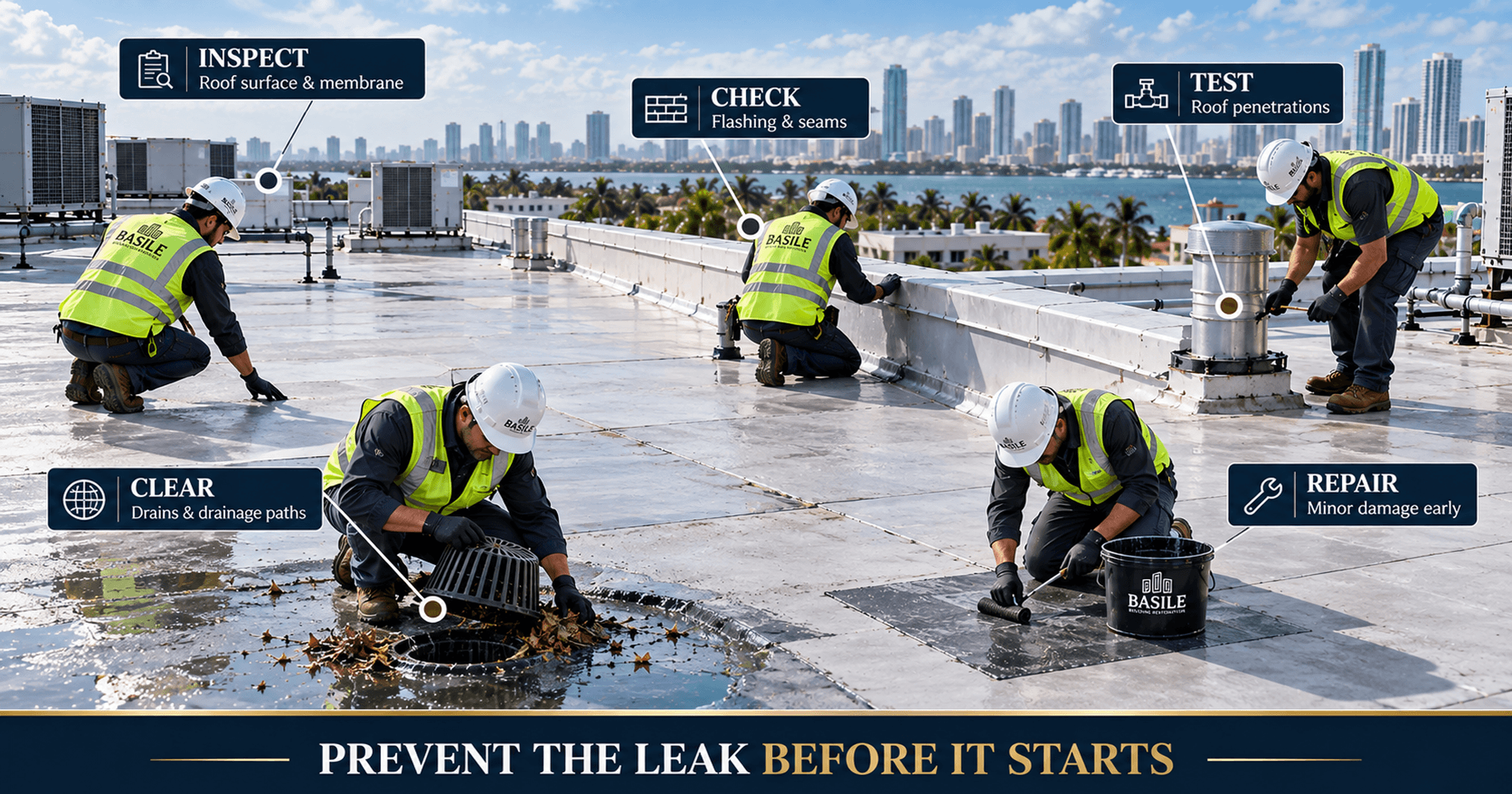
The most cost-effective roof leak repair is the one you never have to make. Prevention comes down to a few consistent habits.
Schedule Regular Roof Inspections
Routine, seasonal, and post-storm inspections catch minor problems — a lifting seam, a clogged drain, early membrane wear — while they are small and inexpensive to fix.
Keep Roof Drains Clear
Regular debris removal, drain inspections, and gutter and scupper maintenance keep water moving off the roof and prevent the ponding that leads to leaks.
Maintain Flashing and Seams
Because flashing and seams fail first, repairing small failures early — before they open into active leaks — is one of the highest-value maintenance tasks.
Inspect Roof Penetrations
The seals around HVAC systems, pipes, vents, skylights, and equipment supports should be checked regularly, since these details loosen and deteriorate over time.
Address Minor Damage Quickly
Small problems do not stay small on a roof. Addressing minor damage promptly prevents localized issues from spreading into a larger, more expensive roofing problem.
Maintain a Commercial Roof Maintenance Plan
A documented maintenance plan — inspection schedules, repair records, maintenance history, storm-inspection procedures, and budget planning — is what turns reactive repairs into proactive protection and extends the life of the roof.
Common Commercial Roof Leak Repair Mistakes to Avoid
Repairing Only the Visible Water Damage
Fixing the stained ceiling without fixing the roof source leaves the leak active; the interior damage simply returns.
Patching Without Finding the Root Cause
Sealing the spot where water appears, without tracing it to the true entry point, means the water just finds the patch's edge.
Ignoring Small Leaks
A minor leak left alone spreads through insulation and structure and becomes a major, expensive problem.
Applying Sealant Without Proper Surface Preparation
Sealant applied to a dirty, wet, or unprepared surface will not bond and fails quickly.
Ignoring Drainage Problems
Repairing a leak without correcting the drainage that caused it guarantees the problem comes back.
Delaying Post-Storm Inspections
Storm damage is often hidden; delaying inspection lets small breaches leak unnoticed until the interior damage is severe.
Using Incompatible Repair Materials
Repair materials that are not compatible with the existing roofing system fail prematurely and can worsen the damage.
Choosing a Contractor Based Only on Price
The cheapest bid often means shortcuts on leak detection, preparation, and materials — leading to recurring leaks and higher long-term costs.
How Much Does Commercial Roof Leak Repair Cost?
There is no flat price for commercial roof leak repair; the cost depends on the specific situation. The factors below drive it.
| Cost Factor | Potential Impact |
|---|---|
| Leak location | Difficult-to-access areas may increase labor |
| Roof size | Larger systems may require more inspection |
| Damage severity | Extensive damage increases repair scope |
| Roof material | Repair requirements differ by system |
| Flashing condition | Damaged flashing may require replacement |
| Membrane damage | Larger damaged areas increase material and labor |
| Drainage problems | Drain repairs may add to project scope |
| Roof accessibility | Difficult access increases complexity |
| Interior damage | Additional building repairs may be required |
| Emergency repair | Urgent work may carry additional costs |
Because these factors vary from roof to roof and much of the damage is hidden until it is investigated, an inspection is generally needed for an accurate estimate rather than a quote sight unseen.
How to Choose a Commercial Roofing Contractor for Leak Repair
Choosing the right commercial roofing contractor is what ensures the leak is actually solved rather than temporarily hidden. Look for experience with commercial roofing systems and specific commercial roof leak repair experience; knowledge of different roofing materials and genuine leak-detection capabilities; and a track record with commercial properties. Confirm proper licensing and insurance, documented safety procedures, and references and previous projects. Expect a detailed scope of work, clear repair recommendations, appropriate repair materials, warranty information, and preventative maintenance options. Qualified commercial roofing contractors can speak to all of these without hesitation.
Why Professional Commercial Roof Leak Repair Matters
The value of a professional is in getting the whole problem right. Professional commercial roof leak repair delivers accurate leak detection, identifies the underlying cause, and selects the correct repair method. It brings proper surface preparation, appropriate materials, and the safety procedures that rooftop work demands. Most importantly, it aims at preventing recurring leaks — protecting the building interior and extending the useful life of the roofing system — rather than producing a patch that fails at the next heavy rain. That is the difference between solving a leak and merely postponing it.
Commercial Building Repair for a Leaky Roof
When a roof has been leaking, the damage often extends beyond the roof itself, which means commercial building repair for a leaky roof can involve more than roofing work. Water that has already entered the building may have damaged ceilings, walls, insulation, and interior finishes, and it can affect electrical components, HVAC areas, equipment, and inventory. The correct order of operations matters: the first priority is always stopping the source of water intrusion at the roof, followed by evaluating and repairing any resulting building damage. Fixing the interior before the roof simply invites the damage to return with the next rain.
When Should You Call a Commercial Roofing Company?
Some situations call for professional help right away. Contact a commercial roofing company when you have an active roof leak, repeated leaks, or multiple leak locations; after storm damage; when you see visible membrane damage, damaged flashing, or ponding water; when there is interior water damage; when the roof is nearing the end of its serviceable life; or when previous repairs keep failing. In each of these cases, professional assessment and repair protect both the roof and the building — and catch the larger problems that a quick surface fix would miss.
Why Choose Basile Contractors?
Basile Contractors brings more than 25 years of South Florida commercial building experience to roof leak repair. As a licensed Florida roofing contractor (license #CCC1511747), fully insured and bonded, and ICRI certified, OSHA compliant, and manufacturer-certified, Basile focuses on finding the true source of a leak and fixing the roofing system so it stays fixed — not just patching the visible symptom. The team's strengths in roofing, waterproofing, and building-envelope restoration mean the leak, its cause, and any related water intrusion are addressed together, and its rope-access and high-rise capabilities let even difficult roofs and elevations be inspected and repaired safely. Serving commercial properties across Broward, Miami-Dade, and Palm Beach, Basile pairs roofing expertise with real knowledge of how South Florida's rain, heat, storms, and salt air cause roofs to leak.
Not sure which repair your building needs?
Walk the building with a licensed restoration contractor before you write a scope.
Is Your Commercial Roof Showing Signs of a Leak?
Water stains, dripping, damp insulation, or damage after a storm are all reasons to act before the problem spreads. Basile Contractors helps commercial property owners, property managers, facility managers, building owners, developers, and business owners inspect their roofs and repair leaks at the source. Call (352) 657-8653 to schedule a professional commercial roof inspection and leak assessment.
Conclusion
Commercial roof leaks can result from damaged membranes, failed seams, flashing problems, roof penetrations, drainage issues, storms, and aging materials — and small leaks should never be ignored, because water migrates and causes extensive interior damage. Finding the actual source of a leak is the core of effective commercial roof leak repair, and the right repair method depends on the roofing system and the type and extent of the damage. Regular inspections, drainage maintenance, flashing checks, and prompt preventative repairs sharply reduce the risk of recurring leaks. Not every leaking roof needs full replacement, but widespread deterioration may call for a more extensive solution. Working with an experienced commercial roofing professional helps property owners address both the immediate leak and its underlying cause. Contact Basile Contractors to schedule a commercial roof leak inspection and repair assessment.
Frequently asked questions
Updated: October 8, 2026