Historic Building Restoration Challenges in Florida: What Property Owners Should Know
The unique challenges of historic building restoration in Florida — climate, aging materials, structural issues, preservation requirements — and how property owners should approach them.
By Luigi Basile
President
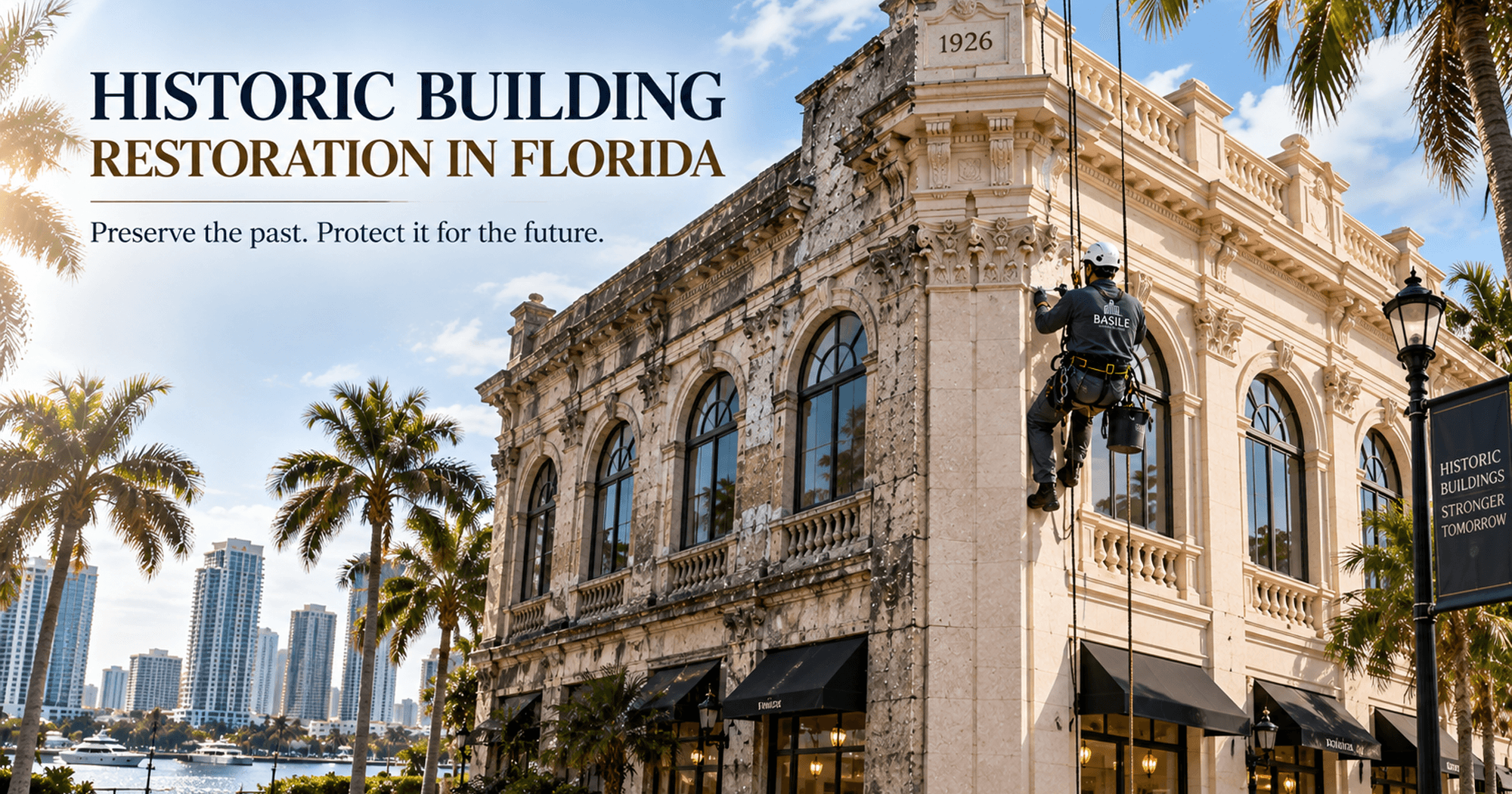
Restoring a historic building anywhere is demanding work. Doing it in Florida adds a set of challenges that few other places impose all at once: heat, humidity, torrential rain, hurricanes, wind-driven rain, and salt air, all working on materials that may be a century old. Historic building restoration in Florida is not simply a matter of making an old building look good again — it is the careful work of repairing deterioration and protecting the structure while preserving the architectural character that makes it worth saving, under conditions actively working against you. This guide walks property owners through the major challenges, the climate's effects, the preservation and structural considerations, and how to approach a restoration the right way.
The through-line is that historic buildings behave differently from modern ones, and Florida's environment magnifies every weakness. An early, thorough assessment is what keeps a manageable restoration from becoming an extensive one — because with a historic structure, the damage you can see is usually only part of the story.
What Is Historic Building Restoration?
Historic building restoration is the process of repairing and stabilizing a historic structure while retaining as much of its original fabric, materials, and architectural character as possible. The goal is preservation of what makes the building significant — not modernization. That distinguishes it from related work: renovation updates a building for current use and often prioritizes function over historical accuracy; rehabilitation adapts a building for a new purpose while keeping its character-defining features; and preservation focuses on maintaining a building's existing historic materials and form. Restoration leans toward returning the building to its original condition and appearance.
Because of that goal, historic buildings require specialized assessment. The original brick, stone, mortar, woodwork, and finishes are the building's authenticity, and once removed they cannot truly be recovered. Restoring an old building is fundamentally different from remodeling a modern property, where materials are readily replaced and design is flexible. In restoration, the existing fabric constrains — and guides — every decision.
Historic Restoration vs. Renovation
The difference between restoring and renovating is worth making concrete, because it shapes the whole project.
| Factor | Historic Restoration | Renovation |
|---|---|---|
| Primary goal | Preserve historical character | Improve or update the property |
| Original materials | Often retained | May be replaced |
| Architectural details | Preserved | May be modified |
| Documentation | Often important | Usually less extensive |
| Materials | Historically appropriate where possible | Modern materials may be used |
| Design limitations | Often greater | Generally more flexible |
Restoration accepts greater constraints in exchange for authenticity; renovation trades authenticity for flexibility. Knowing which one a project actually is — and it is often a blend leaning one way — sets the expectations for materials, methods, and approvals.
Why Is Historic Building Restoration Challenging in Florida?

Florida concentrates an unusual number of destructive forces on aging buildings. Heat and intense UV, high humidity, heavy rainfall, hurricanes and wind-driven rain, salt air, and coastal exposure all attack historic materials, while moisture intrusion works quietly inside walls and assemblies. Add the reality of aging construction materials — some no longer manufactured — and the preservation requirements that may govern the property, and it becomes clear why restoring a historic building here is more complex than almost anywhere else. These conditions do two things at once: they accelerate deterioration, and they make the restoration itself harder, because every repair has to withstand the same forces that damaged the building in the first place.
Common Challenges in Historic Building Restoration in Florida
Several specific challenges come up on nearly every Florida historic restoration.
Moisture and Water Intrusion
Water is the single greatest enemy of a historic building. In Florida it arrives constantly — through roof leaks, failed flashing, cracked masonry, poor drainage, and deteriorated sealants — and moisture trapped inside walls does damage that stays hidden until it is severe. Older buildings were designed to manage moisture in particular ways, and when those systems fail, water drives most other forms of deterioration.
High Humidity and Mold-Related Concerns
Florida's humid environment keeps materials damp and slows drying. That moisture retention leads to wood deterioration, paint failure, and general material degradation, and it creates conditions for mold. Historic buildings often lack modern ventilation, which compounds the challenge of keeping assemblies dry.
Hurricane and Storm Damage
Hurricanes bring wind damage and wind-driven rain that can breach roofs, break windows, and deteriorate exterior elements, and severe storms can cause structural damage. Post-storm restoration is a recurring reality for Florida's historic properties, and storm damage often reveals — or worsens — weaknesses that were already present.
Salt Air and Coastal Exposure
For coastal historic buildings, salt air is a persistent, corrosive force. Chloride exposure corrodes metal elements, deteriorates masonry and concrete, and accelerates weathering across the building. Protective restoration measures matter more here than almost anywhere, because the environment never stops attacking.
Aging and Deteriorated Materials
Finally, the materials themselves — historic wood, masonry, concrete, metal, plaster, mortar, and historic finishes — deteriorate with age and exposure. The challenge is that replacing original materials without proper assessment can strip away the very historic character the restoration is meant to preserve. Deciding what to save, repair, or replace is a judgment that requires experience with historic materials.
Structural Challenges When Restoring Historic Buildings
Beneath the finishes, the structure has usually aged too, and structural assessment is essential before restoration work begins.
Deteriorated Structural Components
Wood framing, concrete, masonry, steel, and foundations all degrade over decades of Florida exposure. Identifying which structural components remain sound and which need repair is foundational to any restoration plan.
Cracks and Structural Movement
Settlement, foundation movement, thermal movement, and water-related deterioration all produce structural cracking. Because cracks can be cosmetic or a symptom of a serious structural issue, historic structures should be assessed to understand what the movement means before repairs begin.
Corrosion of Metal and Reinforcement
Coastal exposure drives rust and reinforcement corrosion, and as embedded steel corrodes it expands and cracks the surrounding concrete or masonry from within. Deteriorated metal connections carry structural implications that are easy to underestimate.
Hidden Damage
Perhaps the most important structural truth about historic buildings: visible deterioration usually represents only a portion of the problem. Moisture behind walls, rot inside framing, corroded reinforcement, deteriorated mortar, and damaged roof assemblies frequently lurk out of sight. A restoration priced or planned only around what is visible is almost always underestimated.
Preserving Original Materials and Architectural Features
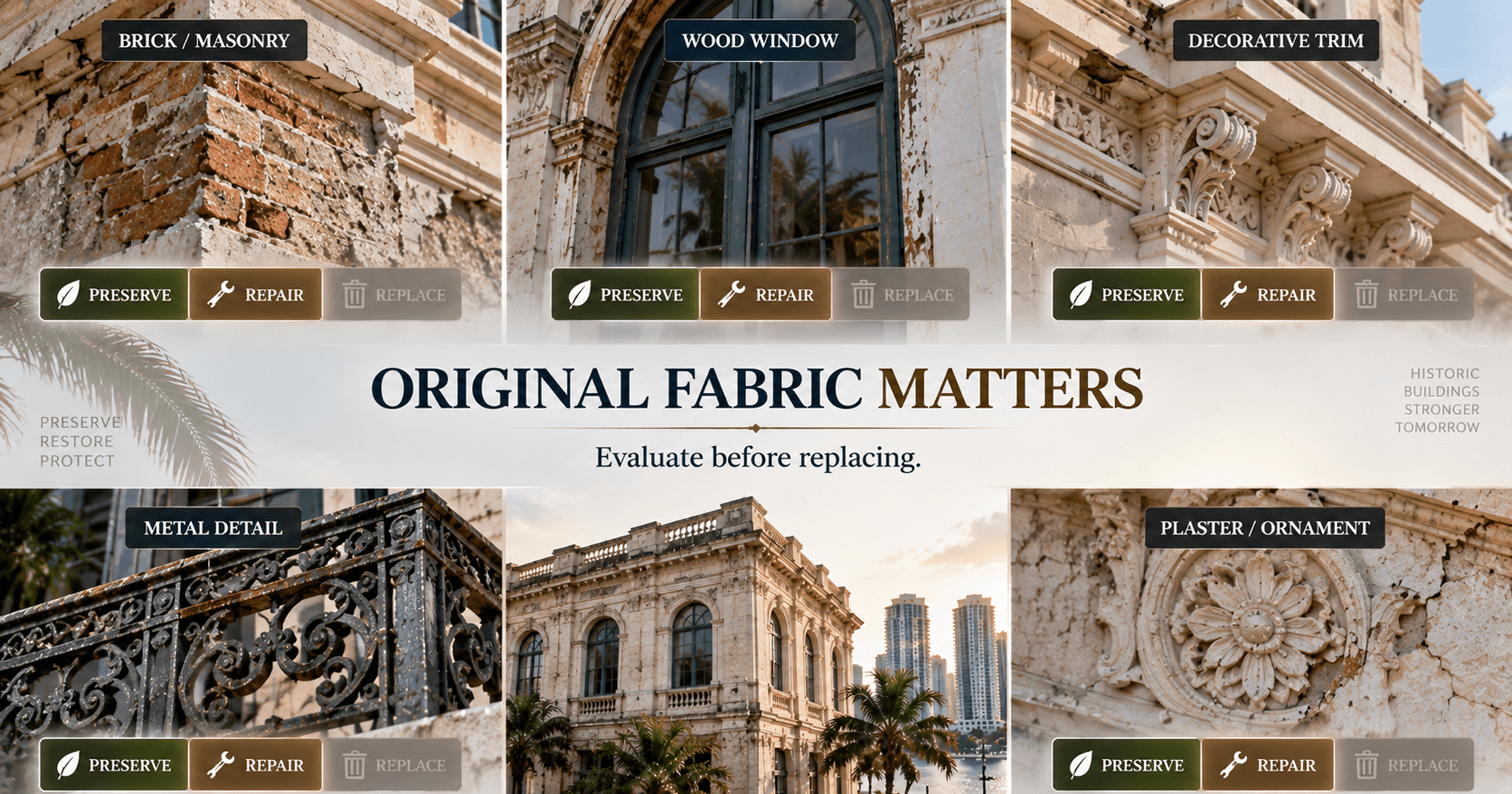
The features that give a historic building its identity — historic windows and doors, decorative details, masonry, woodwork, columns, cornices, facades, and historic finishes — are exactly what a good restoration works hardest to keep. These are the elements that cannot be reproduced once lost, and preserving them is the difference between a restored building and a merely renovated one.
Why Original Materials Should Be Evaluated Before Replacement
Original materials should always be evaluated before anyone decides to replace them, for reasons of historical significance and architectural authenticity, but also practical ones — compatibility with the surrounding fabric, longevity, and preservation value. Materials that have survived a century have often proven their durability, and repairing them in place is frequently both more authentic and more sound than replacing them.
Matching Replacement Materials
When replacement genuinely is necessary, matching matters enormously: matching masonry, compatible mortar, the right wood species, correct paint colors, appropriate historic finishes, and faithful decorative elements. A crucial caution here is that a visually similar modern material may not perform appropriately on a historic structure — a harder modern mortar, for example, can damage the softer historic masonry around it. Matching is about performance and compatibility, not just appearance.
Historic Building Restoration and Preservation Requirements in Florida
Before construction begins, it is important to determine whether a property carries a historic designation, is subject to local preservation requirements, faces architectural restrictions, needs special permitting, or has documentation requirements. These vary widely.
Why Property Owners Should Research Requirements Before Construction
Researching the applicable requirements early protects the project, because approval processes can shape the restoration scope, exterior modifications, material changes, treatment of historic features, and documentation. It is worth emphasizing that not every historic building in Florida is subject to the same regulations — requirements differ by designation, jurisdiction, and property. Understanding what actually applies to a specific building prevents costly missteps and delays once work is underway.
The Role of an Architect in Historic Building Restoration
On larger or more complex projects, an architect for historic building restoration can play a valuable role distinct from the contractor's. An architect may contribute existing-condition documentation, historical research, and restoration planning; architectural assessment and design development; material recommendations; and coordination with preservation authorities and with the contractors performing the work, along with construction documentation. On significant restorations, this planning and documentation layer helps ensure the work is both historically appropriate and properly permitted.
When Should Property Owners Work With an Architect?
Working with an architect makes the most sense on major restoration projects, those involving significant structural modifications or complex historical features, projects governed by preservation requirements, large commercial properties, and any project requiring detailed documentation. On smaller, more straightforward repairs, an experienced restoration contractor may be sufficient — but where the project is large or the history is intricate, architectural involvement is worth considering early.
The Role of Historic Building Restoration Contractors
Alongside — and sometimes independent of — an architect, specialized historic building restoration contractors do the hands-on work, and their experience is what determines whether the restoration actually holds. The valuable ones bring experience with historic masonry, concrete restoration, facade restoration, waterproofing, and structural repairs, along with knowledge of historic materials, building-envelope restoration, and the weather-related deterioration specific to the region.
What Should You Look for in a Historic Restoration Contractor?
When evaluating a contractor, look for relevant project experience and genuine restoration expertise; Florida experience and knowledge of historic materials; documented safety procedures and qualified personnel; references and a detailed scope of work; appropriate repair methods and thorough documentation; and proper insurance and licensing where applicable. A contractor who can speak specifically to how they would handle your building's materials and conditions — rather than in generalities — is the one to trust with historic fabric.
Common Restoration Problems in Florida Historic Buildings
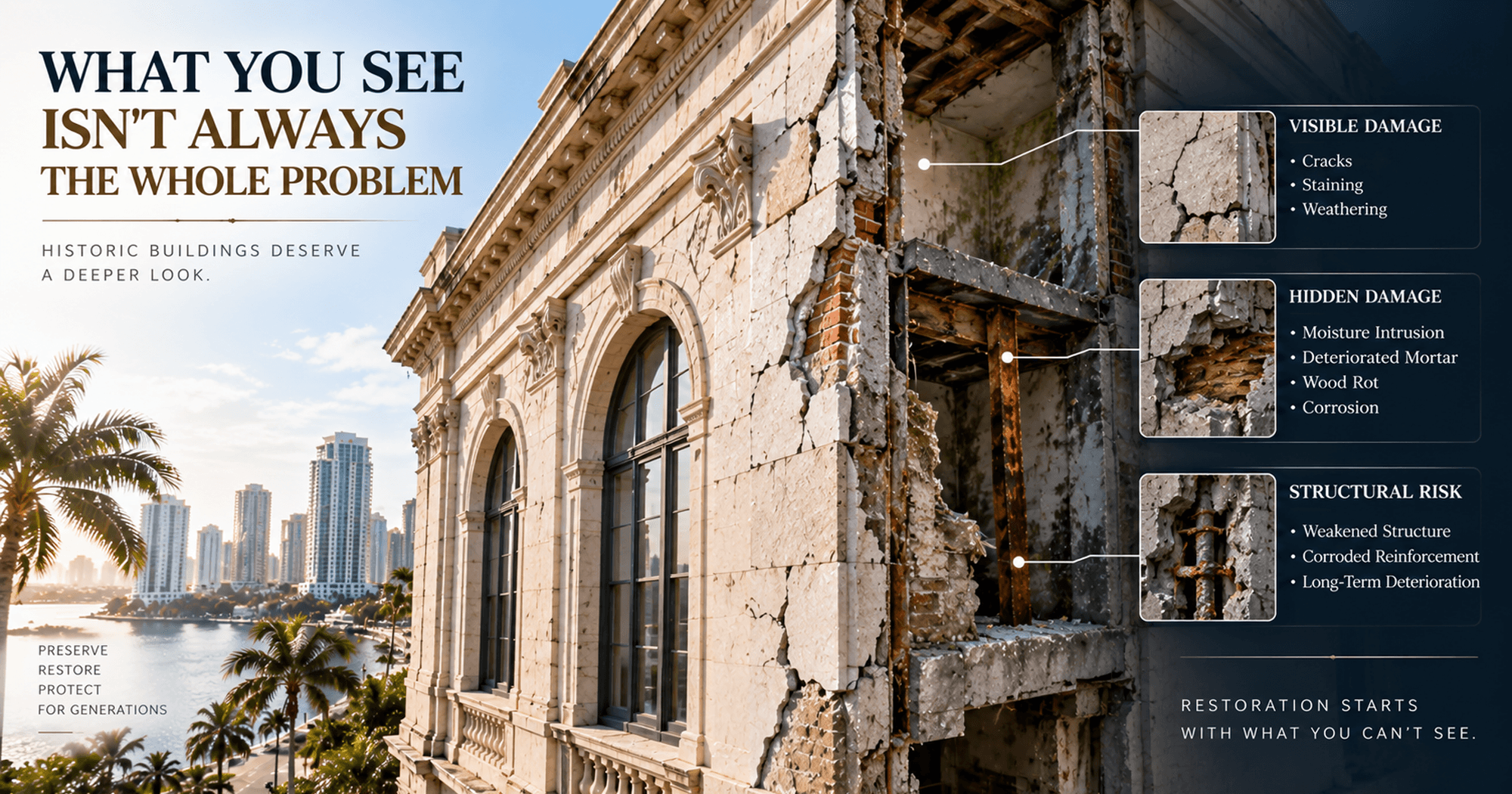
Certain problems recur across Florida's historic buildings, and each points back to a cause that must be understood before repair.
| Problem | Potential Cause | Restoration Consideration |
|---|---|---|
| Masonry cracks | Movement, moisture, age | Identify cause before repair |
| Spalling concrete | Corrosion, moisture | Assess reinforcement |
| Wood rot | Moisture intrusion | Identify and eliminate moisture source |
| Paint failure | Moisture, weathering | Determine substrate condition |
| Roof leaks | Aging materials, flashing | Repair source of water intrusion |
| Metal corrosion | Salt air, moisture | Assess and treat corrosion |
| Plaster deterioration | Moisture, age | Determine underlying cause |
| Facade deterioration | Weather, water, age | Conduct condition assessment |
The common thread across every row is diagnosis before repair: the visible problem is a symptom, and treating it without addressing the cause — usually moisture, movement, or corrosion — guarantees it returns.
How Florida's Climate Affects Historic Building Restoration
The local climate deserves its own close look, because it shapes both the damage and the repair.
Heat and UV Exposure
Florida's intense sun degrades paint, deteriorates sealants, drives material expansion, and weathers surfaces — steadily undoing protective layers on a historic building.
Heavy Rainfall
Frequent, heavy rain drives water infiltration, roof leaks, drainage problems, and masonry deterioration, testing every joint and surface of an aging envelope.
Hurricanes and Tropical Storms
Storms bring wind damage, water intrusion, and roof and exterior damage, and often require emergency stabilization to protect a historic structure before permanent restoration can proceed.
Humidity
Persistent humidity causes moisture retention, wood deterioration, mold-related concerns, paint failure, and corrosion — a slow, constant pressure on historic materials.
Coastal Salt Exposure
Near the coast, salt exposure corrodes metal, deteriorates concrete, and weathers masonry, accelerating decay and making protective restoration measures especially important.
The Historic Building Restoration Process
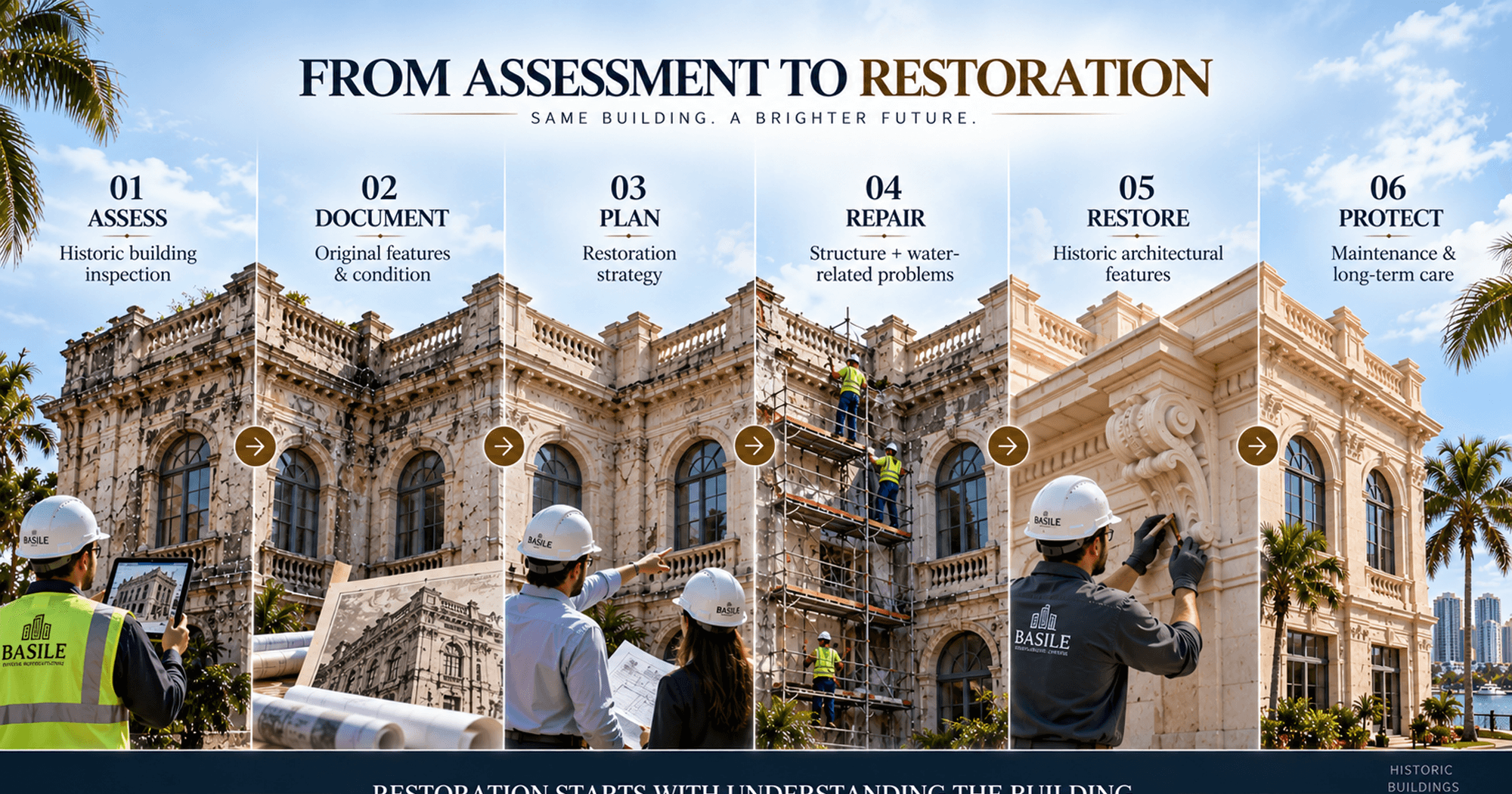
A sound restoration follows a deliberate sequence built around understanding the building before touching it.
1. Initial Property Assessment
The project begins with a review of the exterior, interior, roof, facade, masonry, concrete, wood, and structural components to establish overall condition.
2. Historical Research and Documentation
Original plans where available, historic photographs, the building's history, its architectural features, and previous modifications are researched and documented as the reference for the work.
3. Condition Assessment
A closer assessment identifies structural deterioration, water intrusion, material deterioration, surface damage, and any safety concerns — including the hidden problems that don't show at a glance.
4. Develop a Restoration Plan
With the building understood, a plan is built: prioritizing repairs, selecting restoration methods, identifying materials, setting preservation objectives, and phasing the project.
5. Address Structural and Water-Related Problems
Structure and water come first. Underlying deterioration — structural issues and moisture intrusion — must be resolved before any cosmetic restoration, or the finishes will simply fail again.
6. Restore Historic Features
Then the character-defining work: restoring facade elements, windows, doors, decorative features, masonry, woodwork, and historic finishes, keeping and repairing original fabric wherever possible.
7. Final Inspection and Maintenance Planning
The project closes with quality control, documentation, resolution of any remaining issues, maintenance recommendations, and a schedule for future inspections to protect the restoration.
How Much Does Historic Building Restoration Cost in Florida?
Restoration costs vary substantially with the property and the scope of work, and historic buildings are especially prone to surprises. The factors below drive the estimate.
| Cost Factor | Potential Impact |
|---|---|
| Building size | Larger properties require more labor and material |
| Building age | Older materials may require specialized work |
| Structural damage | Can significantly increase scope |
| Material condition | Severe deterioration requires additional restoration |
| Historic features | Specialized craftsmanship may increase complexity |
| Accessibility | Difficult access can increase labor |
| Facade condition | Extensive deterioration increases restoration requirements |
| Water damage | Moisture-related repairs can expand project scope |
| Material matching | Specialized or custom materials may increase costs |
| Regulatory requirements | Additional documentation or approvals may affect scope |
| Project location | Coastal and environmental conditions can influence requirements |
Because hidden damage so often surfaces once work begins, and because material matching and approvals add variables, an on-site assessment is generally required for an accurate project estimate — a blanket per-square-foot figure rarely holds on a historic building.
Common Mistakes to Avoid When Restoring Historic Buildings
Replacing Original Materials Too Quickly
Tearing out original fabric that could have been repaired destroys authenticity that can never be recovered.
Ignoring the Cause of Water Damage
Repairing the visible damage without eliminating the moisture source guarantees the deterioration returns.
Using Incompatible Modern Materials
Modern materials that look similar but behave differently — hard cements, non-breathable coatings — damage the historic fabric around them.
Painting Over Deteriorated Surfaces
Coating over deteriorated or damp surfaces hides the problem temporarily while it keeps advancing underneath.
Ignoring Structural Problems
Cosmetic restoration over unresolved structural issues treats the symptom while the real problem worsens.
Failing to Document Existing Conditions
Without thorough documentation, decisions are made blind and the building's history and features can be lost.
Choosing a Contractor Without Historic Restoration Experience
General construction skills do not translate to historic work, and inexperience shows up as irreversible damage to historic fabric.
Focusing Only on Appearance
A successful restoration has to address both appearance and building performance; a beautiful finish over unresolved moisture or structural problems is not a real restoration.
How to Choose a Historic Building Restoration Company in Florida
Choosing the right historic building restoration company is what protects both the building's character and your investment. Look for historic restoration experience and Florida project experience; commercial restoration capabilities and structural restoration knowledge; waterproofing expertise; and masonry, concrete, and facade restoration experience. Confirm historic material knowledge, a qualified project team, and documented safety procedures. Ask for references and completed projects, a detailed project scope, appropriate repair methods, and warranty information. A company that can speak specifically to how they would treat your building's materials and conditions is the one worth trusting.
Historic Building Restoration Services Property Owners May Need
A historic restoration project can call on a range of historic building restoration services depending on the property's condition. Commonly needed services include historic facade restoration, masonry restoration, concrete restoration and structural concrete repair, waterproofing, roof restoration, and building-envelope restoration, along with window and door restoration, decorative architectural restoration, and wood, metal, and historic surface restoration. Which of these a given project needs is determined by the building's condition and history — and property owners should confirm that a prospective contractor actually offers the specific services their building requires.
Restoring Historic Buildings: Restoration vs. Replacement
A recurring decision in restoring historic buildings is whether to preserve, repair, restore, or replace a given feature — a progression that should always be worked through in that order. The right answer depends on the condition of the original material, its historical significance, the structural integrity, the compatibility of any repair materials, cost, long-term performance, and the availability of suitable replacement materials. The guiding principle is that replacement should generally be considered only after determining whether the original feature can reasonably be preserved or restored. Replacing too readily is how historic character is quietly lost, one feature at a time.
Why Professional Historic Building Restoration Matters
Nearly everything in this guide points to the same conclusion: historic restoration rewards expertise and punishes guesswork. Professional historic building restoration protects the building's historic character while addressing the hidden deterioration that inexperienced work misses. It uses appropriate, compatible materials, prevents recurring moisture damage, and improves long-term building performance while maintaining the architectural details that matter. Done well, it supports the property's value and reduces future restoration requirements. Done poorly, it can cause irreversible harm to an irreplaceable structure — which is exactly why the expertise behind the work is what counts most.
Why Choose Basile Contractors?
Basile Contractors brings more than 25 years of South Florida restoration experience to the disciplines at the heart of restoring aging and historic structures. As a licensed Florida contractor (license #CCC1511747), fully insured and bonded, and ICRI certified, OSHA compliant, and manufacturer-certified, Basile specializes in concrete restoration, facade restoration, masonry and structural repair, waterproofing, and building-envelope restoration — the core work that protects a historic building's fabric and makes it sound for the decades ahead. The team's rope-access and high-rise capabilities let even difficult elevations be assessed and worked safely, and its deep familiarity with how South Florida's heat, humidity, storms, and salt air attack a building means the restoration is grounded in real local knowledge. Serving commercial and historic properties across Broward, Miami-Dade, and Palm Beach, Basile focuses on addressing both a building's historic character and its long-term performance.
Not sure which repair your building needs?
Walk the building with a licensed restoration contractor before you write a scope.
Planning to Restore a Historic Building in Florida?
The surest way to protect a historic building is to understand its condition before major work begins. Basile Contractors helps property owners, building managers, developers, and preservation stakeholders assess historic structures and plan the right restoration. A professional assessment can identify existing deterioration, structural concerns, water intrusion, material condition, restoration priorities, and recommended repair strategies. Call (352) 657-8653 to schedule a professional historic building assessment.
Conclusion
Historic building restoration in Florida presents unique challenges because of heat, humidity, rainfall, hurricanes, salt air, and aging materials, all working at once. Moisture intrusion, structural deterioration, corrosion, and material incompatibility can complicate every project, and original architectural features and historic materials should be carefully evaluated before anyone decides to replace them. Restoration planning often calls for coordination between property owners, architects, preservation professionals, and specialized contractors, and early condition assessments help identify problems before they become extensive. Above all, selecting experienced historic building restoration contractors is what ensures the work addresses both the building's historical character and its long-term performance. Contact Basile Contractors to schedule a historic building restoration assessment in Florida.
Standards and further reading
Official standards and public sources on this topic:
- National Park Service Preservation Briefs, the federal technical guidance series on repairing historic buildings.
- Preservation Brief 15, on the preservation of historic concrete.
- Preservation Brief 22, on the preservation and repair of historic stucco.
- Preservation Brief 2, on repointing mortar joints in historic masonry buildings.
Frequently asked questions
Updated: October 8, 2026