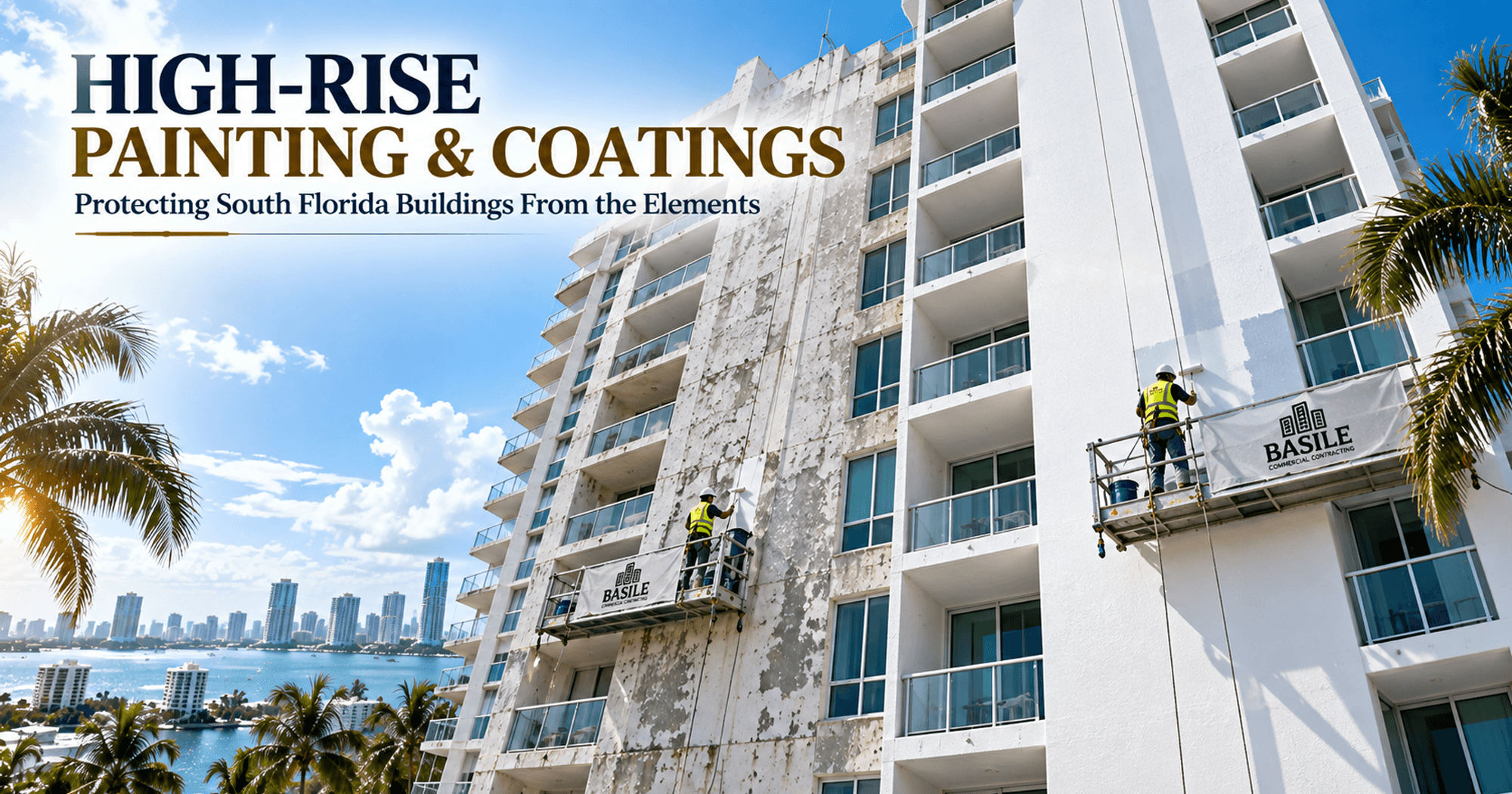
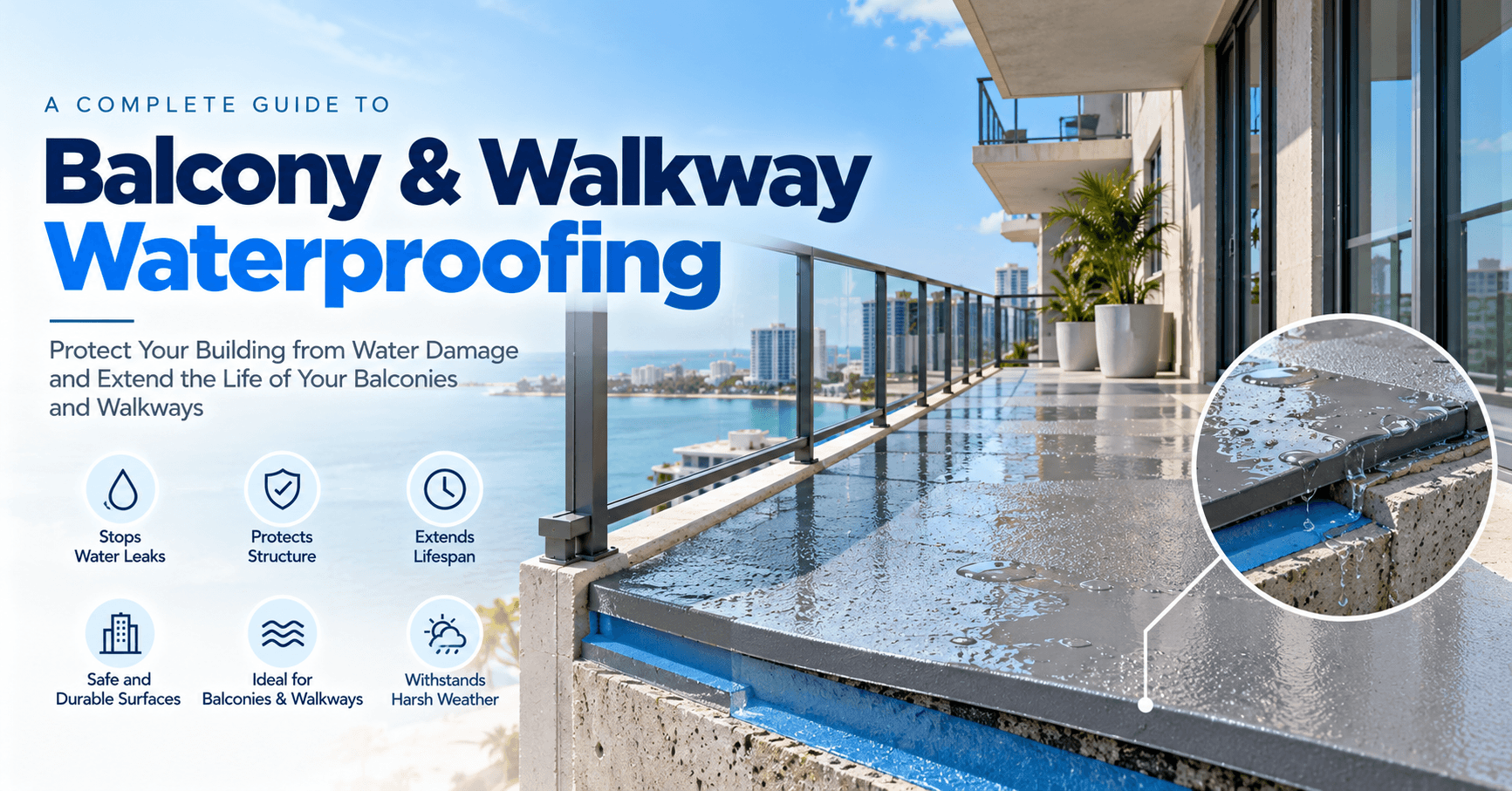
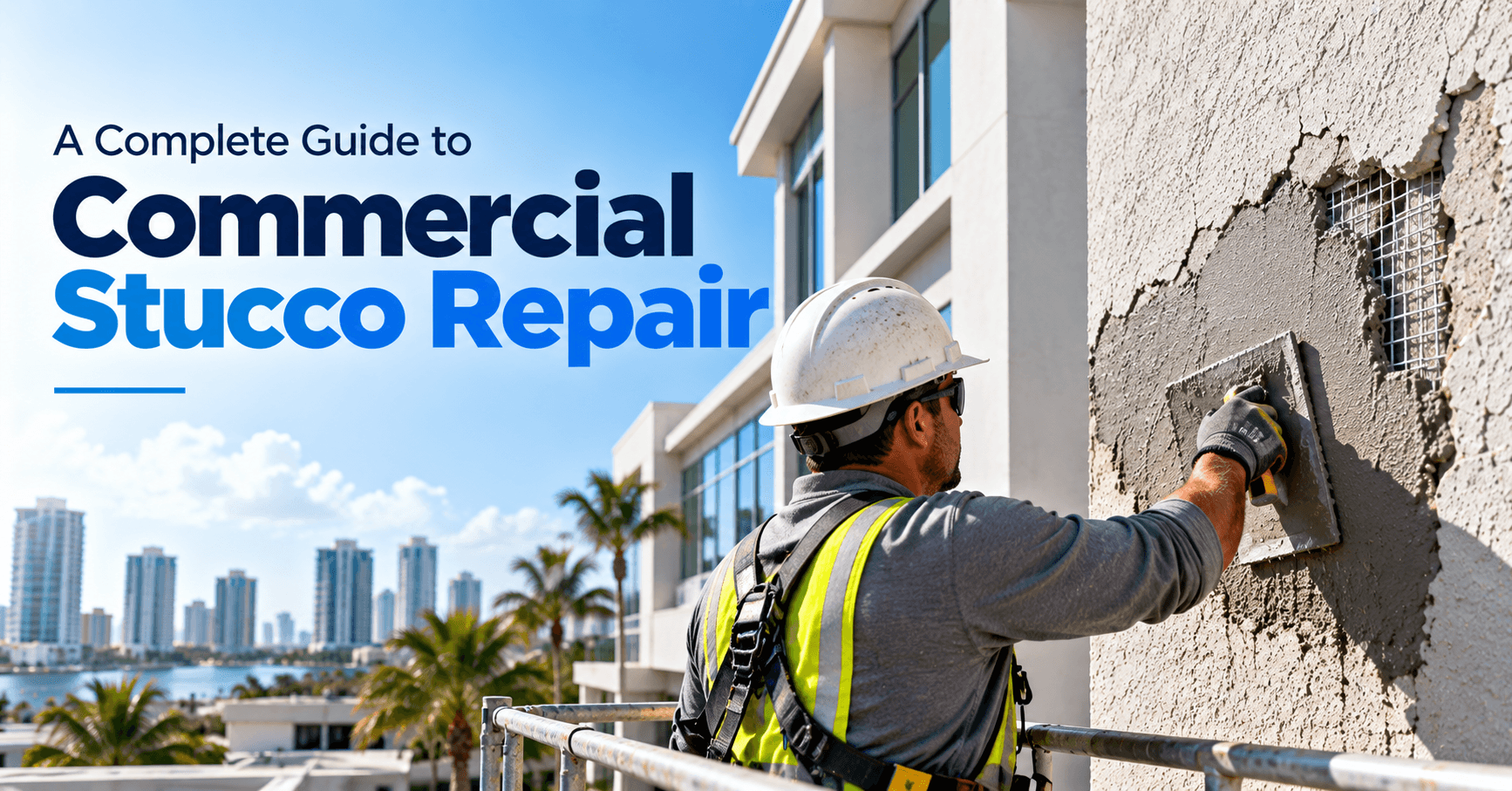
How to Choose the Right Coating for a Commercial Building in Florida
How to choose the right exterior coating for a commercial building in Florida — matching the system to your climate, substrate, durability needs, and maintenance expectations.
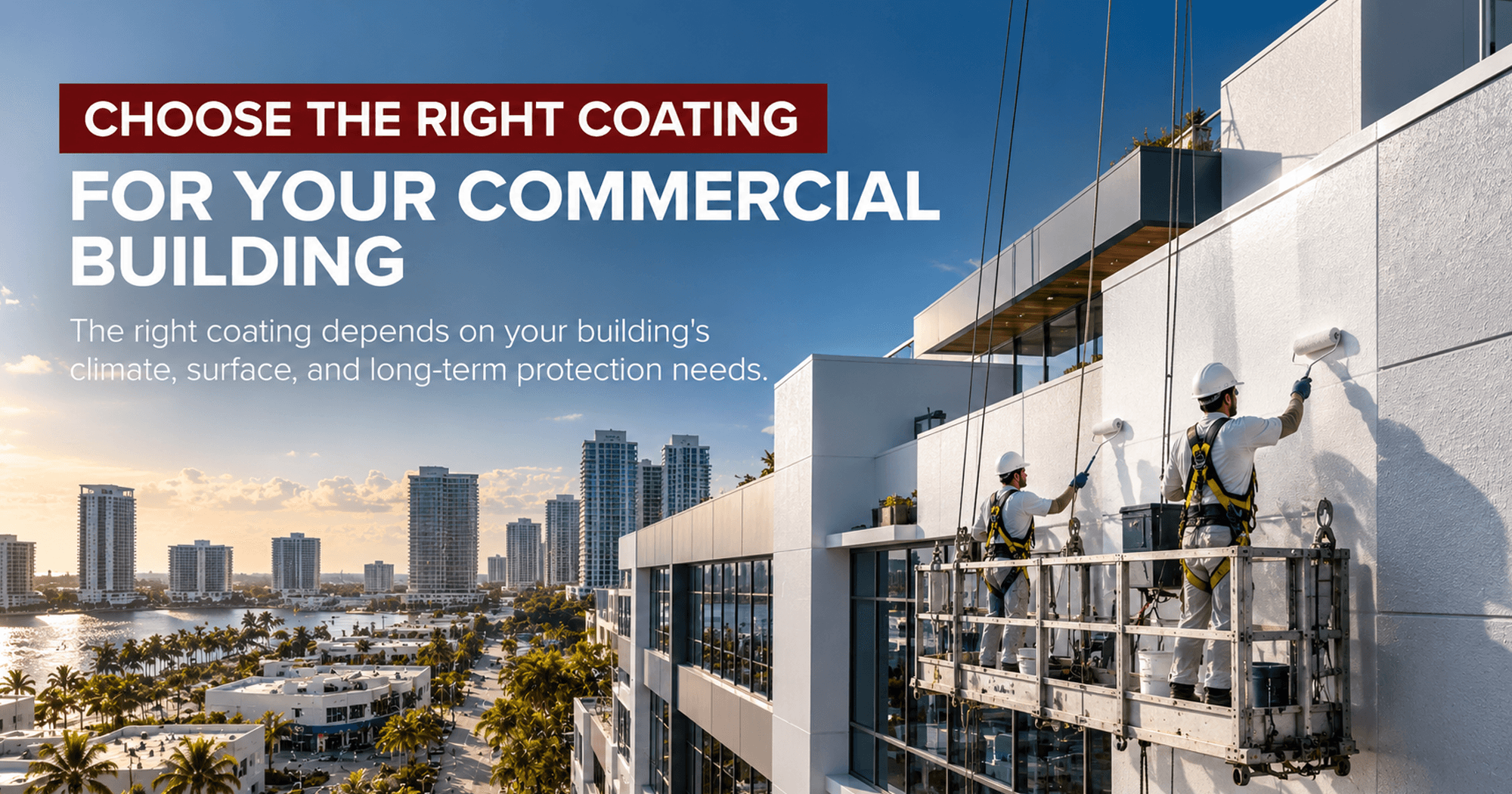
Choosing an exterior coating for a commercial building in Florida is not the same as picking a paint color. It is a performance decision, because the coating is the building's first line of defense against one of the harshest exterior environments in the country — intense UV, relentless heat, high humidity, heavy rain, hurricanes, and, near the coast, corrosive salt air. Get exterior coatings for commercial buildings right and you protect the structure and stretch the years between maintenance cycles; get them wrong and the coating fades, chalks, blisters, or peels long before it should. This guide walks through how to choose the right commercial building coating in Florida based on the things that actually determine performance: climate exposure, the substrate, durability requirements, surface preparation, and professional application.
The core idea to carry through is that the right coating depends on the specific building, not on which product is most popular or expensive. A system that performs beautifully on an inland stucco office can be the wrong choice on a coastal concrete tower. And even the best coating fails if it is applied to a poorly prepared surface. That is why coating selection, surface preparation, and professional application all matter together — and why it starts with looking at your actual building.
Why Commercial Buildings in Florida Need Specialized Exterior Coatings
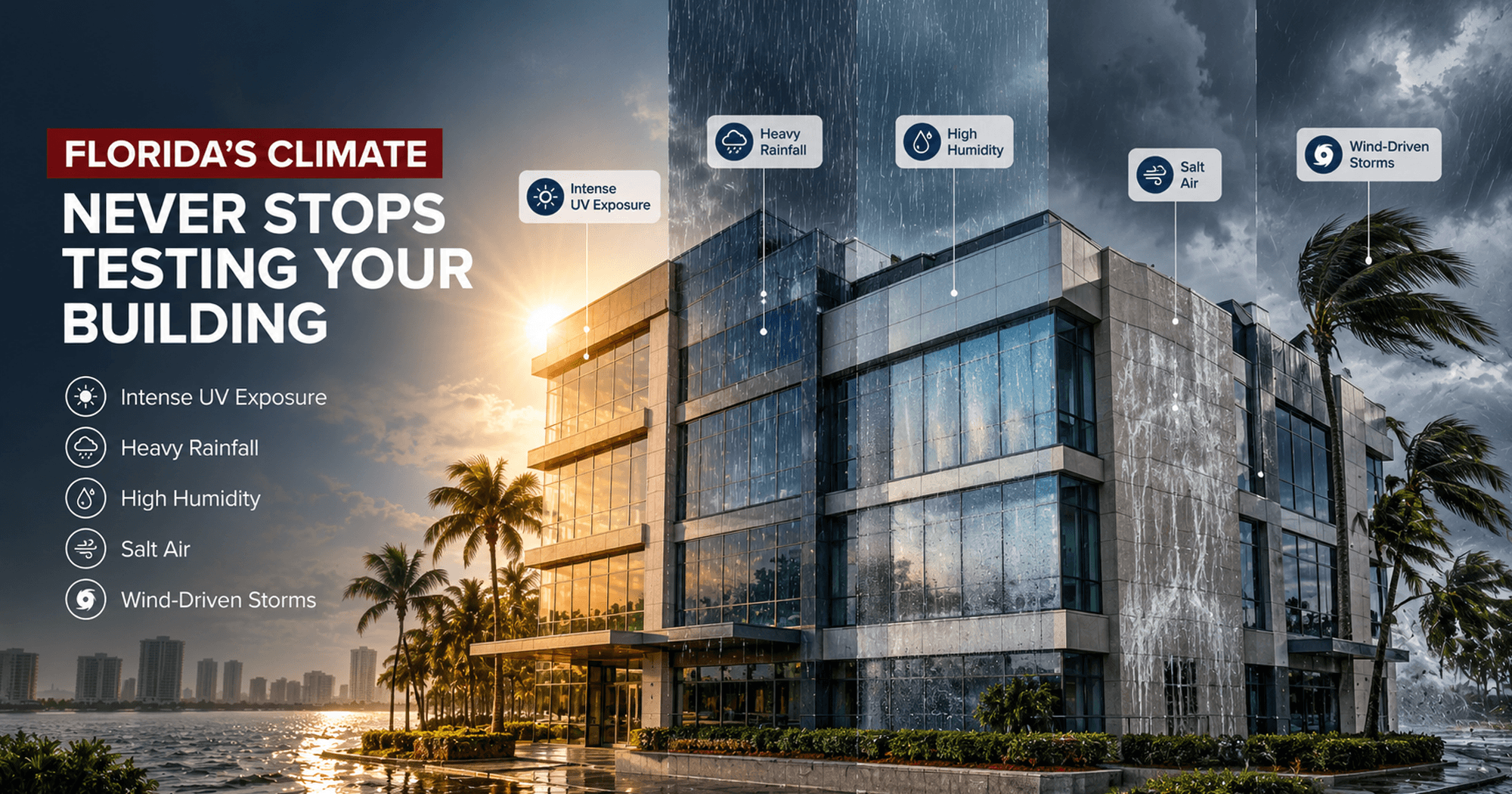
Florida's environment is uniquely demanding for commercial properties. Buildings here face intense sunlight and UV exposure, high temperatures, and constant humidity, punctuated by heavy rainfall, tropical storms, hurricanes, and wind-driven rain. Near the coast, salt exposure adds a corrosive load, and the frequent temperature swings drive expansion and contraction that stresses every exterior surface. Moisture intrusion is a persistent threat across all of it.
Standard residential or general-purpose coatings are often not built for that combination of stresses on a large commercial exterior. A commercial building presents more surface area, greater height, more penetrations and transitions, and higher stakes if the envelope fails. Specialized exterior coatings — formulated for UV resistance, moisture management, flexibility, and durability — exist because Florida's climate breaks down anything less over time.
What Are Exterior Coatings for Commercial Buildings?
Exterior coatings for commercial buildings are protective, fluid-applied systems installed on a building's outside surfaces to shield them from the elements while providing appearance and color. Their purpose runs well beyond looks: they protect exterior surfaces, reduce moisture penetration, improve resistance to UV exposure, guard against weathering, extend maintenance cycles, and support the building's long-term performance.
These coatings are applied to the common commercial exterior surfaces — concrete, stucco, masonry, metal, tilt-up concrete panels, previously painted surfaces, and EIFS where applicable. Each of those substrates behaves differently and imposes its own requirements, which is why the right exterior coatings for commercial buildings are chosen around the surface they will protect, not selected in the abstract.
What Factors Should You Consider When Choosing a Commercial Building Coating?
Selecting a coating is a matter of working through a handful of practical factors about the building and its exposure.
Building Location
Where the building sits shapes everything. Inland and coastal properties face different loads: coastal buildings deal with salt-air exposure and accelerated weathering, while all buildings are affected by local weather patterns and their exposure to direct sunlight. A beachfront property needs a coating built for salt and spray that an inland one may not require.
Existing Substrate
The surface being coated — concrete, stucco, masonry, metal, or a previously coated surface — largely determines which systems are compatible, and the degree of surface deterioration affects what preparation and product are appropriate. Coating compatibility depends heavily on the substrate; the same product is not right for both bare metal and aging stucco.
UV Exposure
Florida's sun is relentless, and UV drives color fading, surface degradation, chalkiness, and a general loss of coating performance over time. This makes UV-resistant formulations important, and it is why the top-rated UV-resistant exterior coatings for commercial buildings are a common starting point for Florida projects.
Moisture and Humidity
The state's humidity and rain make moisture management central. Water penetration, mildew-related concerns, blistering, peeling, adhesion problems, and moisture trapped beneath a coating are all risks when a system is not suited to a damp environment or is applied over an unaddressed moisture problem.
Durability Requirements
Commercial properties often need coatings that withstand heavy activity around the building, sustained weather exposure, periodic cleaning, and long maintenance cycles — standing up to sun, rain, and temperature changes for years without frequent recoating.
Appearance and Branding
Finally, appearance matters: color selection, finish, company branding, overall property aesthetics, and a consistent look across multiple buildings are legitimate factors in the choice, alongside performance.
Types of Exterior Coatings Used on Commercial Buildings
Several coating families are used on commercial exteriors, and none is universally best — each suits particular substrates and conditions.
Acrylic Coatings
Acrylic coatings are widely used for general exterior applications, offering a broad range of colors, good UV resistance, and flexibility. They are a common, cost-effective choice for many commercial surfaces.
Elastomeric Coatings
Elastomeric coatings are thick and flexible, with crack-bridging capabilities and strong moisture resistance. They perform well on suitable masonry and stucco surfaces that develop hairline cracks and move with temperature — provided the substrate is properly prepared first.
Polyurethane Coatings
Polyurethane coatings offer durability, UV resistance, and abrasion resistance, and suit applications that demand a tough finish. As with any system, they must be compatible with the rest of the coating stack and the substrate.
Epoxy-Based Coatings
Epoxy coatings are most commonly associated with floor and industrial applications — commercial epoxy flooring, commercial epoxy floor coating, concrete floor coating, and industrial floor coatings. It is important to understand that interior commercial floor coating requirements differ fundamentally from exterior wall and facade coating requirements; an epoxy floor system is not an exterior wall solution.
Specialized Protective Coatings
Beyond these, specialized protective coatings are formulated for specific performance requirements — corrosion resistance, waterproofing, UV resistance, chemical exposure, or high durability — and are selected when a building has a particular demand to meet.
How Florida's Climate Affects Commercial Building Coating Selection
Because the climate is what breaks coatings down, it deserves a close look — each condition points toward a specific coating property.
Intense Sun and UV Exposure
Florida's intense sun causes fading, chalking, surface deterioration, and coating breakdown, which is why UV-resistant products are so important on exterior commercial surfaces here.
Heat and Temperature Changes
Heat and daily temperature swings drive thermal expansion and contraction, creating surface stress and cracking — so coating flexibility matters on Florida buildings.
Humidity and Moisture
Constant humidity leads to moisture retention, adhesion problems, blistering, peeling, and biological growth concerns, making moisture-tolerant systems and proper application essential.
Heavy Rainfall
Frequent heavy rain drives water penetration and surface erosion, exposes drainage concerns, and deteriorates sealants — underscoring the importance of water-resistant coating systems.
Hurricanes and Wind-Driven Rain
Hurricanes bring wind exposure and rain penetration that punish exterior surfaces, and post-storm inspections are prudent. Durable exterior systems hold up far better through storm season.
Coastal Salt Air
Near the coast, salt air corrodes metal, accelerates weathering, and deteriorates concrete, making protective coatings especially important for coastal commercial properties.
How to Match the Coating to the Building's Surface
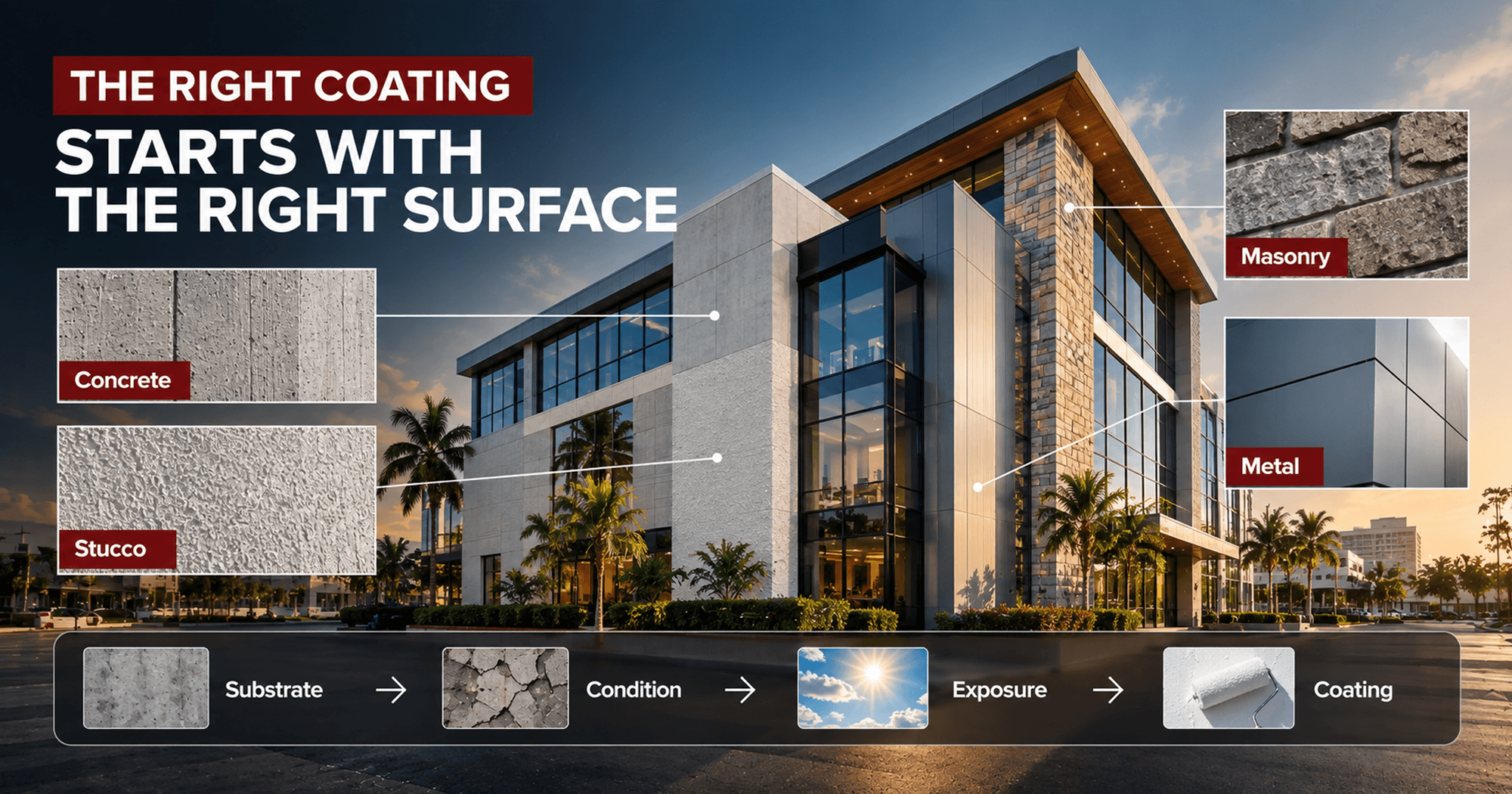
Because the substrate largely dictates the system, the surface must be evaluated before a coating is chosen. The table below summarizes the key considerations by surface.
| Surface | Key Considerations | Potential Coating Requirements |
|---|---|---|
| Concrete | Cracking, moisture, porosity | Adhesion and moisture resistance |
| Stucco | Cracks, texture, moisture | Flexible, breathable system where appropriate |
| Masonry | Porosity, water exposure | Water resistance and compatibility |
| Metal | Corrosion, oxidation | Corrosion protection and proper primer |
| Previously painted surfaces | Existing coating condition | Compatibility and adhesion |
| Tilt-up panels | Concrete condition, joints | Durable exterior protection |
The pattern is consistent: identify the surface and its condition, then choose a system whose properties match. Skipping this step is how incompatible coatings end up failing early.
Why Surface Preparation Matters as Much as the Coating
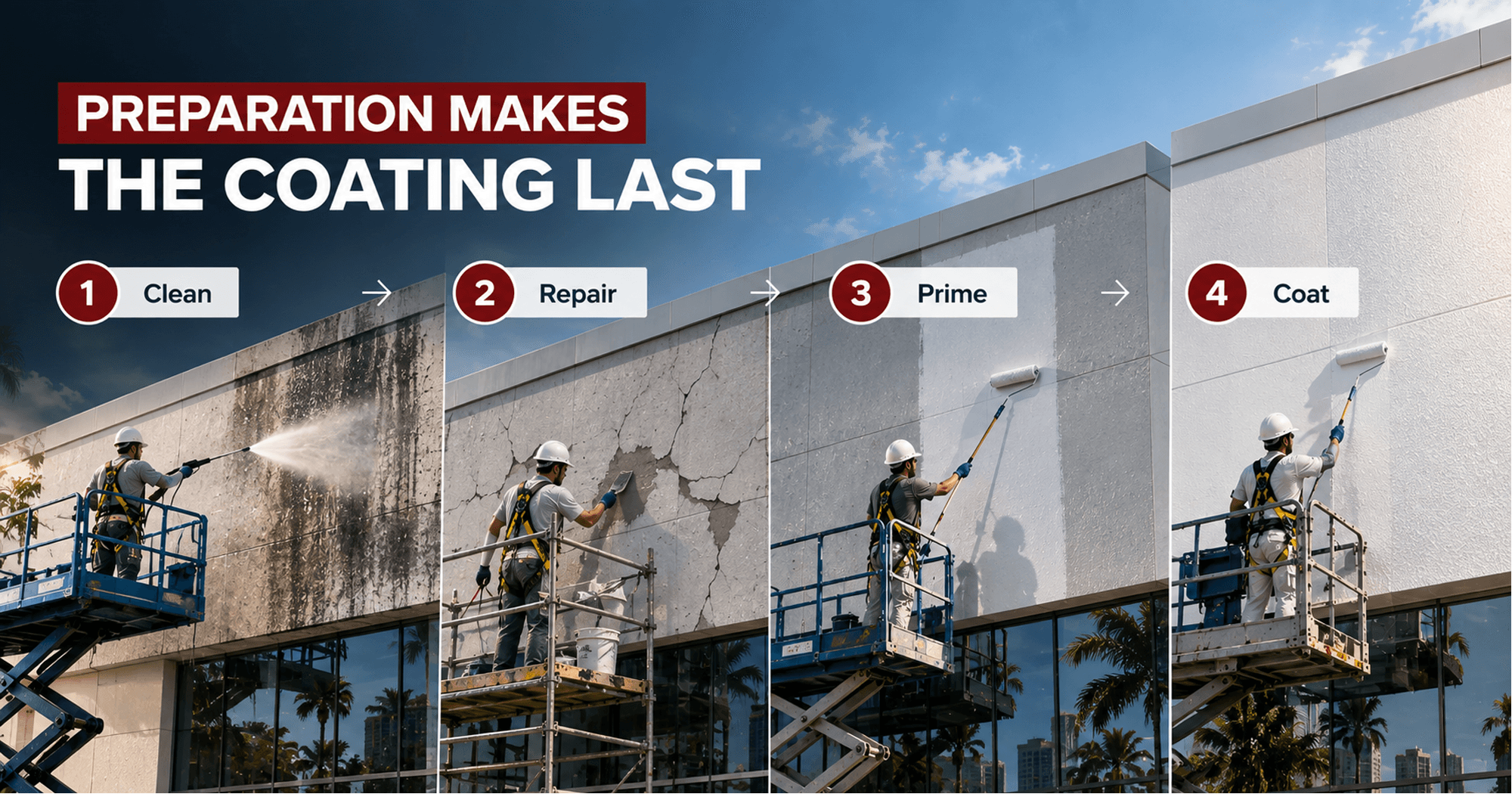
Even a premium coating fails if the substrate is improperly prepared. Preparation is not a formality — it is half the job.
Cleaning
The surface must be freed of dirt, dust, grease, biological growth, and other contaminants so the coating can bond.
Repairing Cracks and Damage
Cracks, spalling, deteriorated surfaces, joint issues, and surface defects need to be repaired before coating, or they telegraph through and undermine the finish.
Removing Failed Coatings
Peeling, flaking, blistering, and delaminated existing coatings must be removed so the new system bonds to sound material rather than to a failing layer.
Moisture Assessment
Moisture should be identified and addressed before application — coating over a damp or moisture-affected surface traps water and guarantees blistering and adhesion failure. This is one reason a qualified commercial painting contractor tests and prepares surfaces rather than simply spraying over them.
How to Choose a Commercial Painting Company for Your Florida Project
The coating is only as good as the company applying it, so choosing the right commercial painting company matters as much as the product. Property owners should weigh a contractor's commercial project experience and specific Florida climate experience; their exterior coating expertise and surface preparation capabilities; their knowledge of different substrates and coating products; their safety procedures and project management; references; insurance and licensing where applicable; warranty information; and a detailed scope of work. Experienced commercial painters and commercial exterior painting contractors can speak to all of these clearly.
Questions to Ask Commercial Painters Before Hiring Them
A few questions quickly reveal whether a contractor knows Florida commercial work: What coating system do you recommend, and why? How will you prepare the existing surface? How will you address moisture or cracks? Is the coating appropriate for Florida's climate, and does the system provide UV resistance? What maintenance will be required, and what is the expected service life? What warranty is provided? How will the project be scheduled, and how will surrounding areas be protected? Clear, specific answers are a good sign; vague ones are a warning.
How Much Does Commercial Exterior Coating Cost in Florida?
There is no flat price for commercial exterior coating; it depends on the building and the scope of work. The factors below drive the estimate.
| Cost Factor | Potential Impact |
|---|---|
| Building size | Larger surface area increases labor and material |
| Surface condition | Repairs and preparation can increase project scope |
| Building height | Specialized access equipment may be required |
| Coating type | Different systems have different material costs |
| Number of coats | Additional coats increase labor and material |
| Accessibility | Difficult areas can increase labor requirements |
| Moisture damage | Repairs may be necessary before coating |
| Existing coating | Removal or preparation may increase costs |
| Coastal exposure | Specialized protective systems may be required |
| Project complexity | Detailed commercial projects may require added planning |
Because these variables interact, an on-site inspection and a detailed scope are generally needed for an accurate estimate rather than a quote sight unseen.
Common Mistakes When Choosing Exterior Commercial Building Coatings
The wrong choice usually comes from one of these errors.
Choosing Based Only on Price
The cheapest coating rarely offers the best long-term value; a system that fails early costs more once you factor in recoating and interim damage.
Ignoring the Existing Substrate
A coating that is not compatible with the substrate will not perform, no matter how good the product is on its own.
Skipping Surface Preparation
Inadequate preparation leads to premature peeling, blistering, and adhesion problems — the most common cause of early coating failure.
Ignoring Florida's UV Exposure
Choosing a system without adequate UV resistance means fading, chalking, and breakdown far sooner than necessary in Florida's sun.
Applying Coatings Over Moisture Problems
Coating over an unaddressed moisture problem traps water and guarantees failure; the underlying issue has to be resolved first.
Choosing the Wrong Product for the Application
An exterior wall coating and a floor coating system are not interchangeable; matching the product to the application is essential.
Hiring a Contractor Without Commercial Experience
Commercial exterior work has demands that residential experience does not cover; relevant commercial project experience matters.
Expert Recommendations for Exterior Commercial Building Coatings
A sound approach to choosing and applying a commercial coating follows a repeatable framework rather than a favorite product. The expert recommendations for exterior commercial building coatings are, in order: inspect the building and substrate; identify the environmental exposure; determine the primary performance requirements; address moisture and surface defects; select a compatible primer and coating system; account for UV and weather resistance; confirm the application requirements; use qualified commercial painting professionals; establish a maintenance schedule; and reinspect the coating periodically. Notably, this framework never begins with "pick this one product" — because the right system is the one that fits the building in front of you.
How to Maintain Commercial Exterior Coatings in Florida
A coating is protected by maintenance. Routine inspections, regular cleaning, and checks for cracks, peeling, fading, and chalking keep small problems visible; inspecting joints and sealants and watching for moisture intrusion catches envelope issues early; and addressing minor deterioration promptly — recoating when required — prevents localized wear from spreading. In Florida's climate, this preventive maintenance is what extends coating performance and holds off the larger, costlier repairs that neglected coatings eventually demand.
Commercial Exterior Coatings vs. Commercial Floor Coatings
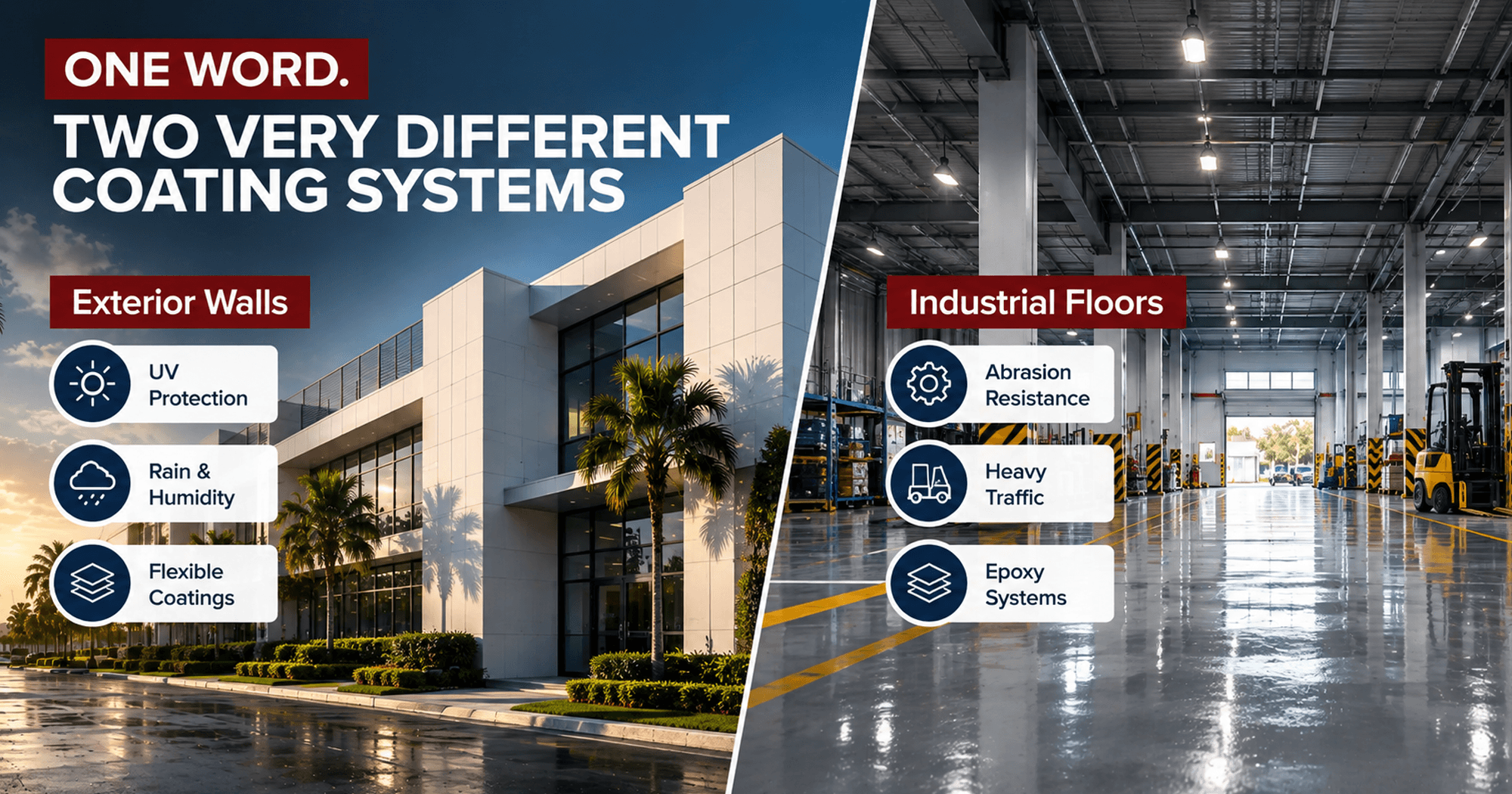
It is worth clarifying a common point of confusion, because "commercial coatings" can mean two very different things. Exterior building coatings and commercial floor coatings are engineered for different jobs.
| Factor | Exterior Building Coatings | Commercial Floor Coatings |
|---|---|---|
| Primary surface | Walls / facades | Floors |
| Main exposure | UV, rain, humidity | Traffic, abrasion, chemicals |
| Common substrates | Stucco, concrete, masonry, metal | Concrete |
| Key performance needs | Weather and UV resistance | Durability and abrasion resistance |
| Common systems | Acrylic, elastomeric, polyurethane | Epoxy and other floor systems |
So while commercial epoxy flooring, commercial epoxy floor coating, concrete floor coating, and industrial floor coatings are all important products, they belong to floor applications — not exterior walls. Coating selection should always follow the intended application and substrate.
A Step-by-Step Process for Choosing the Right Commercial Building Coating
The whole decision can be reduced to a clear sequence.
1. Inspect the Building
Assess the exterior surfaces, existing coating, cracks, moisture, corrosion, and surface deterioration.
2. Identify Environmental Exposure
Consider the building's UV, heat, rain, humidity, coastal salt, and wind exposure.
3. Identify the Substrate
Determine whether the surface is concrete, stucco, masonry, metal, or previously coated.
4. Define Performance Requirements
Decide what the project most needs — UV resistance, moisture resistance, flexibility, durability, corrosion protection, or appearance.
5. Select a Compatible Coating System
Choose the primer, any intermediate coat, and finish coat as a compatible system, following manufacturer specifications and substrate compatibility.
6. Prepare the Surface
Clean, repair, address cracks and failed coatings, and resolve moisture problems before applying anything.
7. Apply the Coating Correctly
Apply under appropriate weather conditions, using the right method, thickness, and drying and curing times per manufacturer requirements.
8. Establish a Maintenance Plan
Set up inspections, cleaning, repairs, recoating, and documentation to protect the finished system.
Why Professional Commercial Painting Matters
Every step above is easy to get wrong and consequential when it goes wrong, which is why professional commercial painting matters. Professionals bring proper product selection, thorough surface preparation, and quality application, along with the safety and project management that large commercial jobs demand. The result is a consistent finish, long-term coating performance, and a maintenance plan that protects the investment. On a Florida commercial exterior, that expertise is the difference between a coating that lasts and one that fails early.
Why Choose Basile Contractors?
Basile Contractors brings more than 25 years of South Florida commercial building experience to exterior painting and coatings. As a licensed and insured Florida contractor (license #CCC1511747) that is OSHA compliant and works with manufacturer-certified systems, Basile selects and applies the right coating for a specific building and substrate rather than defaulting to a single product — pairing exterior coating and commercial painting expertise with the concrete restoration, waterproofing, and facade work that a building envelope often needs alongside a coating. The team's rope-access and high-rise capabilities mean even tall, hard-to-reach elevations are prepared and coated safely, and its deep familiarity with how South Florida's sun, heat, humidity, storms, and salt air break down exterior finishes means the recommendation is grounded in real local experience. Serving commercial properties across Broward, Miami-Dade, and Palm Beach, Basile focuses on protecting the building for the long term.
Not sure which repair your building needs?
Walk the building with a licensed restoration contractor before you write a scope.
Need the Right Exterior Coating for Your Florida Commercial Building?
The right coating starts with looking at your actual building — its surfaces, its condition, its exposure. Basile Contractors helps property owners, building and facility managers, developers, and business owners assess their buildings and choose the right coating system. A professional assessment can identify the existing coating and substrate condition, moisture concerns, UV exposure, needed surface repairs, and the recommended coating requirements and project scope. Call (352) 657-8653 to schedule a commercial building coating assessment.
Conclusion
Choosing the right exterior coating is one of the most important decisions in protecting a commercial building in Florida, where heat, UV, humidity, rainfall, hurricanes, and coastal salt accelerate exterior deterioration. The right choice weighs the substrate, the environmental exposure, the durability required, the moisture conditions, and the maintenance expectations — and treats surface preparation as just as important as the coating itself. UV-resistant, weather-resistant systems are often especially valuable on Florida commercial properties, but the guiding principle is that a coating should be selected for the specific application and building rather than for being the most popular or expensive product. Working with experienced commercial painting contractors is what ensures the right system is chosen and properly applied. Contact Basile Contractors to schedule a commercial building coating assessment.
Frequently asked questions
Updated: September 29, 2026