Concrete Spalling Repair in Florida: Causes, Warning Signs & How to Fix It
What causes concrete spalling in Florida, how to spot the warning signs, how spalled concrete is repaired, what it costs, and when to call a professional concrete repair contractor.
By Luigi Basile
President
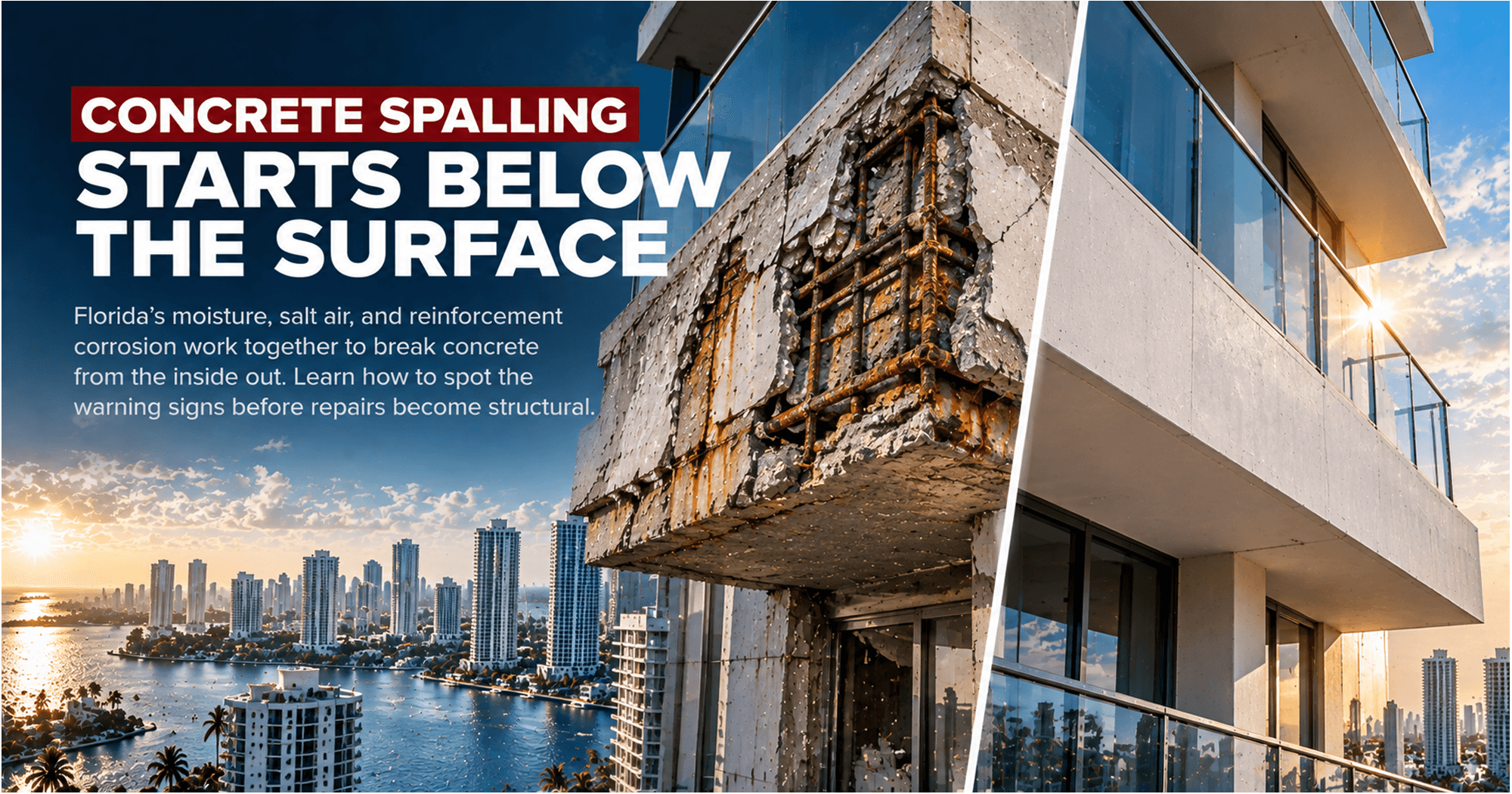
Concrete spalling — when concrete chips, flakes, or breaks away from a surface — is one of the most common and most misunderstood forms of building deterioration in Florida. It is easy to mistake for a cosmetic blemish, but in most cases spalling is a symptom of something happening beneath the surface: moisture reaching the reinforcing steel inside the concrete, corroding it, and forcing the concrete apart from within. Left alone, it spreads, and on balconies, parking garages, and building facades it can become both a structural and a safety concern. This guide explains what concrete spalling is, why Florida's climate accelerates it, how to recognize the warning signs, how spalled concrete is properly repaired, what the repair costs depend on, and when to bring in a professional concrete repair contractor.
The principle running through all of it is that effective concrete spalling repair addresses the underlying cause — usually reinforcement corrosion and moisture — rather than just patching the visible damage. A patch placed over an unresolved corrosion problem hides it briefly and then fails, often taking more concrete with it. Sound repair follows a clear sequence: inspect, identify the cause, remove deteriorated material, treat the reinforcement, replace the concrete, and protect the result.
What Is Concrete Spalling?
Concrete spalling is the breaking, flaking, chipping, or popping away of concrete from a surface. Spalled concrete looks rough, pitted, and broken, sometimes with shallow flaking and sometimes with deep sections of concrete missing entirely. There is an important difference between minor surface damage — a shallow scaling of the top layer — and deeper deterioration that reaches the reinforcing steel; the two look somewhat similar but mean very different things for the structure.
Concrete usually begins spalling because of what is happening inside it. Steel reinforcement is normally protected by the surrounding concrete, but when moisture and chlorides reach the steel, it corrodes. As it corrodes, it expands — rust occupies several times the volume of the original steel — and that expansion creates internal pressure that cracks and eventually breaks the concrete off from within. This is why simply patching the visible damage may not solve the underlying problem: if corroding steel is left untreated, it keeps expanding and the spalling returns. Spalling commonly appears on balconies, parking garages, concrete decks, building facades, columns, beams, slabs, foundations, driveways, walkways, and pool decks.
What Causes Concrete Spalling in Florida?
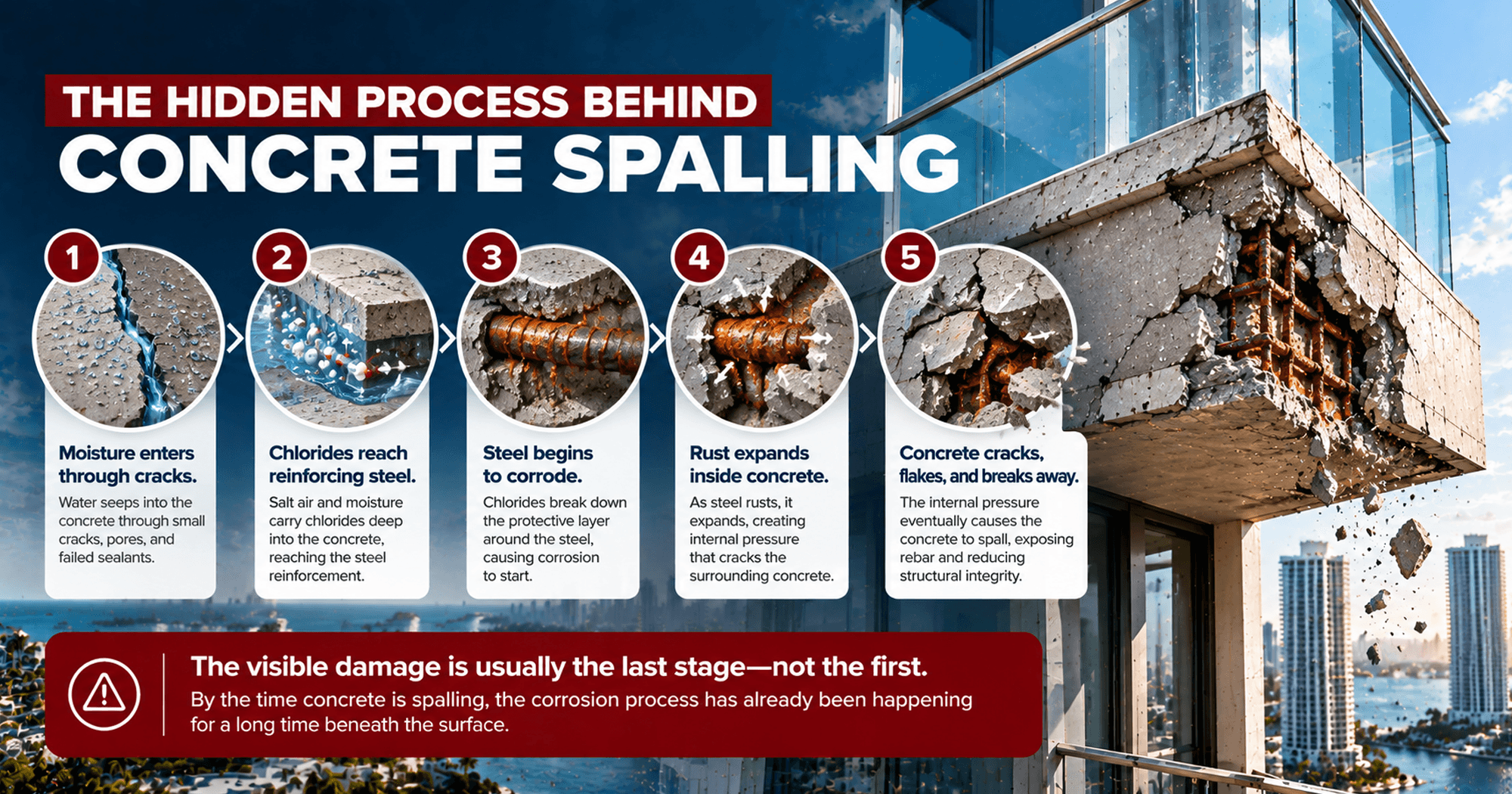
Florida's environment is especially conducive to the moisture-and-corrosion cycle that drives spalling.
Moisture and Water Intrusion
Water entering cracks and pores, repeated moisture exposure, poor drainage, and general water infiltration all carry moisture into the concrete and toward the reinforcing steel. Unlike colder climates, most of Florida sees little freeze-thaw damage — but moisture-driven deterioration remains a leading cause of spalling here regardless.
Reinforcing Steel Corrosion
Reinforcing steel is normally shielded by the alkaline concrete around it, but once moisture and chlorides reach it, corrosion begins. The resulting rust expands, generating internal pressure that cracks the concrete and, over time, causes it to spall away — the central mechanism behind most structural spalling.
Salt Air and Coastal Exposure
Florida's coastal environment adds a powerful accelerant: chloride from salt-laden air penetrates concrete and reaches reinforcement, driving corrosion faster than in inland settings. Coastal structures therefore face a significantly increased risk of spalling.
Cracks and Concrete Defects
Cracks, voids, poor consolidation, honeycombing, and construction defects all create pathways for moisture to enter the concrete and accelerate deterioration. A defect that admits water is often where spalling begins.
Age and Deferred Maintenance
Finally, untreated cracks, failed sealants, ongoing water intrusion, and deteriorated coatings compound over time. What begins as minor, manageable wear can eventually contribute to extensive concrete damage when maintenance is deferred year after year.
What Does Spalling Concrete Look Like?
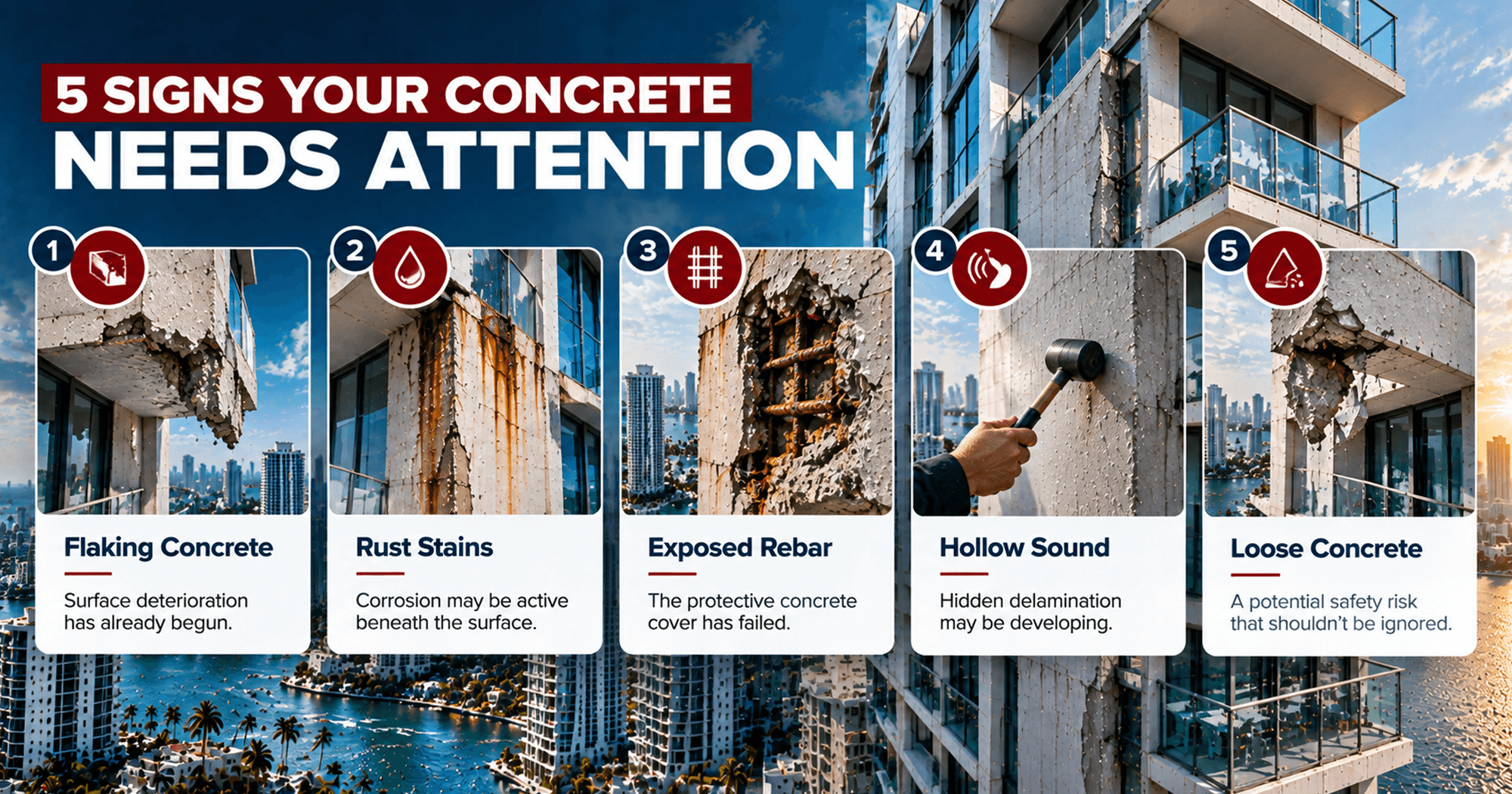
Spalling announces itself through several visual and physical indicators.
Flaking or Chipping Concrete
Small pieces of concrete breaking away, surface deterioration, and rough or uneven areas are often the first visible signs that the surface is failing.
Cracks Around Reinforcement
Cracks that appear near reinforcing steel — often running in lines that trace the bars beneath — can indicate corrosion-related deterioration developing inside the concrete.
Rust Stains
Orange or brown staining and rust bleeding through the concrete surface are strong indicators that the reinforcing steel inside is corroding, even before the concrete has broken away.
Exposed Reinforcing Steel
Visible reinforcing steel means the concrete cover has already been lost. Exposed steel should never be ignored, because corrosion accelerates once the steel is no longer protected.
Hollow-Sounding or Delaminated Concrete
Delamination — a separation between concrete layers — often produces a hollow sound when the surface is sounded during a professional inspection, even where the surface still looks intact. It frequently signals concrete that is about to spall.
Falling or Loose Concrete
Loose or falling concrete is both a deterioration sign and a safety hazard, particularly on balconies, parking garages, building facades, elevated slabs, and other overhead structures where pieces can fall. This condition warrants prompt professional attention.
Concrete Spalling vs. Cracking: What's the Difference?
Cracking and spalling are related but distinct defects, and telling them apart helps clarify what a building is dealing with.
| Factor | Concrete Cracking | Concrete Spalling |
|---|---|---|
| Appearance | Linear breaks or fractures | Chipped, broken, or detached concrete |
| Typical cause | Movement, shrinkage, stress, moisture | Corrosion, moisture, deterioration |
| Reinforcement | May remain concealed | May become exposed |
| Severity | Can range from minor to serious | Can indicate deeper deterioration |
| Repair | Depends on cause and crack type | Usually requires removal of deteriorated concrete |
| Investigation | Cause should be identified | Underlying deterioration should be assessed |
Cracks and spalling are often connected — cracks admit the moisture that eventually causes spalling — but they are not the same defect, and each calls for its own assessment.
How Do You Repair Spalling Concrete?
There is no single method that fits every situation. The appropriate way to repair spalling concrete depends on the depth of deterioration, the cause of the spalling, the condition of the reinforcement, the location, the degree of moisture exposure, the structural importance of the element, and the overall extent of damage. A shallow surface spall on a walkway and a deep, corrosion-driven spall on a structural balcony edge require very different approaches. In every case, though, professional repair follows the same essential logic: understand the cause, remove what is unsound, treat the reinforcement, restore the concrete with compatible materials, and protect against the moisture that caused the problem.
How to Repair Spalling Concrete: Step-by-Step Process
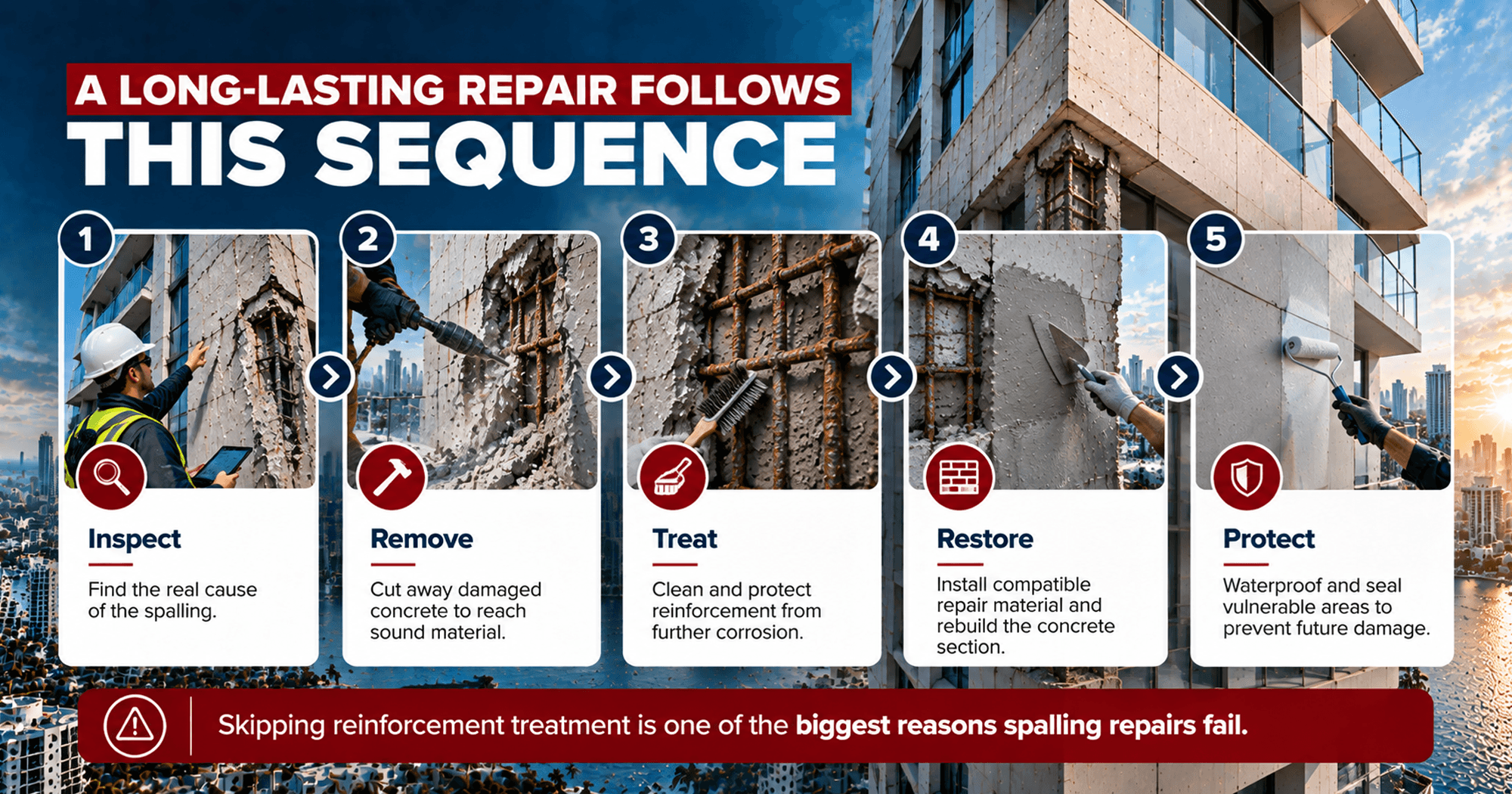
Professional concrete spalling repair follows a clear, repeatable sequence.
1. Inspect the Damaged Concrete
A visual inspection identifies cracks, locates the spalled areas, checks for exposed reinforcement, assesses the surrounding concrete, and looks for signs of moisture intrusion.
2. Determine the Cause of Spalling
Before repairing anything, the cause is identified — reinforcement corrosion, water intrusion, chloride exposure, poor concrete quality, drainage problems, or failed coatings and waterproofing. This step is what makes the repair last.
3. Remove Loose and Deteriorated Concrete
All unsound concrete is removed to expose the full repair area and create a sound substrate. Repairing over loose or deteriorated material simply guarantees the repair will fail.
4. Prepare and Treat Reinforcement
Exposed reinforcing steel is cleaned and its corrosion assessed to determine whether it has lost cross-sectional area, with appropriate corrosion protection applied where required. Not every repair needs identical reinforcement treatment — the condition of the steel dictates the approach.
5. Replace the Deteriorated Concrete
Compatible repair materials are selected and placed to restore the damaged area, with proper placement, surface finishing, and matching of the surrounding concrete where appropriate.
6. Address Water Intrusion
Because repairing concrete without addressing the moisture source leads to recurring deterioration, this step targets the water — through waterproofing, sealants, drainage improvements, joint repairs, and crack treatment.
7. Apply Protective Coatings Where Appropriate
Where suitable, protective coatings add moisture and chloride protection, weather and UV resistance, and must be compatible with the existing concrete to perform.
8. Conduct Final Inspection
Finally, the repair is inspected for quality — checking remaining cracks, reinforcement condition, coating coverage, waterproofing, and surface finish — and maintenance recommendations are provided.
Common Concrete Spalling Repair Methods
Several methods are used depending on the situation; no single one suits every spalling problem.
Concrete Patch Repair
Patch repair removes deteriorated concrete, prepares the substrate, treats reinforcement where necessary, installs a compatible repair material, and finishes the surface — the workhorse method for localized spalling.
Reinforcement Corrosion Repair
Where corrosion is the driver, repair focuses on the steel: identifying corroded reinforcement, removing the surrounding deteriorated concrete, cleaning and evaluating the reinforcement, and repairing or replacing it when required.
Crack Repair
Crack repair selection depends on the crack's width, depth, movement, location, cause, and water exposure, since different cracks require different treatments.
Concrete Resurfacing
Resurfacing may be appropriate for certain surface-level conditions, but it should never be used to hide active deterioration — resurfacing over corroding steel simply conceals a worsening problem.
Waterproofing
Waterproofing prevents water intrusion, protects repaired areas, reduces moisture penetration, and extends the life of the repair by keeping water away from the reinforcement.
Protective Coatings
Protective coatings add moisture resistance, chloride protection, UV and weather resistance, and appearance, complementing the repair and waterproofing beneath them.
When Is Concrete Spalling a Structural Concern?
Not all spalling is structural, but some conditions point to deeper trouble. Warning signs that spalling may be a structural concern include extensive spalling, deep concrete loss, exposed reinforcement, significant reinforcement corrosion, large or progressive cracks, delamination, damage to beams or columns, deterioration of balconies, damage to load-bearing elements, and repeated repair failures. When any of these are present, the situation moves from routine concrete repair into structural concrete repair and commercial concrete repair territory, and suspected structural deterioration requires evaluation by appropriately qualified professionals before repairs proceed. Determining whether spalling is cosmetic or structural is one of the most important reasons to obtain a professional assessment.
How Much Does Concrete Spalling Repair Cost in Florida?
There is no single reliable price for concrete spalling repair, because cost varies with the condition and scope of the project. The factors below drive the estimate.
| Cost Factor | Potential Impact |
|---|---|
| Size of damaged area | Larger areas require more materials and labor |
| Depth of spalling | Deeper deterioration can increase repair complexity |
| Reinforcement corrosion | Corroded steel may require additional treatment |
| Building height | Access can increase project complexity |
| Location of damage | Difficult-to-access areas may require specialized equipment |
| Water intrusion | Additional waterproofing may be necessary |
| Surface preparation | Extensive preparation increases labor |
| Repair material | Material selection affects project cost |
| Protective coatings | Additional protection increases project scope |
| Structural evaluation | Engineering assessment may add to project requirements |
| Project accessibility | Lifts, scaffolding, or other access methods can affect cost |
| Extent of deterioration | Widespread damage generally requires a larger repair program |
Because these variables interact, an inspection is generally necessary before a reliable estimate can be provided; a per-square-foot figure quoted without seeing the concrete rarely reflects the real scope, especially where hidden corrosion is involved.
Concrete Spalling Repair vs. Concrete Replacement
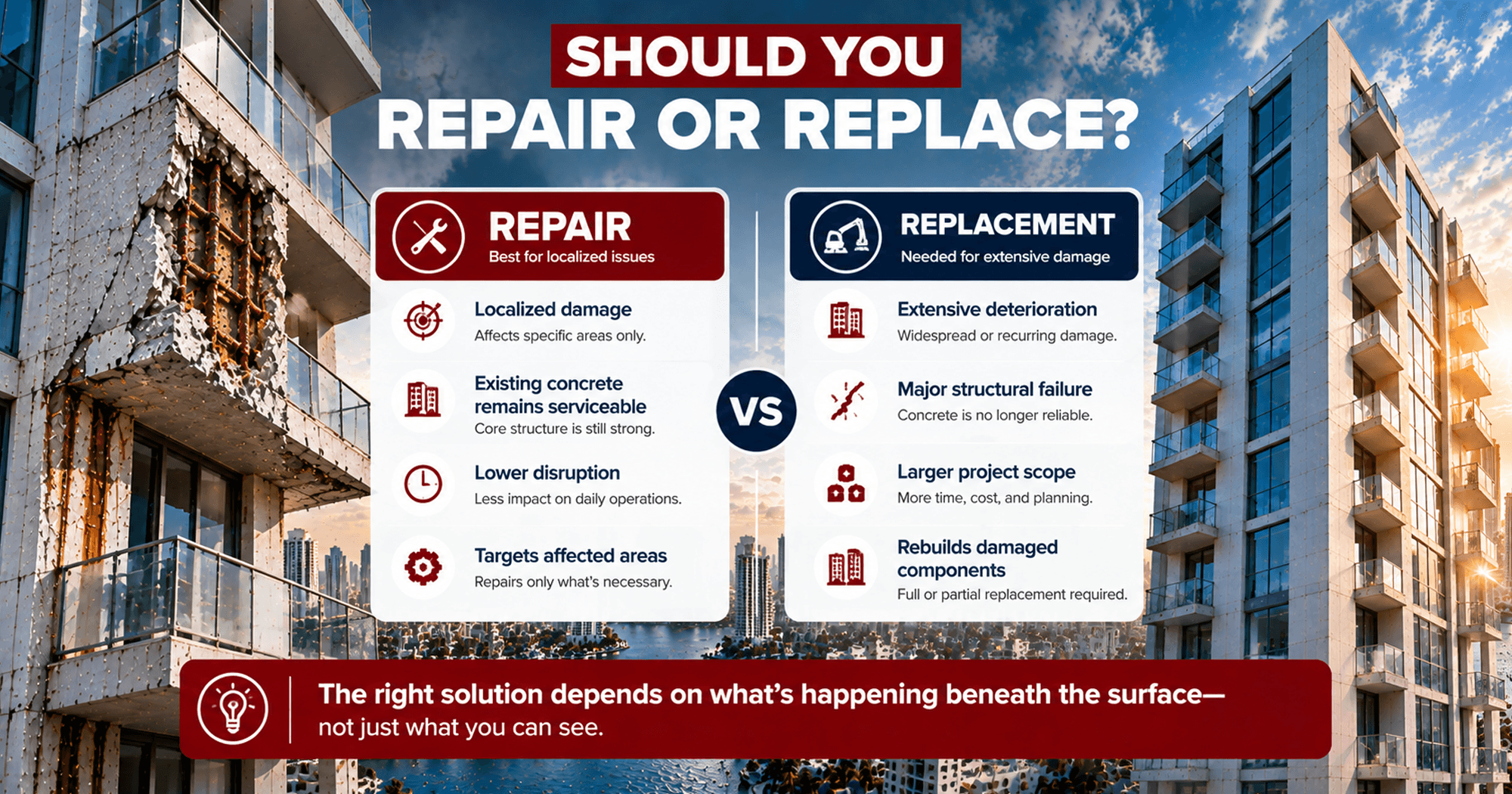
Spalling does not automatically mean the concrete must be replaced. In many cases, targeted repair restores the affected areas effectively; replacement becomes appropriate only when deterioration is extensive or severe.
| Factor | Spalling Repair | Concrete Replacement |
|---|---|---|
| Damage | Localized deterioration | Extensive or severe deterioration |
| Scope | Targeted repair | Removal and replacement |
| Existing concrete | Mostly serviceable | May be beyond practical repair |
| Cost | Often lower for localized damage | Can be higher due to demolition and replacement |
| Structural condition | Repairable | May require reconstruction |
| Objective | Restore damaged areas | Replace failed concrete |
| Long-term solution | Depends on underlying cause | May be appropriate for severely deteriorated components |
The right choice depends on the extent of deterioration, the condition of the reinforcement and structure, and the underlying cause — which is why the decision should follow a professional assessment rather than the mere presence of spalling.
Why Waterproofing Matters After Concrete Spalling Repair
Waterproofing is what protects a spalling repair over time. The logical sequence is repair, then waterproof, then protect, then maintain — each step safeguarding the one before it. After the deteriorated concrete is replaced, waterproofing prevents water intrusion, protects the repaired concrete, reduces the moisture reaching the reinforcement, seals vulnerable areas and joints, and treats cracks. Because spalling is fundamentally a moisture-and-corrosion problem, keeping water away from the repaired area is essential; without it, moisture reaches the steel again and the deterioration recurs. Integrated waterproofing reduces recurring deterioration and significantly extends the useful life of the repair.
How Preventive Concrete Maintenance Can Reduce Spalling
The most cost-effective defense against spalling is preventive maintenance. A good program includes routine concrete inspections, crack monitoring, spalling inspections, reinforcement condition checks, sealant and waterproofing inspections, drainage checks, protective coating inspections, moisture monitoring, and the prompt repair of minor defects. Maintenance does not eliminate deterioration entirely — concrete in a demanding climate will always face moisture and chlorides — but early intervention keeps localized defects from developing into extensive, expensive repair projects. Catching a hairline crack or a failing sealant early is far cheaper than repairing the spalled, corroded concrete it eventually produces.
How Often Should Concrete Be Inspected in Florida?
There is no single inspection schedule appropriate for every structure. How often concrete should be inspected depends on building age, coastal exposure, concrete type, previous repairs, any history of corrosion, moisture exposure, building location, maintenance history, previous spalling, and the structural importance of the elements involved. An older, coastal building with a history of spalling and corrosion warrants more frequent professional inspection than a newer, inland, low-exposure structure. The right cadence reflects the specific structure's condition and risk rather than a one-size-fits-all calendar.
Concrete Spalling in Coastal Florida: Why Location Matters
Proximity to the coast has a direct effect on spalling risk. Salt-laden air, chloride exposure, humidity, heavy rainfall, and moisture penetration all reach the reinforcing steel inside concrete more aggressively near the water. Coastal buildings, parking structures, balconies, and concrete facades are therefore especially prone to corrosion-driven spalling. Structures closer to the coast generally require greater attention to moisture and corrosion-related deterioration — more frequent inspection, more diligent waterproofing, and prompter repair — because the environment that causes concrete spalling repair Florida projects is simply more intense there.
Choosing a Concrete Repair Contractor in Florida
The contractor you choose determines whether a repair lasts or fails. When evaluating a concrete repair contractor in Florida, property owners should weigh a few key areas.
Experience With Concrete Restoration
Look for demonstrated experience with concrete spalling, concrete restoration, and reinforcement corrosion, along with commercial buildings, parking structures, balconies, concrete facades, and structural concrete. This work has demands that general contracting does not necessarily cover.
Inspection and Assessment Capabilities
A capable contractor can identify the extent of damage, the underlying cause, the reinforcement condition, and any water intrusion, and then determine the appropriate repair method. Assessment is where good repairs begin.
Proper Licensing and Insurance
Verify licensing, insurance, safety practices, and relevant credentials before work begins — these protect the property owner and signal a professionally run operation.
Detailed Scope of Work
A proposal should clearly explain the damaged areas, removal procedures, repair materials, reinforcement treatment, waterproofing, coatings, access requirements, timeline, and final inspection. A clear, detailed scope is a strong indicator of competence.
Common Mistakes When Repairing Spalling Concrete
Spalling repairs fail most often because of a handful of avoidable mistakes.
Patching Over Loose Concrete
Applying repair material over unsound concrete guarantees failure; the loose material must be removed and a sound substrate created first.
Ignoring Corroded Reinforcement
Treating only the visible surface while leaving corroded steel untreated allows the corrosion — and the spalling — to continue beneath the repair.
Painting Over Spalled Concrete
Coatings cannot replace proper concrete repair; painting over spalled concrete hides the problem without addressing it.
Ignoring the Source of Moisture
Because water intrusion drives the corrosion behind spalling, failing to address the moisture source leads to recurring deterioration.
Using an Incompatible Repair Material
Repair materials must be compatible with the existing concrete; incompatible materials debond, crack, or fail prematurely.
Treating Structural Damage as Cosmetic
Spalling on structural elements can indicate serious deterioration, and treating it as a cosmetic issue can allow a real problem to worsen — professional evaluation is necessary when structural damage is suspected.
Waiting Until Concrete Begins Falling
By the time concrete is visibly falling or loose, deterioration has usually progressed significantly; waiting that long makes the repair larger and more costly.
How to Know When Your Concrete Needs Spalling Repair
As a practical checklist, consider a professional spalling assessment if your concrete is flaking or breaking away; cracks are expanding; rust stains are visible; reinforcing steel is exposed; the concrete sounds hollow; pieces are loose; delamination is visible; water is entering through cracks; previous repairs have failed; deterioration is spreading; the damage is on a balcony, beam, column, slab, or facade; the structure is exposed to coastal conditions; or the concrete has significant age or deferred maintenance. One small surface defect does not necessarily mean extensive restoration is required — a professional assessment determines the appropriate scope.
Why Professional Concrete Spalling Assessment Matters
A professional assessment is the foundation of any sound spalling repair. It identifies hidden deterioration, determines the depth of damage, evaluates the reinforcing steel, and identifies the moisture sources driving the problem. From there it establishes the appropriate repair methods and compatible materials, identifies any structural concerns, plans access, estimates repair requirements, prioritizes urgent repairs, and informs a maintenance strategy. In short, the assessment turns visible symptoms into a clear, prioritized plan — which is why concrete spalling repair should begin with a qualified professional evaluating the concrete rather than with assumptions about what it needs.
Not sure which repair your building needs?
Walk the building with a licensed restoration contractor before you write a scope.
Is Your Concrete Cracking, Flaking, or Spalling?
If your concrete is flaking, cracking, staining with rust, or exposing reinforcing steel, a professional assessment can identify what is really happening before it spreads or becomes a safety concern. Basile Contractors helps property owners, commercial property managers, condominium associations, facility managers, building owners, and maintenance teams inspect, identify the cause, repair, waterproof, and protect their concrete. Call (352) 657-8653 to schedule a concrete spalling inspection in Florida.
Basile’s concrete restoration service covers this repair work on occupied South Florida buildings.
Standards and further reading
Official standards and public sources on this topic:
- American Concrete Institute: repair of concrete, ACI's reference page on condition evaluation and repair, with the ACI 562 code and the ACI 546R guide.
- ICRI technical publications, the International Concrete Repair Institute's guidelines on surface preparation, corrosion repair and repair materials.
- Florida Statutes 553.899, the milestone inspection law for condominium and cooperative buildings of three or more stories.
- Miami-Dade County building recertification, the county's periodic inspection program for residential and commercial buildings.
Frequently asked questions
Updated: October 8, 2026