Your Phase 2 Report Found Damage. What the Next 365 Days Look Like
Florida gives associations 365 days to begin repairs after a Phase 2 report. Here is what actually fills that year, and where boards lose the months they cannot get back.
By Luigi Basile
President
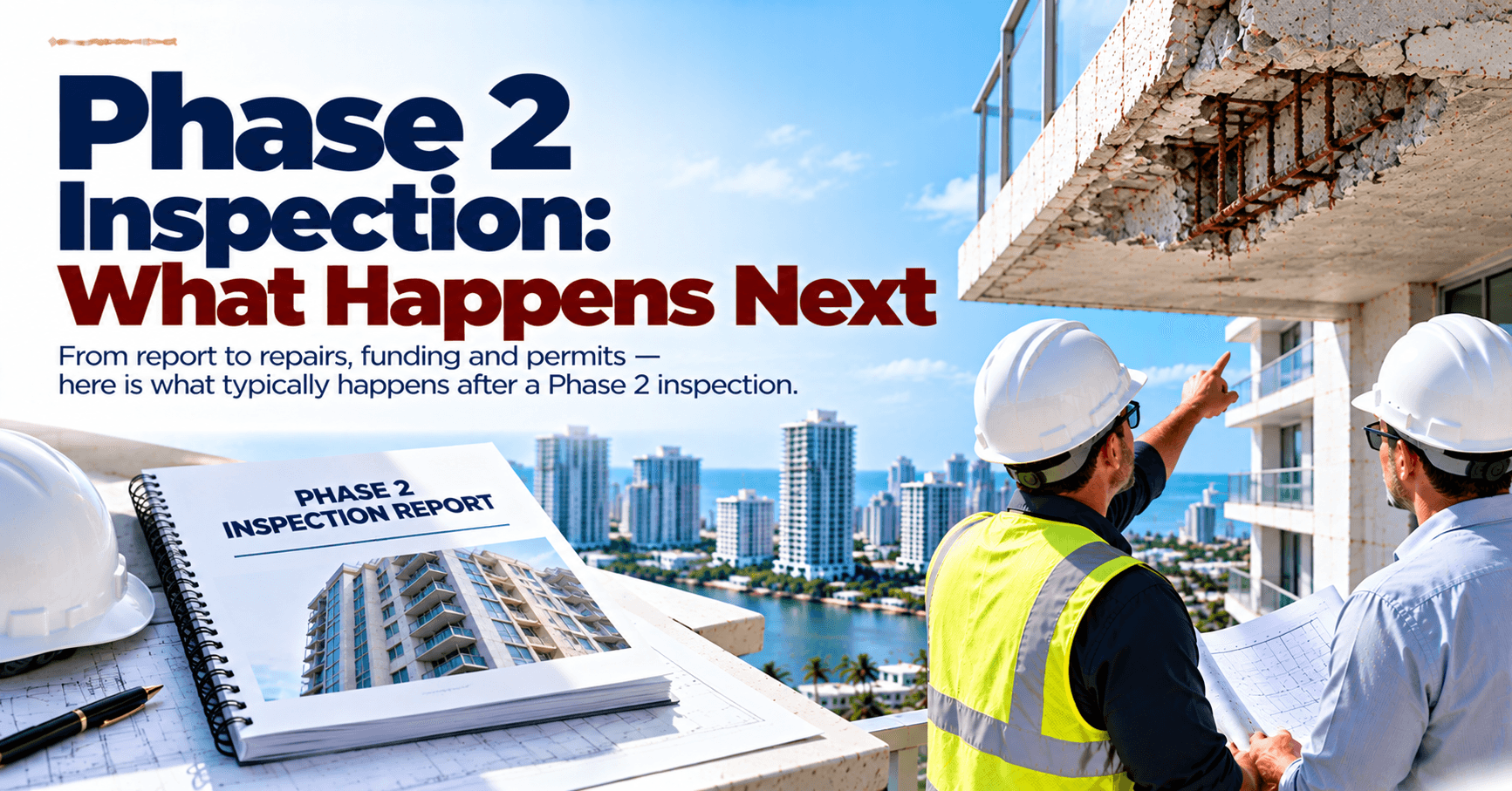
A Phase 2 inspection report has landed on your board's table. It runs to dozens of pages, most of them photographs and engineering notation, and somewhere inside it is the sentence that matters: the building has substantial structural deterioration and it has to be repaired.
Under Florida law, repairs must begin within 365 days. That sounds like ample time. In practice, associations that treat it as a year of runway tend to find they had about four months of genuine slack, because most of the calendar is consumed by decisions that cannot be rushed and approvals that cannot be skipped.
This is a contractor's account of what actually fills those 365 days, and where boards most often lose the months they cannot get back.
What a Phase 2 report gives you, and what it does not
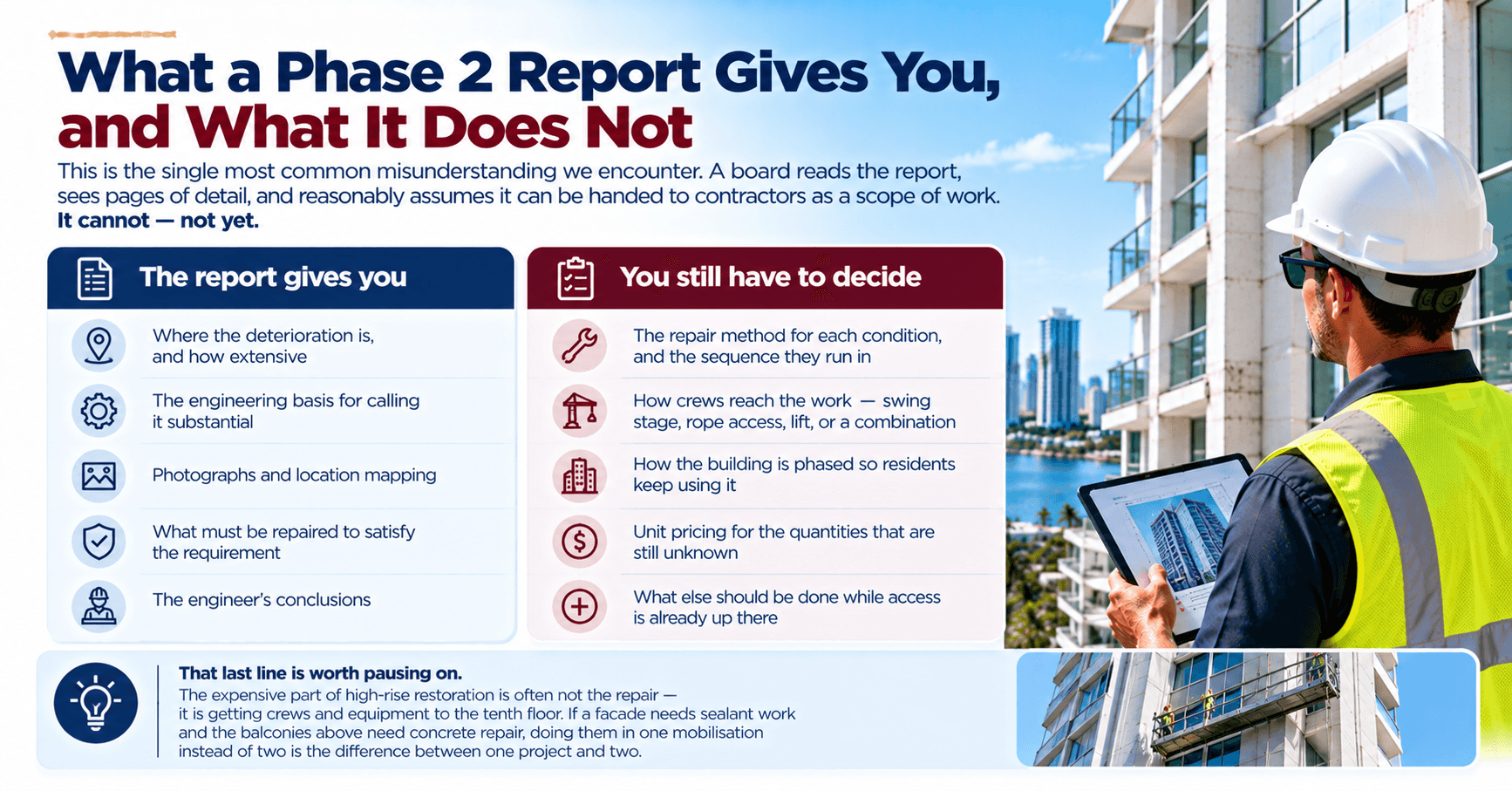
This is the single most common misunderstanding we encounter. A board reads the report, sees pages of detail, and reasonably assumes it can be handed to contractors as a scope of work. It cannot — not yet.
| The report gives you | You still have to decide |
|---|---|
| Where the deterioration is, and how extensive | The repair method for each condition, and the sequence they run in |
| The engineering basis for calling it substantial | How crews reach the work — swing stage, rope access, lift, or a combination |
| Photographs and location mapping | How the building is phased so residents keep using it |
| What must be repaired to satisfy the requirement | Unit pricing for the quantities that are still unknown |
| The engineer's conclusions | What else should be done while access is already up there |
That last line is worth pausing on. The expensive part of high-rise restoration is often not the repair — it is getting crews and equipment to the tenth floor. If a facade needs sealant work and the balconies above need concrete repair, doing them in one mobilisation instead of two is the difference between one project and two.
A realistic shape for the 365 days
Every building is different and nothing below is a promise — schedules depend on the engineer, the permit office, and what the crews find once the surface is opened. But this is the shape we see repeatedly.
| Roughly | What is happening | Why it takes this long |
|---|---|---|
| Months 1-2 | Scope development with the engineer; walk-throughs with contractors | The report has to be translated into biddable line items before anyone can price it honestly |
| Months 2-4 | Bidding and bid levelling | Comparing bids that describe the work differently is slower than collecting them |
| Months 3-6 | Funding: special assessment, loan, or reserves; owner notice and vote | The statutory notice period and the vote run on their own calendar and cannot be compressed |
| Months 5-8 | Permitting, contract execution, submittals and material approvals | Manufacturer system approvals and permit review are both queue-based |
| Months 8-11 | Mobilisation, resident notice, access equipment set up | Swing stage rigging and site protection precede the first repair |
| Month 12 | Repairs must have begun | The statutory deadline |
Read the funding row again. It is the long pole on most association projects, and it is the one boards start last because it feels premature before bids are in. It is not. The conversation with owners, the lender, and counsel can run in parallel with bidding, and starting it early is the cheapest month a board will ever buy.
Not sure which repair your building needs?
Walk the building with a licensed restoration contractor before you write a scope.
Turning deficiencies into a scope you can actually bid
Concrete repair has a property that makes it different from almost every other trade a board contracts: nobody knows the true quantity until the surface is opened. A sounding survey estimates the delaminated area. The real area appears during demolition, and it is routinely larger, because deterioration does not stop at the edge of what sounds hollow.
A scope that ignores this produces one of two bad outcomes. Either contractors pad the number to protect themselves, and the board overpays for repairs that were never needed, or the low bidder prices the estimate honestly and the project turns into a sequence of change orders the board has to defend at every meeting.
The way out is unit pricing. Estimated quantities are bid at an agreed rate per unit, and additional repair area discovered during the work is billed at that same agreed rate. The board approves the rate once, before anything is opened. Nobody negotiates under pressure with a swing stage hanging off the building.
This is also why we write line-item scopes rather than lump sums. A lump sum tells a board what to pay. A line item tells it what it is buying, lets it compare two bids honestly, and gives it something defensible to put in front of owners who are being asked to fund an assessment.
How the work runs while people live there
Nearly all of our restoration work happens on occupied buildings. Nobody moves out. That constraint shapes every decision on the project.
We phase by elevation and stack, which means the work moves through the building in vertical bands rather than floor by floor. A given resident loses the use of their balcony for a defined window rather than living beside an active project for the whole job. Walkways and entries get protected overhead, and access is coordinated with management so residents know which days matter to them.
Access method matters more than boards expect. Rope access and swing stage work means we can reach every floor without standing scaffolding across your entrances for months. Scaffolding is cheaper to rig and far more expensive to live with.
Throughout, the board should be getting photo documentation and progress reporting the property manager can forward straight into the board packet. On a project of this size, documentation is a deliverable, not a courtesy.
The sequence that decides whether the repair lasts
The order of operations is where restoration projects are quietly won or lost.
Unsound concrete comes off first, back to solid material. The exposed reinforcing steel is cleaned or replaced and treated. The section is rebuilt with a repair mortar chosen to be compatible with the existing concrete. Only then does waterproofing go on, and coatings go on last.
Boards under budget pressure are frequently tempted to repair the concrete and defer the waterproofing to a later year. It is an understandable decision and it is the most expensive one available. Paint is the finish; waterproofing is the protection underneath. Concrete repaired and left unprotected in a salt-air environment begins the same corrosion cycle again, and the association pays for the same repair twice within a decade.
If the budget genuinely will not stretch, phase the building — do fewer elevations completely — rather than doing the whole building incompletely.
Where boards lose months
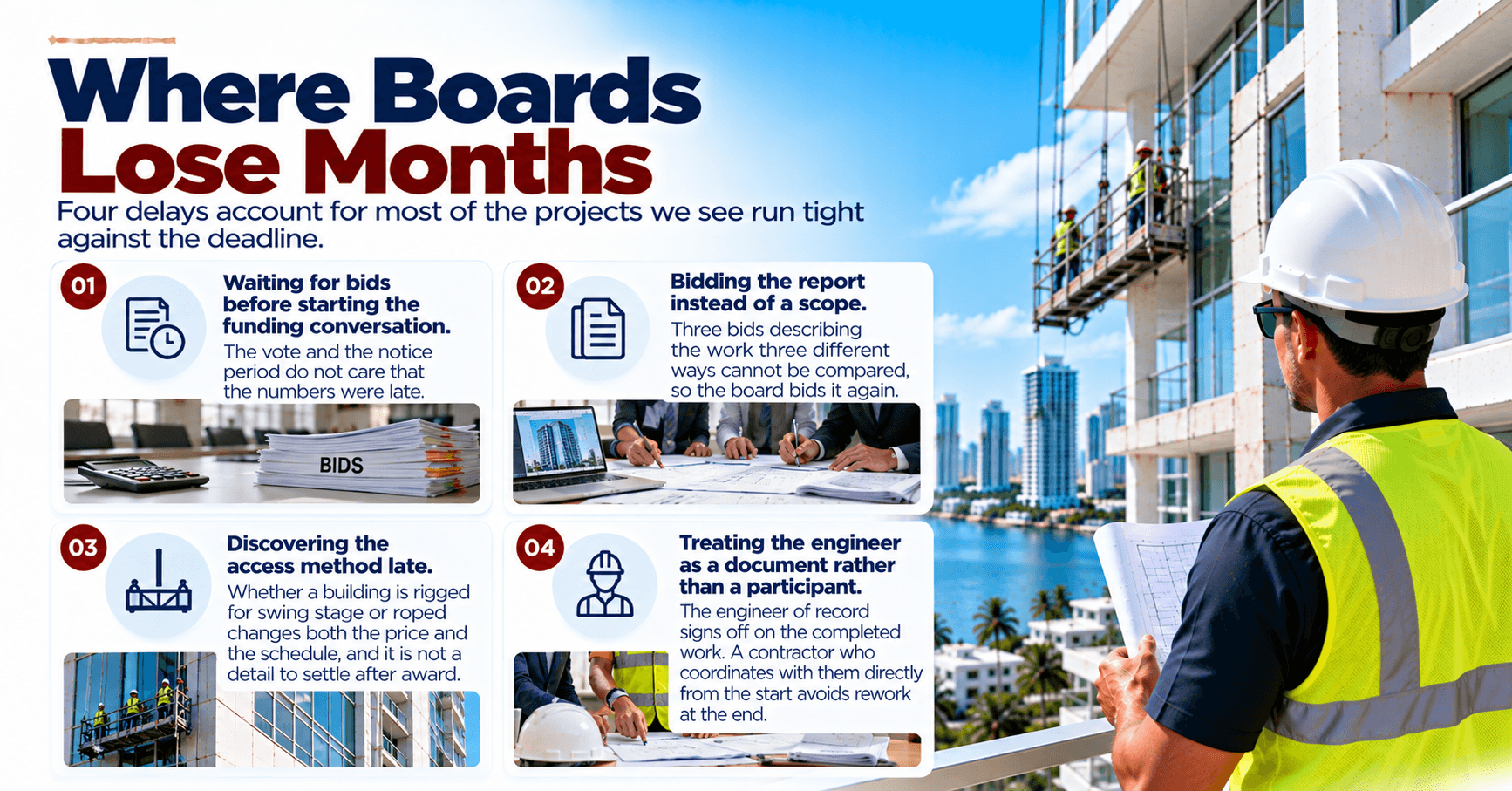
Four delays account for most of the projects we see run tight against the deadline.
Waiting for bids before starting the funding conversation. The vote and the notice period do not care that the numbers were late.
Bidding the report instead of a scope. Three bids describing the work three different ways cannot be compared, so the board bids it again.
Discovering the access method late. Whether a building is rigged for swing stage or roped changes both the price and the schedule, and it is not a detail to settle after award.
Treating the engineer as a document rather than a participant. The engineer of record signs off on the completed work. A contractor who coordinates with them directly from the start avoids rework at the end.
If your report has just arrived
Confirm in writing what date starts your 365 days — it is tied to the Phase 2 report, but pin the precise trigger down with your building department rather than assuming. Then get the building walked, with your engineer and a restoration contractor, before the scope goes out to bid. It costs a morning and it routinely saves a month.
Tell us about your building. We'll come look at it, and tell you honestly what it needs.
Our milestone inspection repairs service covers the repairs a report calls for. We do not perform the inspections themselves.
Not sure which repair your building needs?
Walk the building with a licensed restoration contractor before you write a scope.
Frequently asked questions
Updated: October 16, 2026