How a Condo Board Should Choose a Restoration Contractor
Three bids that look alike on the cover page can differ by hundreds of thousands underneath. Here is what to ask, and what a good answer sounds like.
By Luigi Basile
President

Board members are not contractors. You are volunteers being asked to approve six- and seven-figure structural work, defend an assessment to your neighbours, and make sure the building is safe.
The hardest part is not finding contractors. It is that three bids can look almost identical on the cover page and differ enormously underneath — in what is included, in what happens when the surface is opened, and in who carries the risk when the quantities turn out to be wrong.
This is a guide to reading past the cover page. We are a restoration contractor and we bid this work, so read it with that in mind. Every question below is one we are happy to be asked.
First, make the bids comparable
Most bid comparisons fail before the bids arrive.
A milestone or recertification report describes deficiencies. It does not describe a repair method, a sequence, an access strategy, or a phasing plan. If you send that report to four contractors and ask for a price, you will get four documents that each solve a slightly different problem, and no honest way to rank them.
Define the scope first — with your engineer, and ideally with a contractor walking the building alongside them. Then bid the scope, not the report.
The quantity problem, and why unit pricing exists
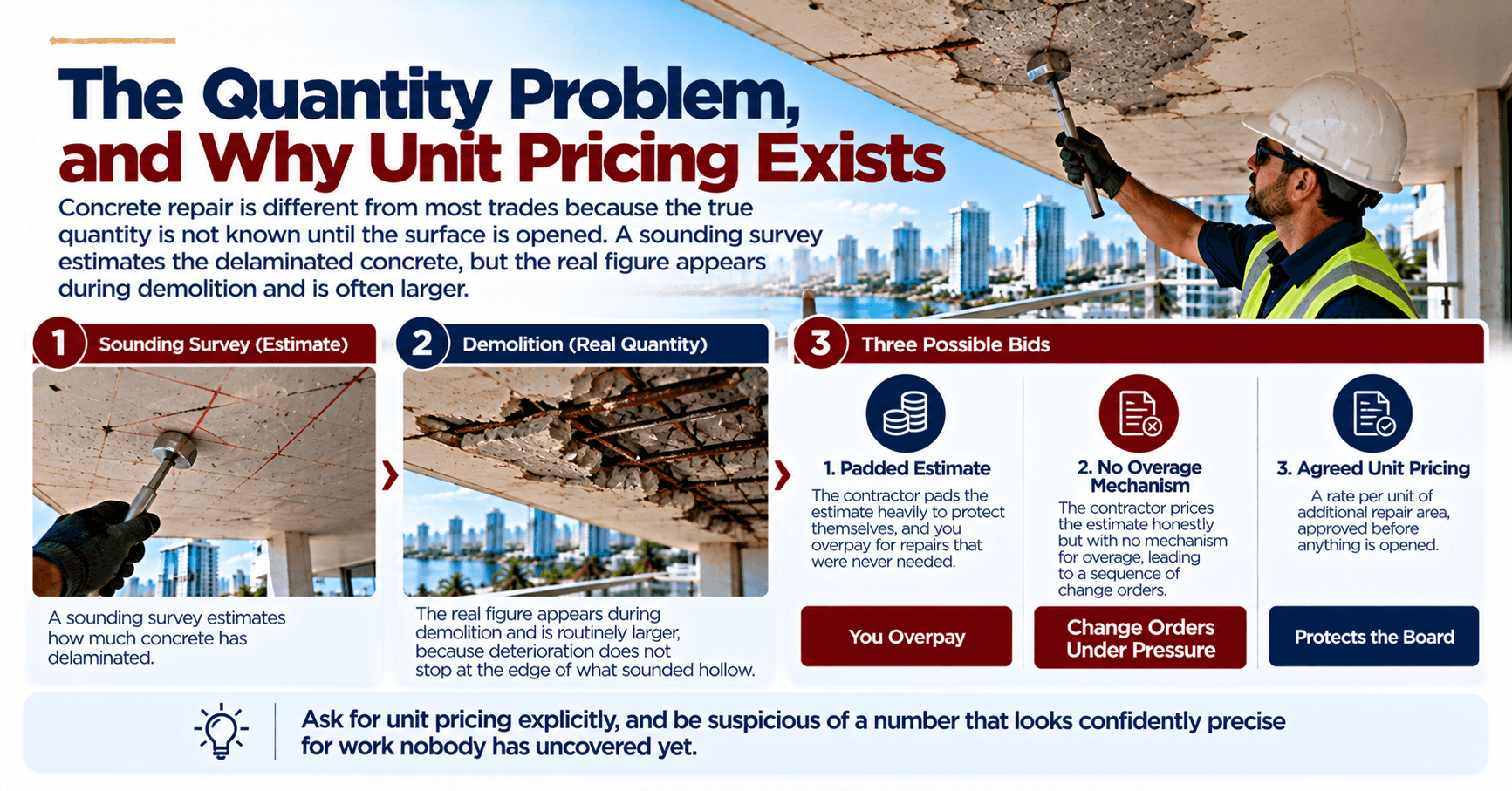
Concrete repair has a property that separates it from almost every other trade a board contracts: nobody knows the true quantity until the surface is opened.
A sounding survey estimates how much concrete has delaminated. The real figure appears during demolition, and it is routinely larger, because deterioration does not stop neatly at the edge of what sounded hollow.
That leaves three possible bids. One pads the estimate heavily to protect the contractor, and you overpay for repairs that were never needed. One prices the estimate honestly with no mechanism for overage, and becomes a sequence of change orders you negotiate under pressure with access equipment already rigged. The third carries agreed unit pricing — a rate per unit of additional repair area, approved before anything is opened.
Only the third protects the board. Ask for it explicitly, and be suspicious of a number that looks confidently precise for work nobody has uncovered yet.
Lump sum versus line item
A lump sum tells a board what to pay. A line-item scope tells it what it is buying.
This matters less for procurement than for governance. When an owner at the annual meeting asks why the assessment is what it is, a line-item scope lets you answer. A lump sum leaves you defending a single number you cannot decompose.
How to compare bids for structural concrete repair
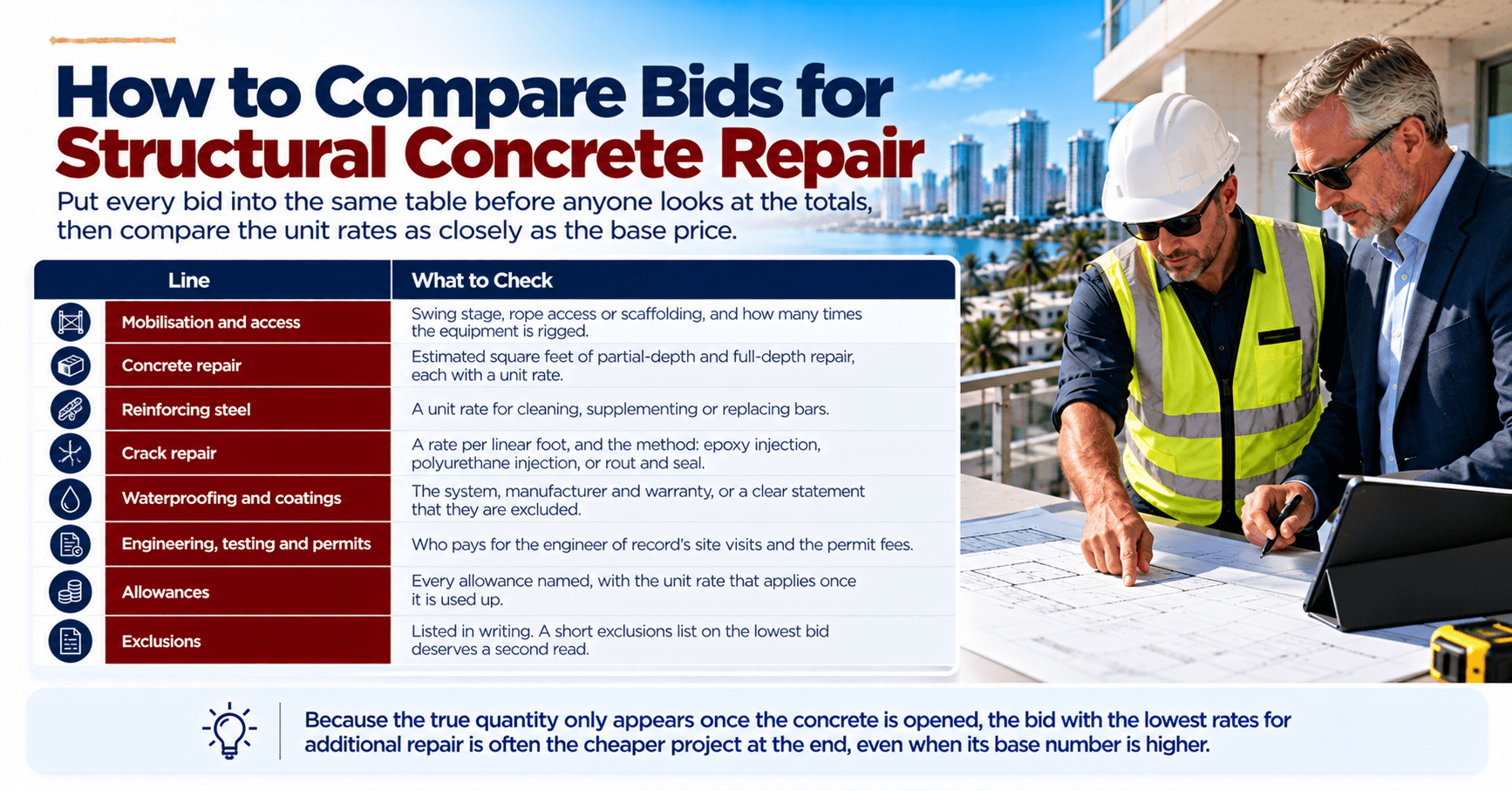
Put every bid into the same table before anyone looks at the totals, then compare the unit rates as closely as the base price. If a bidder will not break their price into these lines, that is the first thing you have learned about them.
| Line | What to check |
|---|---|
| Mobilisation and access | Swing stage, rope access or scaffolding, and how many times the equipment is rigged |
| Concrete repair | Estimated square feet of partial-depth and full-depth repair, each with a unit rate |
| Reinforcing steel | A unit rate for cleaning, supplementing or replacing bars |
| Crack repair | A rate per linear foot, and the method: epoxy injection, polyurethane injection, or rout and seal |
| Waterproofing and coatings | The system, manufacturer and warranty, or a clear statement that they are excluded |
| Engineering, testing and permits | Who pays for the engineer of record's site visits and the permit fees |
| Allowances | Every allowance named, with the unit rate that applies once it is used up |
| Exclusions | Listed in writing. A short exclusions list on the lowest bid deserves a second read |
Because the true quantity only appears once the concrete is opened, the bid with the lowest rates for additional repair is often the cheaper project at the end, even when its base number is higher.
The conflict-of-interest question you are now entitled to ask
HB 913 introduced disclosure requirements covering engineers and contractors alike.
Our suggestion is to treat it as a screening question rather than a form to file. Ask each bidding contractor whether it has any relationship with the engineer who wrote your report. Ask your engineer the same question in reverse. Ask the firm that prepared your reserve study whether it intends to bid the repairs.
The answers matter less than the reaction. A firm that finds the question uncomfortable has told you something.
What to ask, and what a good answer contains
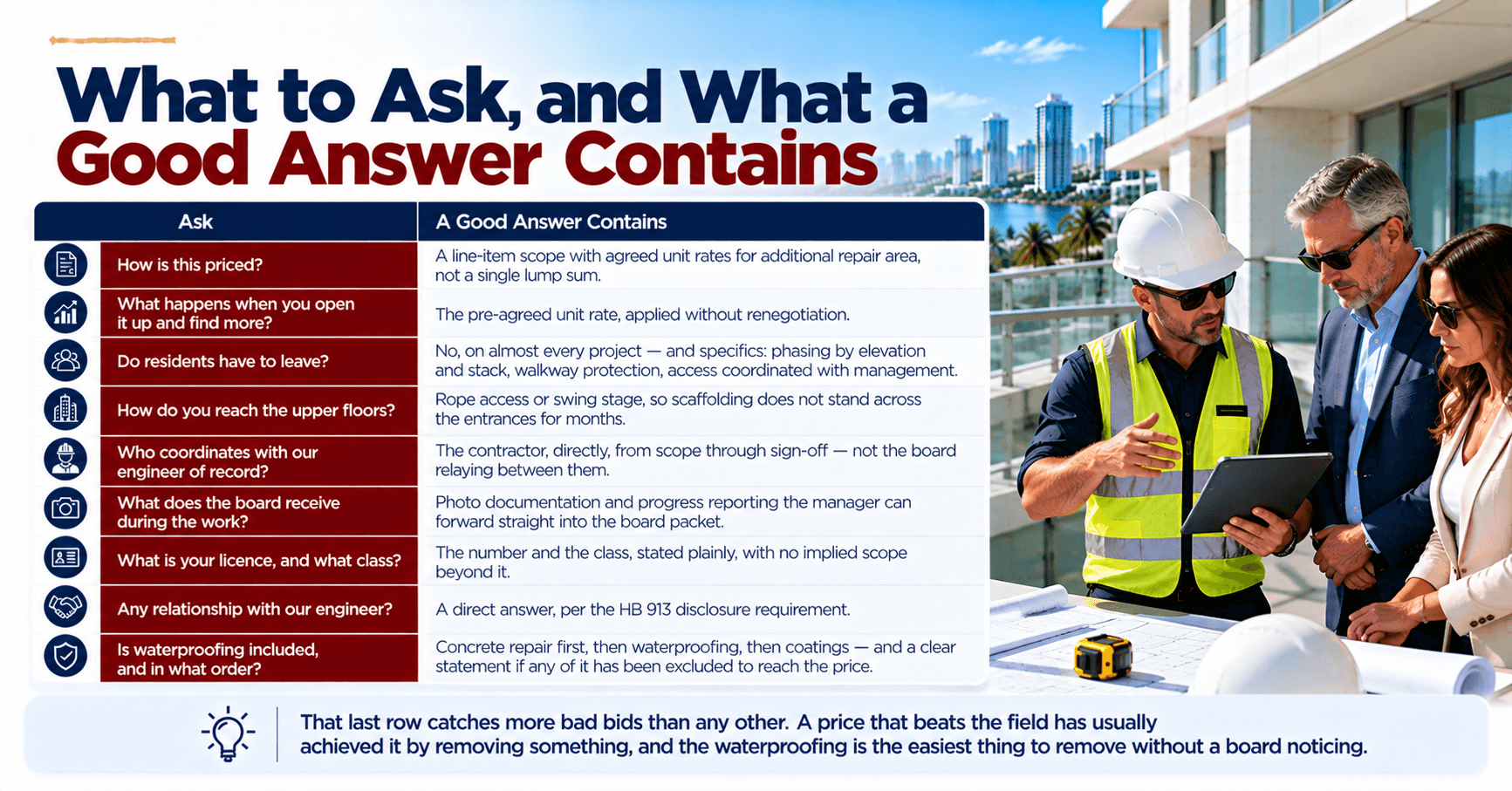
| Ask | A good answer contains |
|---|---|
| How is this priced? | A line-item scope with agreed unit rates for additional repair area, not a single lump sum |
| What happens when you open it up and find more? | The pre-agreed unit rate, applied without renegotiation |
| Do residents have to leave? | No, on almost every project — and specifics: phasing by elevation and stack, walkway protection, access coordinated with management |
| How do you reach the upper floors? | Rope access or swing stage, so scaffolding does not stand across the entrances for months |
| Who coordinates with our engineer of record? | The contractor, directly, from scope through sign-off — not the board relaying between them |
| What does the board receive during the work? | Photo documentation and progress reporting the manager can forward straight into the board packet |
| What is your licence, and what class? | The number and the class, stated plainly, with no implied scope beyond it |
| Any relationship with our engineer? | A direct answer, per the HB 913 disclosure requirement |
| Is waterproofing included, and in what order? | Concrete repair first, then waterproofing, then coatings — and a clear statement if any of it has been excluded to reach the price |
That last row catches more bad bids than any other. A price that beats the field has usually achieved it by removing something, and the waterproofing is the easiest thing to remove without a board noticing.
Not sure which repair your building needs?
Walk the building with a licensed restoration contractor before you write a scope.
Checking a licence
Florida licences are public. You can verify any contractor's licence number, class and status through the Department of Business and Professional Regulation before you shortlist, and it takes a couple of minutes.
Two things to look at. First, that the licence is active and the number matches the entity actually signing your contract, not an affiliate. Second, the class — a licence class defines what a contractor may perform, and a firm should state its class plainly rather than describing itself in terms that imply a broader scope.
For our part: Basile Contractors holds Licence No. CCC1511747, and we are insured and bonded. We are a building restoration contractor. We do not perform milestone inspections or prepare reserve studies, and we do not do electrical work.
What to look for in a concrete restoration contractor in South Florida
For structural concrete work on a South Florida condominium, shortlist contractors who can show all of the following:
- Comparable buildings. Occupied coastal condominiums with balcony, column and slab repairs, and references from boards or managers you can call.
- A written corrosion-repair method. How far concrete is removed around corroded bars, how loss of steel is measured and when bars are supplemented, and what repair material is used. “Patch and paint” is not a method.
- Concrete repair training. Supervisors trained in recognised repair practice, for example through ICRI, the International Concrete Repair Institute.
- Waterproofing in the same scope, so the repaired concrete is protected before the next rainy season.
- Independence from your engineer. The engineer of record specifies and inspects the repairs. The contractor builds to that specification.
- Insurance that matches the building. General liability, workers' compensation and umbrella limits, with the association named as additional insured.
- A licence class that covers the work, checked on DBPR's licence search.
Two things worth more than price
Occupied-building experience. Nearly all South Florida restoration happens around residents who are not going anywhere. Ask how a contractor phases work, how walkways stay usable, how residents are told which days affect them. A generic "we're used to it" is not proof. The specifics are.
Documentation as a deliverable. On a project this size the board answers to owners the whole way through. Photo records and regular progress reporting are not a courtesy — they are what lets the board govern while the work runs.
Before you send the scope out
If your board is preparing to bid restoration work and wants the scope defined before the numbers arrive, we will walk the building at no cost and give you a written, line-item scope. No obligation, and no number over the phone; what the repair costs depends on what is on the wall.
For what the scope itself should contain, and what construction administration covers, see what a condo board’s scope of work should include.
Tell us about your building. We'll come look at it, and tell you honestly what it needs.
Our milestone inspection repairs service covers the repairs a report calls for. We do not perform the inspections themselves.
Not sure which repair your building needs?
Walk the building with a licensed restoration contractor before you write a scope.
Frequently asked questions
Updated: October 16, 2026