40-Year Recertification in Miami-Dade and Broward — It Isn't 40 Years Any More
Miami-Dade and Broward both moved their recertification thresholds, and neither is 40 years now. What applies to your building, and the repairs it triggers.
By Luigi Basile
President
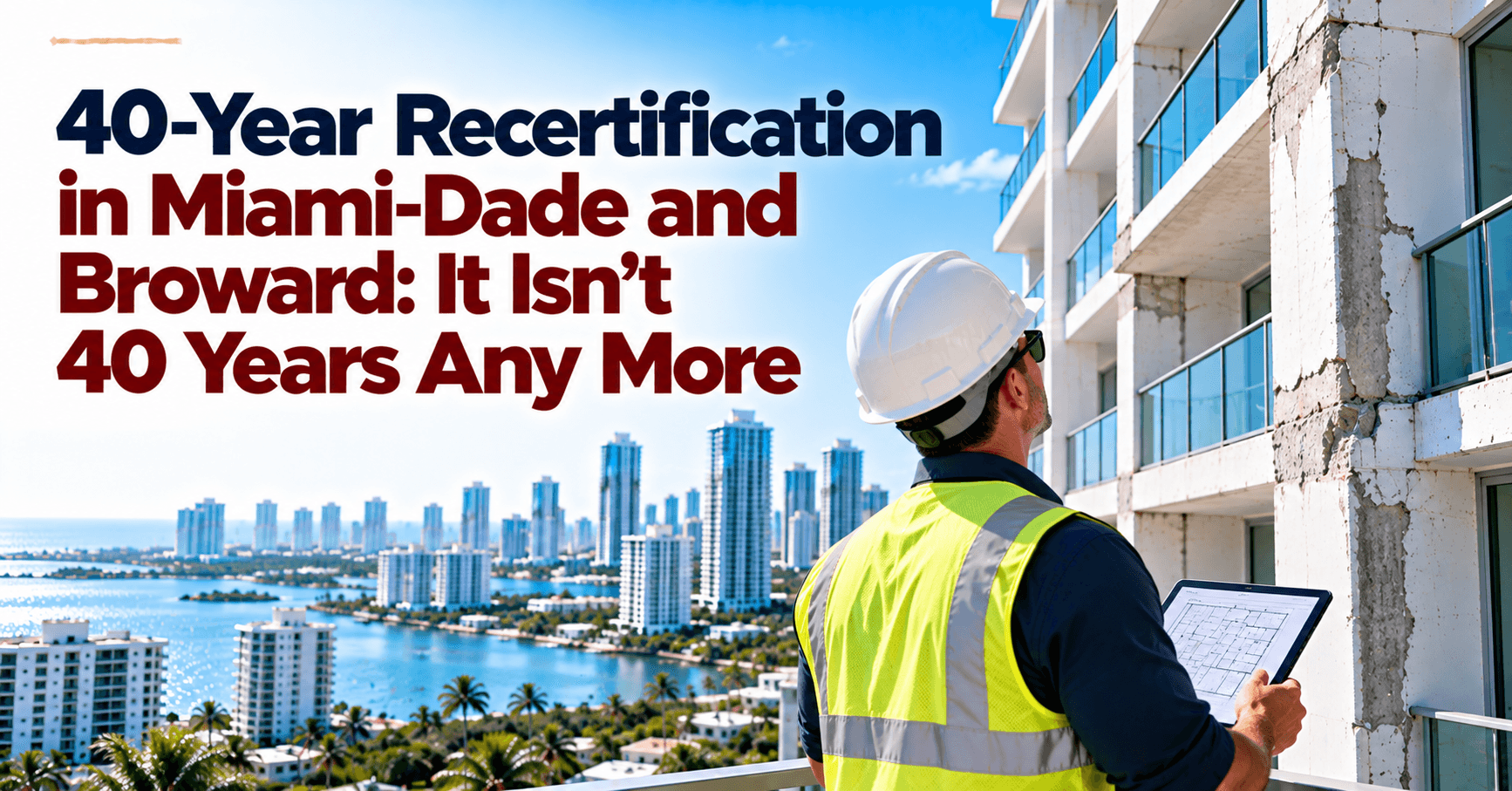
Boards and property managers still call it the 40-year recertification. Engineers still get asked for a "40-year inspection". The phrase has outlived the rule.
Miami-Dade and Broward have both moved their thresholds, and they did not move them to the same number. On top of that, Florida added a statewide milestone inspection that applies to some of the same buildings on a different clock.
A single South Florida condominium can now sit inside two of these programs at once, with two sets of paperwork and two deadlines — and one set of repairs. That last part is where boards save real money, and it is the part nobody explains.
What is the "40-year certification"?
The 40-year certification is the old name for building recertification, the periodic structural and electrical safety review that Miami-Dade County has required since 1975. The name no longer matches the rule. Since the June 2022 amendment, most buildings built in 1993 or later are first due at 30 years. Coastal condos and co-ops of three or more stories built in 1998 or later are first due at 25 years. After the first report, recertification repeats every 10 years.
What does recertification involve in Miami-Dade?
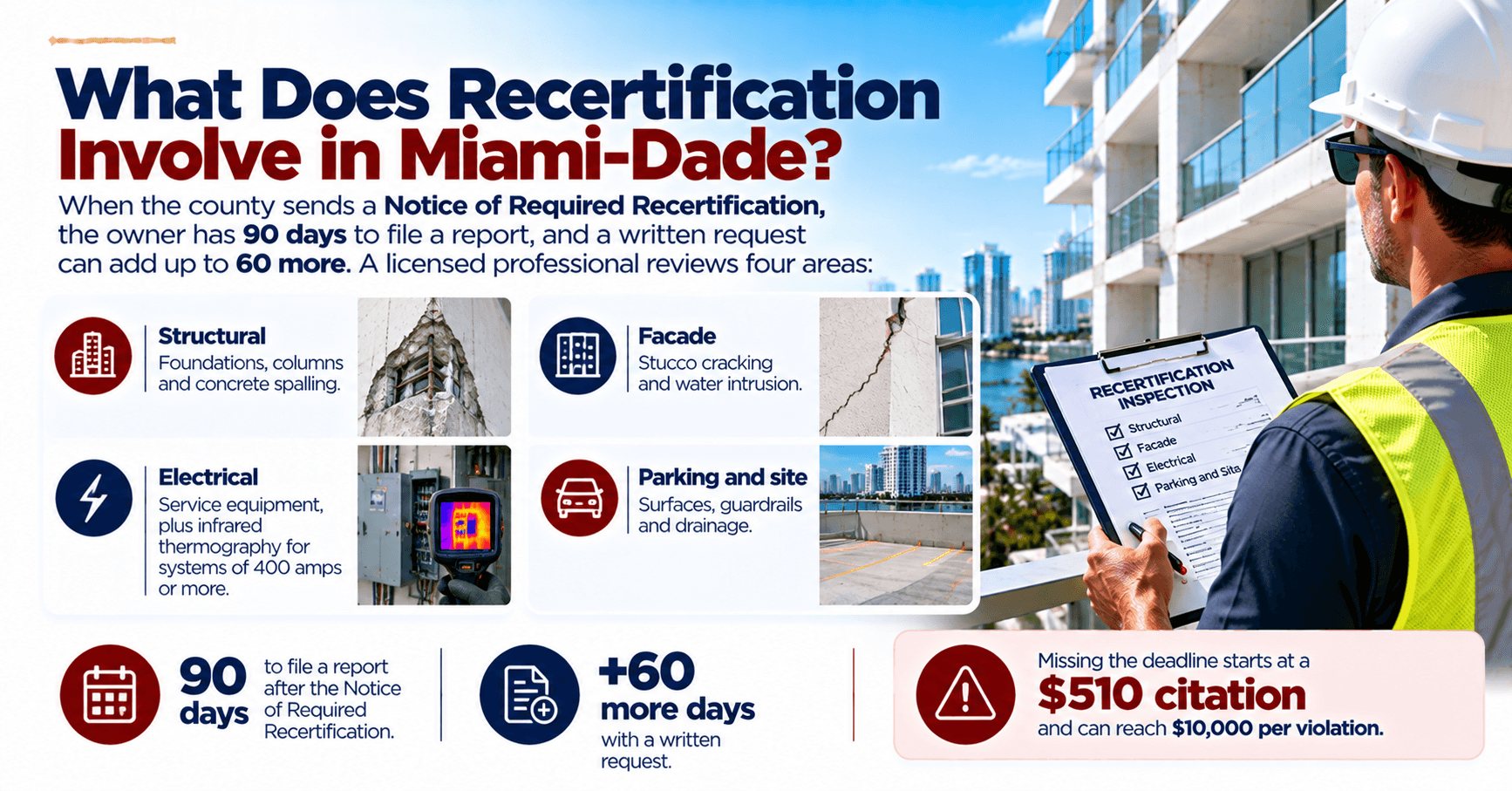
When the county sends a Notice of Required Recertification, the owner has 90 days to file a report, and a written request can add up to 60 more. A licensed professional reviews four areas:
- Structural: foundations, columns and concrete spalling.
- Facade: stucco cracking and water intrusion.
- Electrical: service equipment, plus infrared thermography for systems of 400 amps or more.
- Parking and site: surfaces, guardrails and drainage.
Anything the report flags has to be repaired and certified. Missing the deadline starts at a $510 citation and can reach $10,000 per violation.
The three programs, side by side
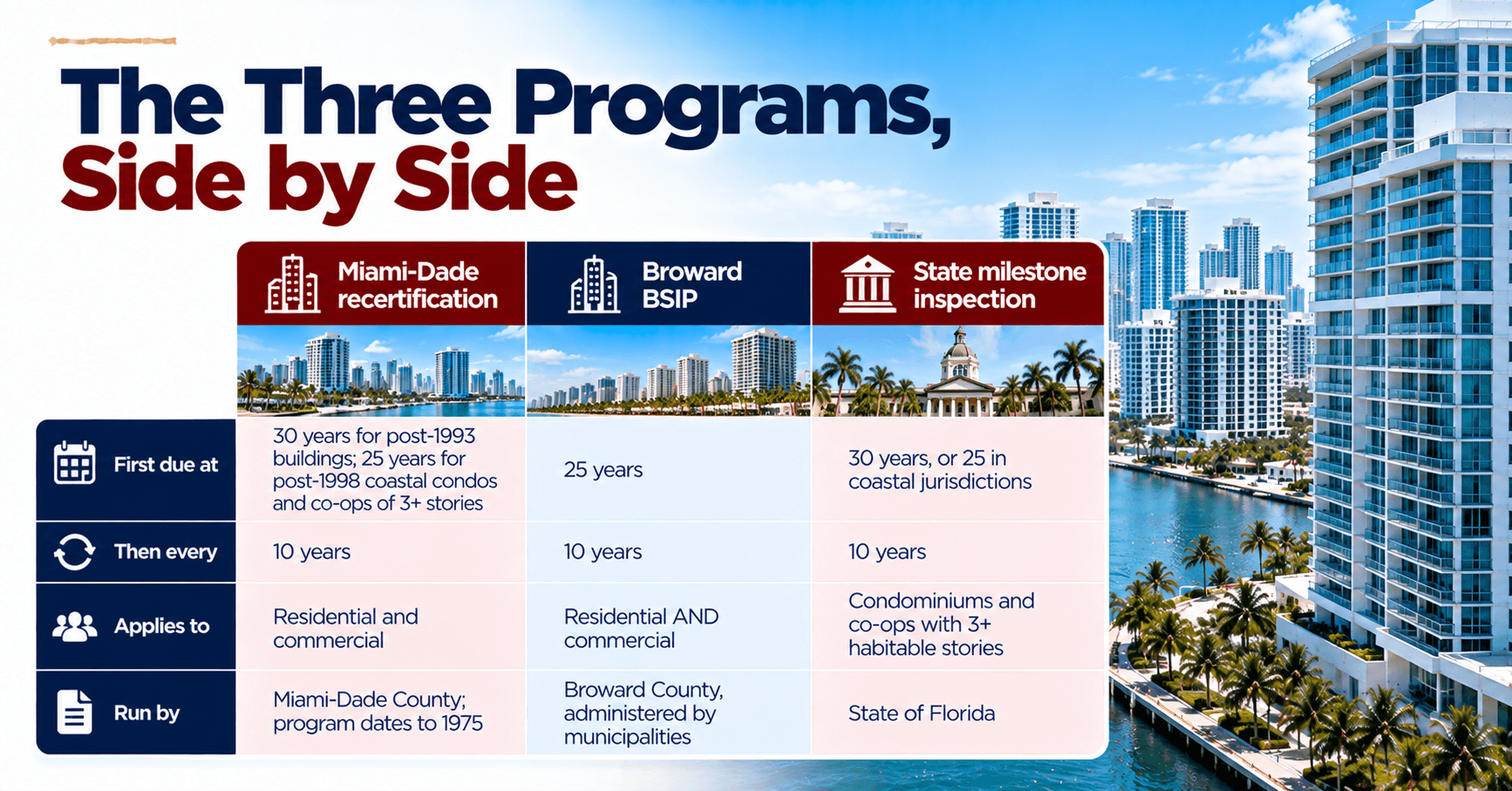
| Miami-Dade recertification | Broward BSIP | State milestone inspection | |
|---|---|---|---|
| First due at | 30 years for post-1993 buildings; 25 years for post-1998 coastal condos and co-ops of 3+ stories | 25 years | 30 years, or 25 in coastal jurisdictions |
| Then every | 10 years | 10 years | 10 years |
| Applies to | Residential and commercial | Residential AND commercial | Condominiums and co-ops with 3+ habitable stories |
| Run by | Miami-Dade County; program dates to 1975 | Broward County, administered by municipalities | State of Florida |
Read the "applies to" row carefully. The county programs are wider than the state milestone inspection. Milestone is a condo and co-op requirement. Both county programs reach commercial buildings too — which is why commercial owners who correctly concluded the milestone law did not apply to them are sometimes surprised by a county notice.
Miami-Dade, specifically
Miami-Dade's program is the oldest in the state, running since 1975. It was amended in June 2022 to fold in the new state milestone requirement rather than run alongside it.
Which threshold applies depends on when your building was built and how close it is to the water.
| Building | First recertification |
|---|---|
| Built 1983-1997, within 3 miles of the coast | Was due by 31 December 2024, then every 10 years |
| Built 1983-1992, further inland | Was due by 31 December 2024, then every 10 years |
| Built 1998 or later, coastal condo or co-op, 3+ stories | At 25 years, then every 10 years |
| Built 1993 or later, everything else | At 30 years, then every 10 years |
Exempt: single-family homes, duplexes, and buildings with an occupant load of 10 or fewer and under 2,000 square feet.
The clock is short. Once the county issues a Notice of Required Recertification, the report is due within 90 days. A written request can buy up to 60 more. That is not much time to engage an engineer, get the building inspected, and produce a report — which is why the associations that cope best are the ones that started before the envelope arrived.
Ignoring it gets expensive. Non-compliance starts at a $510 citation and can accumulate toward $10,000 per violation, with liens available to the county.
Broward, specifically
Broward runs a Building Safety Inspection Program rather than a "recertification" by name, and it now begins at 25 years, with inspections every 10 years after that.
Two things about Broward catch people out.
First, it is administered by the municipalities, not solely at county level. Fort Lauderdale, Hollywood, Pompano Beach and the rest each issue their own notices and can set their own submission windows. Whatever a general guide tells you about deadlines, the number that governs your building is the one printed on your notice.
Second, buildings of three or more stories are treated as threshold buildings, which means the structural portion of the inspection has to be prepared by a Florida-licensed structural engineer rather than a general practitioner.
What recertification actually asks you to fix
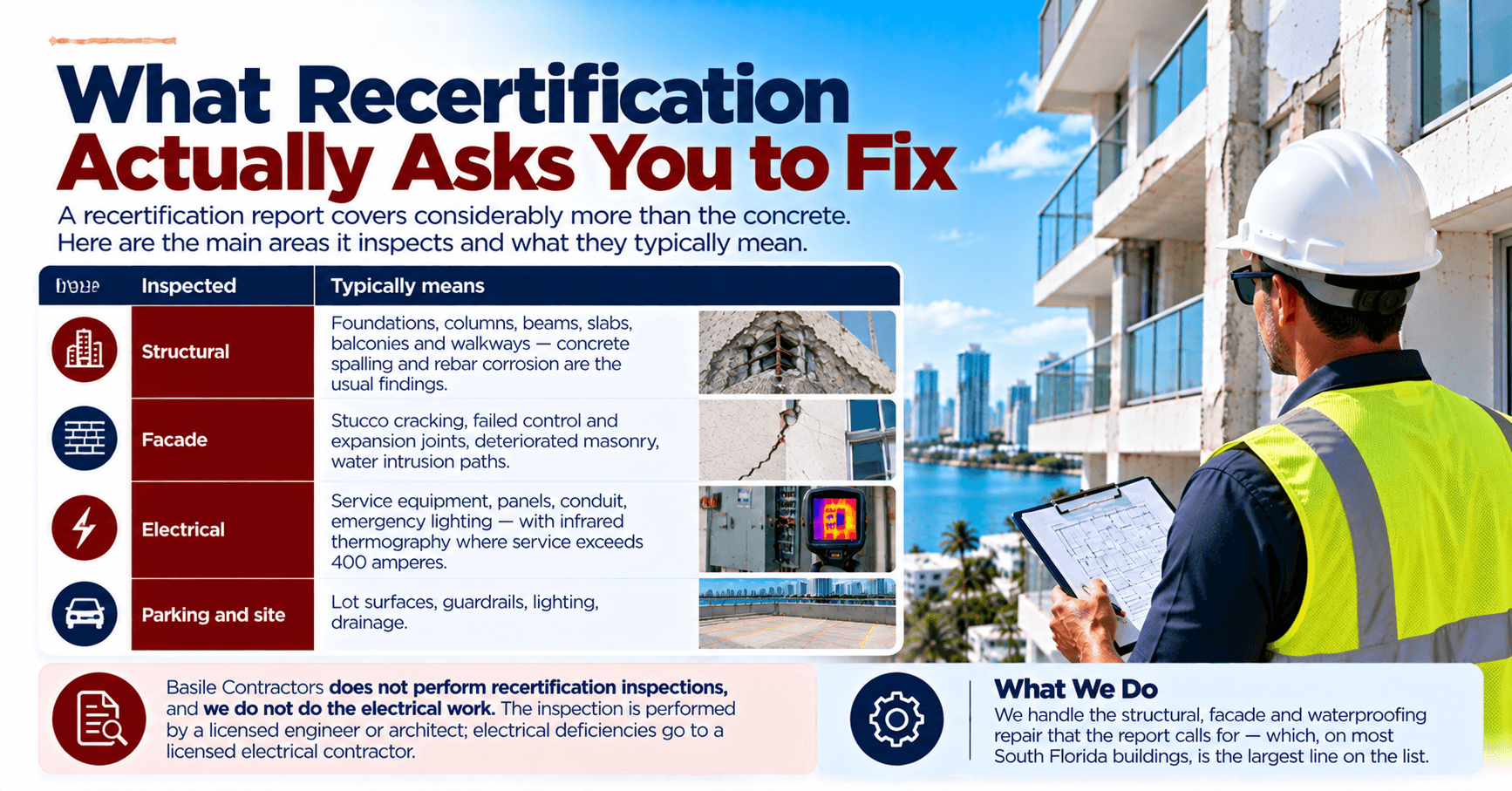
This is where the paperwork turns into a construction project. A recertification report covers considerably more than the concrete.
| Inspected | Typically means |
|---|---|
| Structural | Foundations, columns, beams, slabs, balconies and walkways — concrete spalling and rebar corrosion are the usual findings |
| Facade | Stucco cracking, failed control and expansion joints, deteriorated masonry, water intrusion paths |
| Electrical | Service equipment, panels, conduit, emergency lighting — with infrared thermography where service exceeds 400 amperes |
| Parking and site | Lot surfaces, guardrails, lighting, drainage |
We should be straight with you about scope. Basile Contractors does not perform recertification inspections, and we do not do the electrical work. The inspection is performed by a licensed engineer or architect; electrical deficiencies go to a licensed electrical contractor. What we do is the structural, facade and waterproofing repair that the report calls for — which, on most South Florida buildings, is the largest line on the list.
Not sure which repair your building needs?
Walk the building with a licensed restoration contractor before you write a scope.
One building, two clocks, one project
A 1996 oceanfront condominium in Hallandale Beach can owe Broward a BSIP inspection and the state a milestone inspection, on separate schedules, with separate reports going to separate authorities. Two engineers may even be involved.
But there is only one building. The spalled balcony that appears in the BSIP report is the same balcony in the milestone report. The failed sealant joints are the same joints.
Boards that treat these as two compliance events frequently procure the repairs twice — two scopes, two bids, two mobilisations, two rounds of swing stage rigging. On a high-rise, getting crews and equipment to the upper floors is often a larger cost than the repair itself. Doing it once and satisfying both reports in a single project is the single biggest saving available on this kind of work, and it requires nothing more than sequencing the scope properly before anyone bids it.
If a notice has arrived
Three things, in this order.
Read the deadline on the notice itself. Not the deadline in a guide, not the one a neighbouring association quoted you. Miami-Dade's standard window is 90 days with a possible 60-day extension; Broward's varies by municipality.
Engage the engineer before you think about contractors. The report defines what has to be repaired. Bidding before it exists produces numbers nobody can compare.
Ask whether any other clock is running on the same building. If a milestone inspection is also due, say so at the scoping stage. That one question is what turns two projects into one.
Turning a report into a scope
If you are holding a recertification report — or expecting one — and need the structural and facade items turned into a scope your board can price and defend, we will walk the building at no cost and give you a written, line-item scope. No obligation, and no number over the phone; what the repair costs depends on what is on the wall.
Tell us about your building. We'll come look at it, and tell you honestly what it needs.
Repairs after a recertification or milestone report follow each county’s rules. See our Miami-Dade and Broward pages, and our milestone inspection repairs service.
Not sure which repair your building needs?
Walk the building with a licensed restoration contractor before you write a scope.
Frequently asked questions
Updated: October 16, 2026