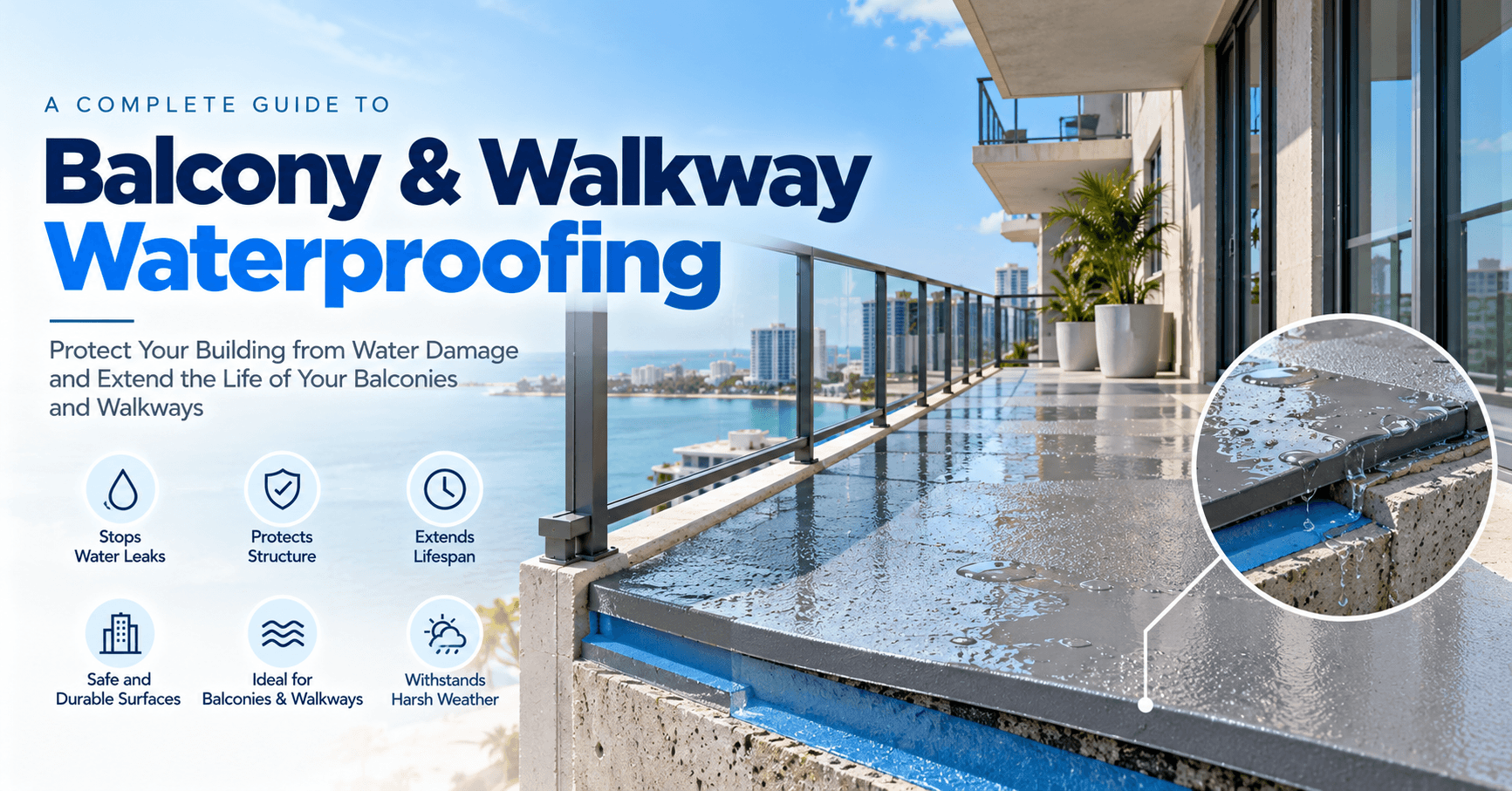
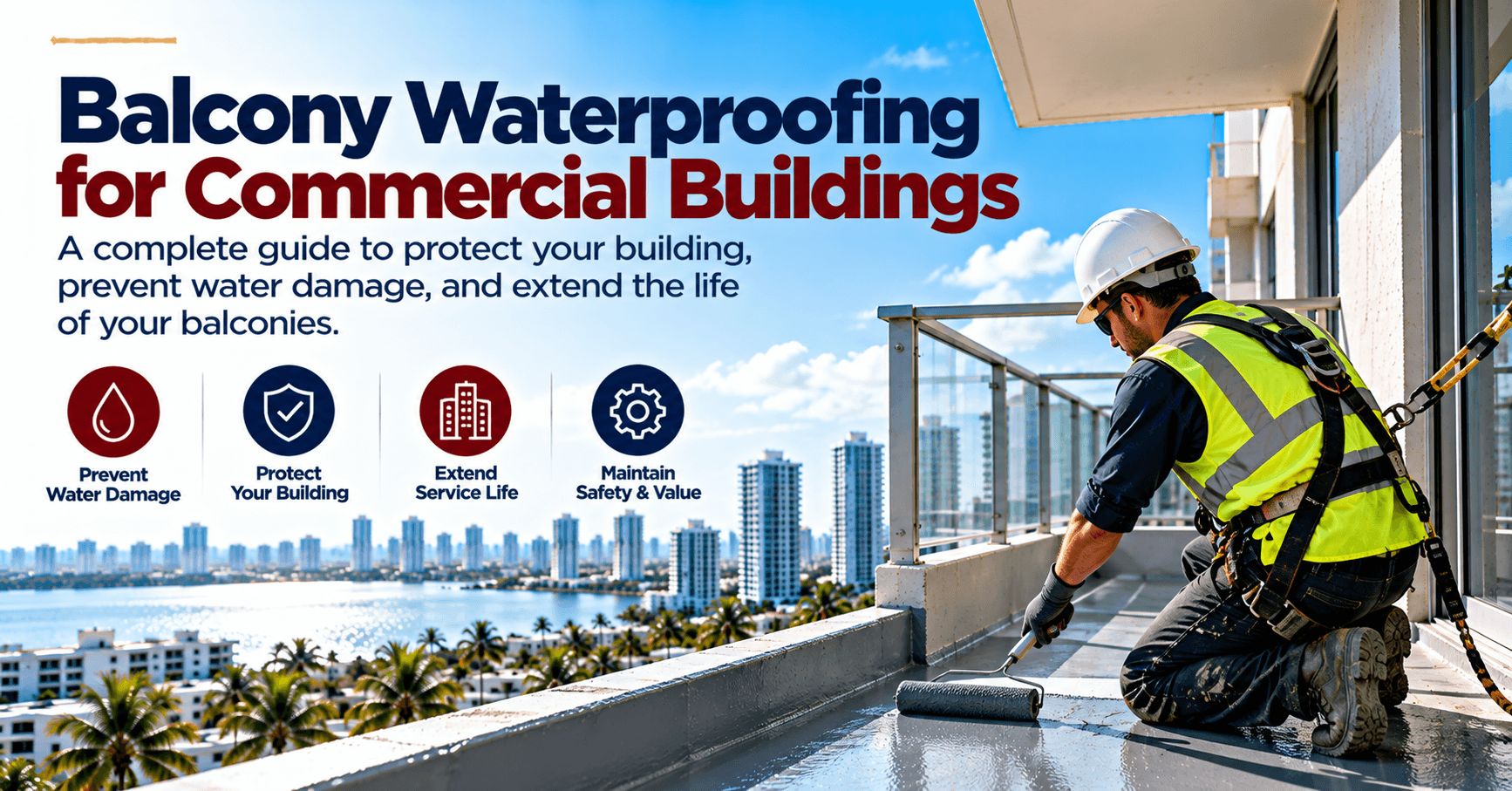
Commercial Roof Waterproofing: How to Prevent Leaks and Water Damage
A practical guide to commercial roof waterproofing in South Florida: how it prevents leaks and water damage, the systems and coatings available, warning signs, costs, and repair vs. replacement.
By Luigi Basile
President
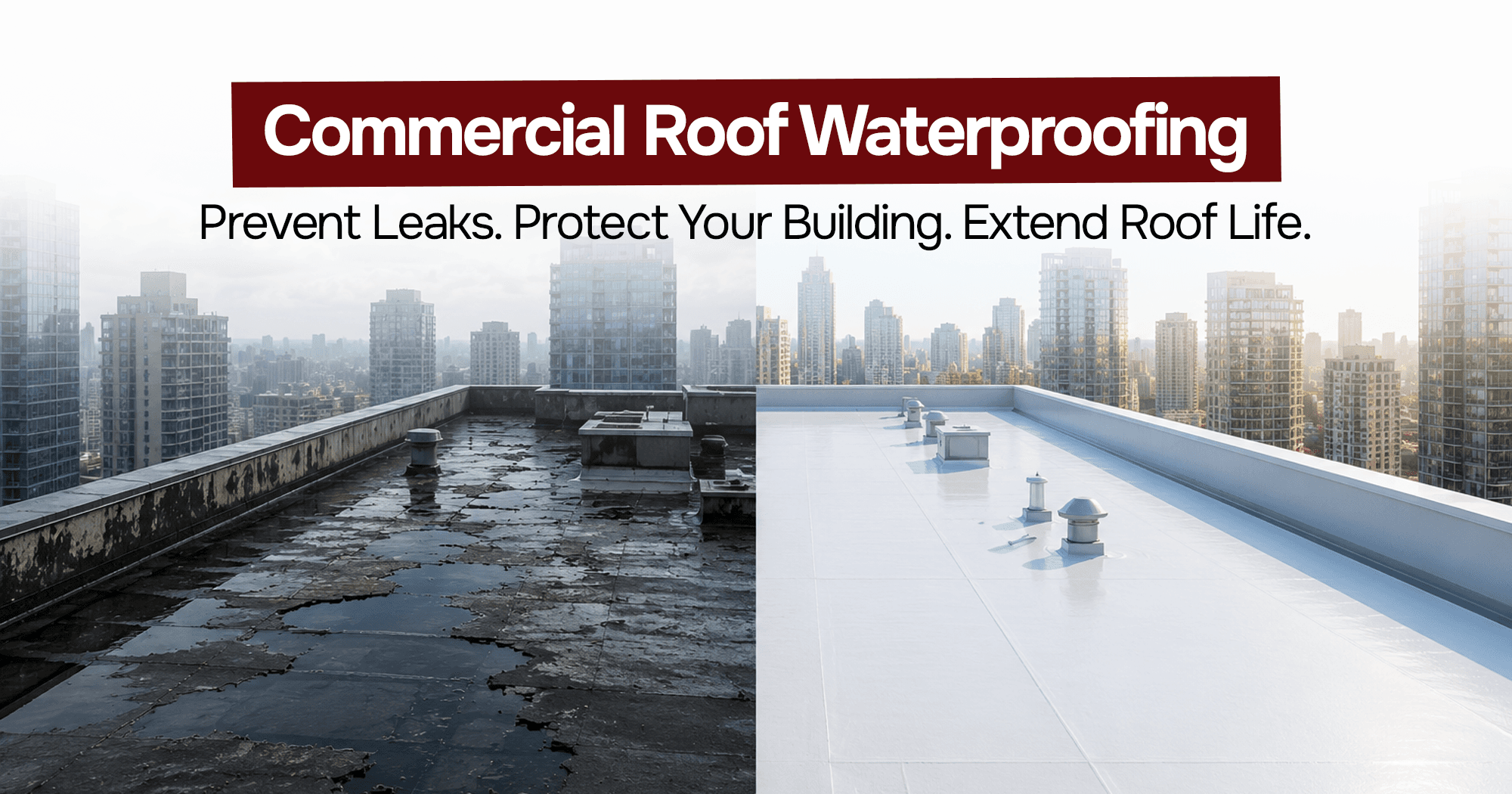
A commercial roof is the single most exposed part of any building, and in South Florida it takes a beating that few other regions can match. Between torrential summer downpours, hurricane-force winds, relentless UV, and long stretches of standing heat and humidity, water is constantly looking for a way in. Commercial roof waterproofing is how you keep it out — sealing the surface, protecting the structure below, and extending the useful life of a roof you have already paid for.
This guide explains what commercial roof waterproofing actually is, why flat and low-slope commercial roofs are so vulnerable to water intrusion, the warning signs that a roof needs attention, and the systems and coatings used to protect it. It also covers how waterproofing compares to a full roof coating, when waterproofing makes more sense than replacement, and what drives the cost — so property owners and facility managers can make an informed decision before the next leak turns into an expensive interior repair.
What Is Commercial Roof Waterproofing?
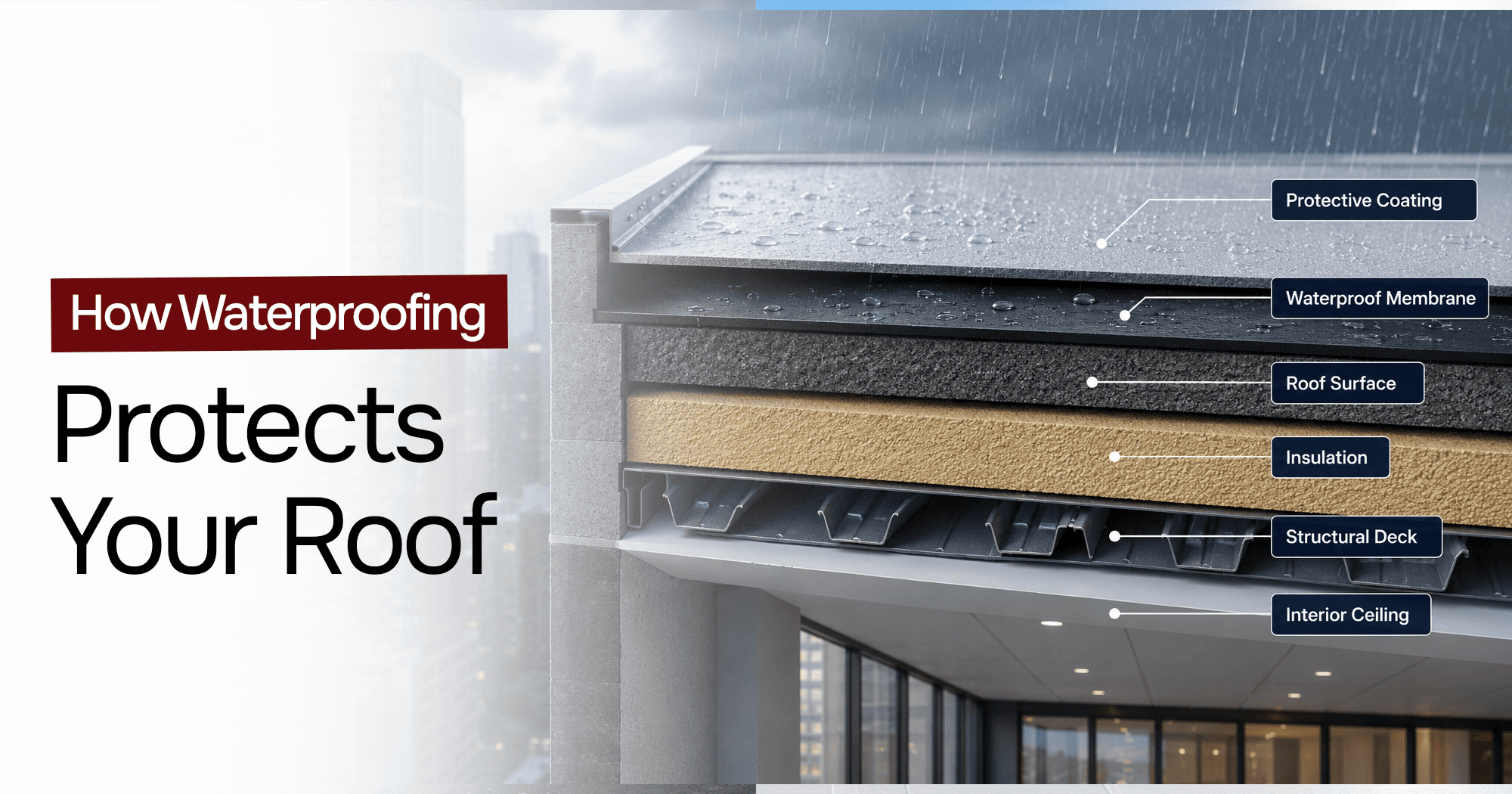
Commercial roof waterproofing is the process of applying a protective barrier to a roof so that water cannot penetrate the surface and reach the building's structure, insulation, and interior spaces. Rather than relying on the aging roofing material alone to shed water, waterproofing adds a continuous, monolithic layer that seals seams, cracks, penetrations, and other weak points where leaks typically begin.
It is important to distinguish waterproofing from standard roof maintenance. Routine maintenance — clearing drains, resealing a flashing detail, patching an isolated puncture — keeps an existing roof functioning. Waterproofing is a more comprehensive intervention that treats the whole roof surface as a system and closes off the pathways water uses to get inside. Maintenance manages problems as they appear; waterproofing is designed to prevent them.
There is also a meaningful difference between waterproofing and a roof coating, even though the two overlap. A commercial roof coating is a fluid-applied layer that protects and restores the existing roof surface, often adding reflectivity and UV resistance. Waterproofing is defined by its purpose — stopping water intrusion — and may be achieved through coatings, liquid membranes, sheet membranes, or a combination, depending on the roof. In practice a coating can be part of a waterproofing strategy, but not every coating is engineered to fully waterproof a roof.
Commercial buildings require specialized solutions because their roofs are almost always flat or low-slope, cover large areas, carry rooftop equipment, and have many penetrations — drains, vents, HVAC curbs, skylights, and pipe boots. Each of those is a potential leak point, and each is subjected to the specific stresses of a South Florida climate. Off-the-shelf residential fixes rarely hold up.
Why Commercial Roofs Need Waterproofing
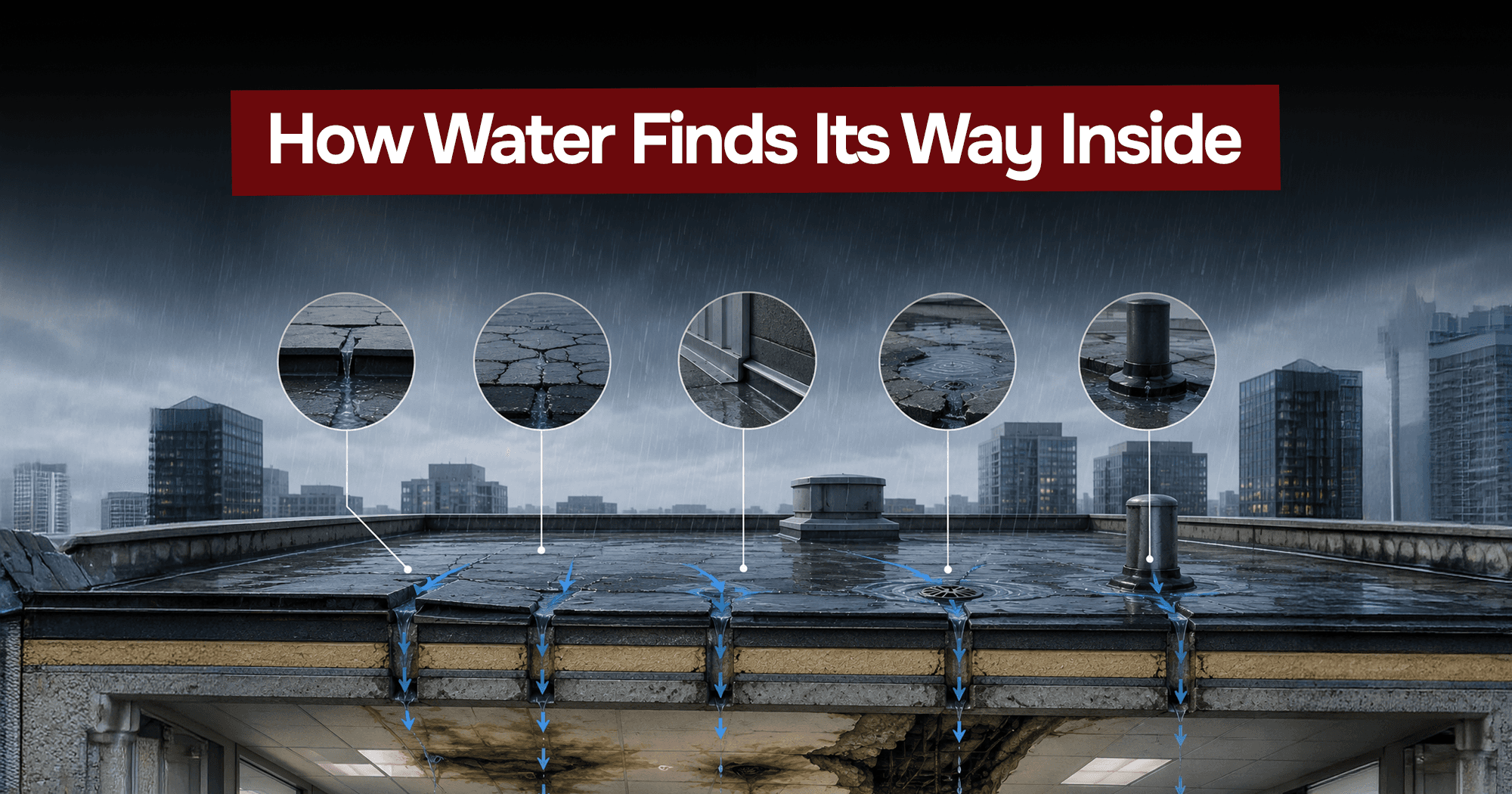
Flat and low-slope commercial roofs do not shed water the way a steep residential roof does. Water lingers, works into every seam and micro-crack, and takes advantage of any weakness. In South Florida the pressure is nearly constant. The most common causes of commercial roof water damage include heavy rainfall that overwhelms drainage and forces water across the entire surface; storms and hurricanes that drive wind and rain sideways, lift edges, and stress every seam; standing (ponding) water that sits for hours or days and slowly degrades the membrane beneath it; roof membrane deterioration from years of UV exposure and thermal cycling; cracks and punctures from foot traffic, dropped tools, and debris; failed flashing around walls, curbs, and penetrations; damaged or open seams where sheets of membrane were joined; aging roofing materials that have simply reached the end of their flexible life; poor drainage that lets water pool instead of leaving the roof; and high humidity and moisture exposure that keep the entire assembly damp and accelerate breakdown.
Any one of these can start a leak. In combination — which is the norm on an older South Florida roof — they make water intrusion a question of when, not if. Proactive commercial roof water damage prevention through waterproofing addresses these failure points before water reaches the insulation and interior, where repairs are far more disruptive and expensive.
Signs Your Commercial Roof Needs Waterproofing
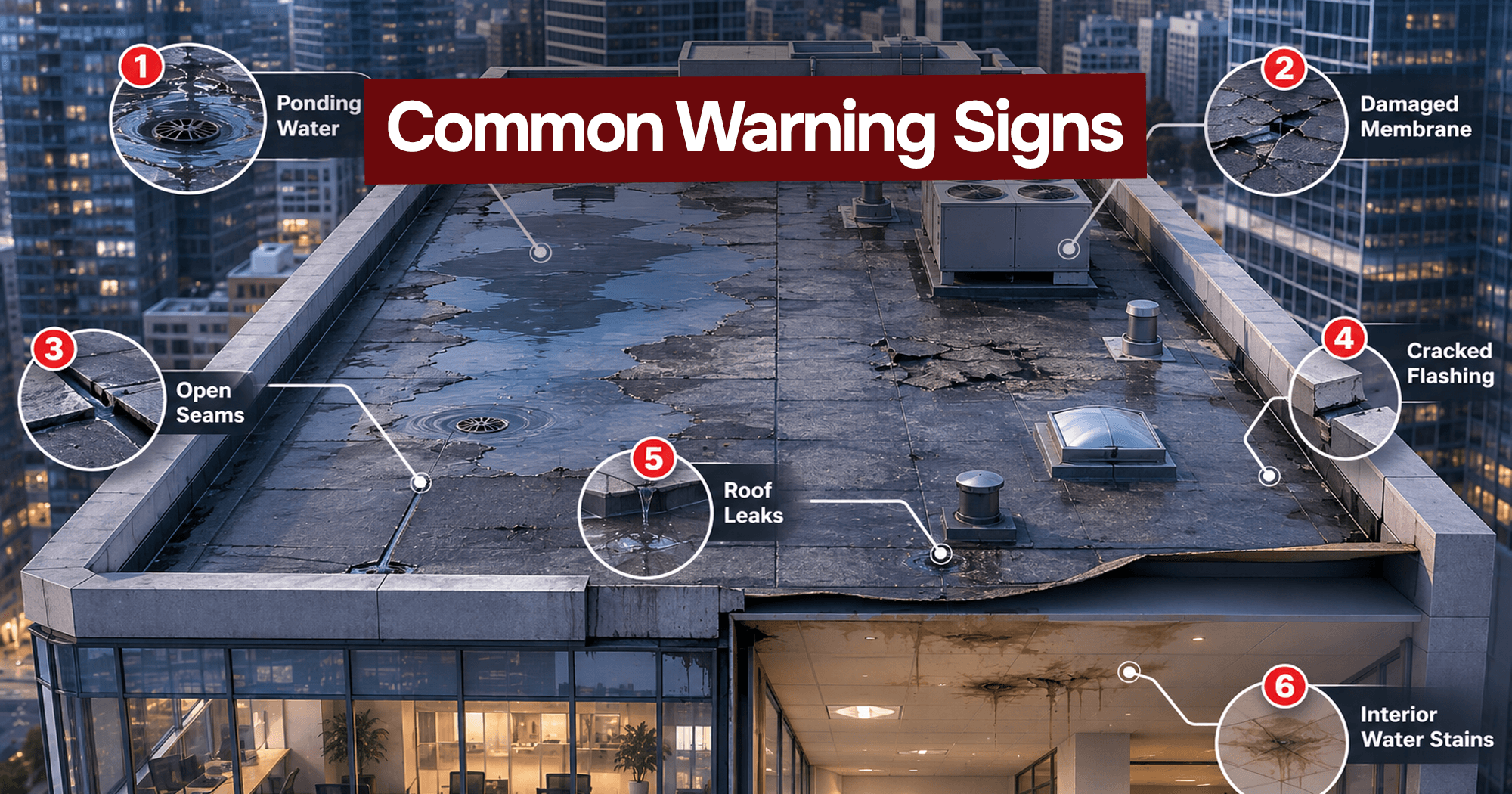
Roofs rarely fail without warning. The signals below usually appear well before a major leak, and catching them early is the difference between a manageable waterproofing project and a costly interior restoration.
Recurring Roof Leaks
If the same area leaks after every heavy rain — or you find yourself paying for the "same" repair more than once — the underlying problem is not being solved. Repeated leaks point to a waterproofing failure, not an isolated defect, and commercial roof leak prevention requires treating the source rather than the symptom.
Cracked or Damaged Roofing Materials
Visible cracking, blistering, splitting, or brittleness in the membrane or surface material means the roof has lost its flexibility and its ability to keep water out. These openings only widen with continued thermal cycling.
Ponding Water
Water that remains on the roof more than 48 hours after rain is a serious red flag. Ponding accelerates membrane breakdown, adds structural load, and is one of the most common precursors to a leak.
Damaged Roof Seams
Seams are where separate sections of membrane are joined, and they are among the most vulnerable points on any commercial roof. Open, lifted, or deteriorated seams are direct pathways for water.
Deteriorated Flashing
Flashing seals the transitions where the roof meets walls, curbs, and penetrations. When it cracks, pulls away, or corrodes, water follows those edges straight into the assembly.
Water Stains on Interior Ceilings
Brown rings, discoloration, or damp patches on ceilings and upper walls mean water has already made it inside. By this stage the intrusion is active and spreading.
Mold and Mildew Growth
Musty odors or visible mold on interior surfaces indicate persistent moisture — a sign that water is entering and staying, with implications for both the building and indoor air quality.
Damaged Roof Membrane
Tears, punctures, shrinkage, or areas where the membrane has separated from the substrate compromise the roof's primary defense and call for prompt commercial roof leak repair as part of a broader waterproofing plan.
Commercial Roof Waterproofing Systems and Solutions
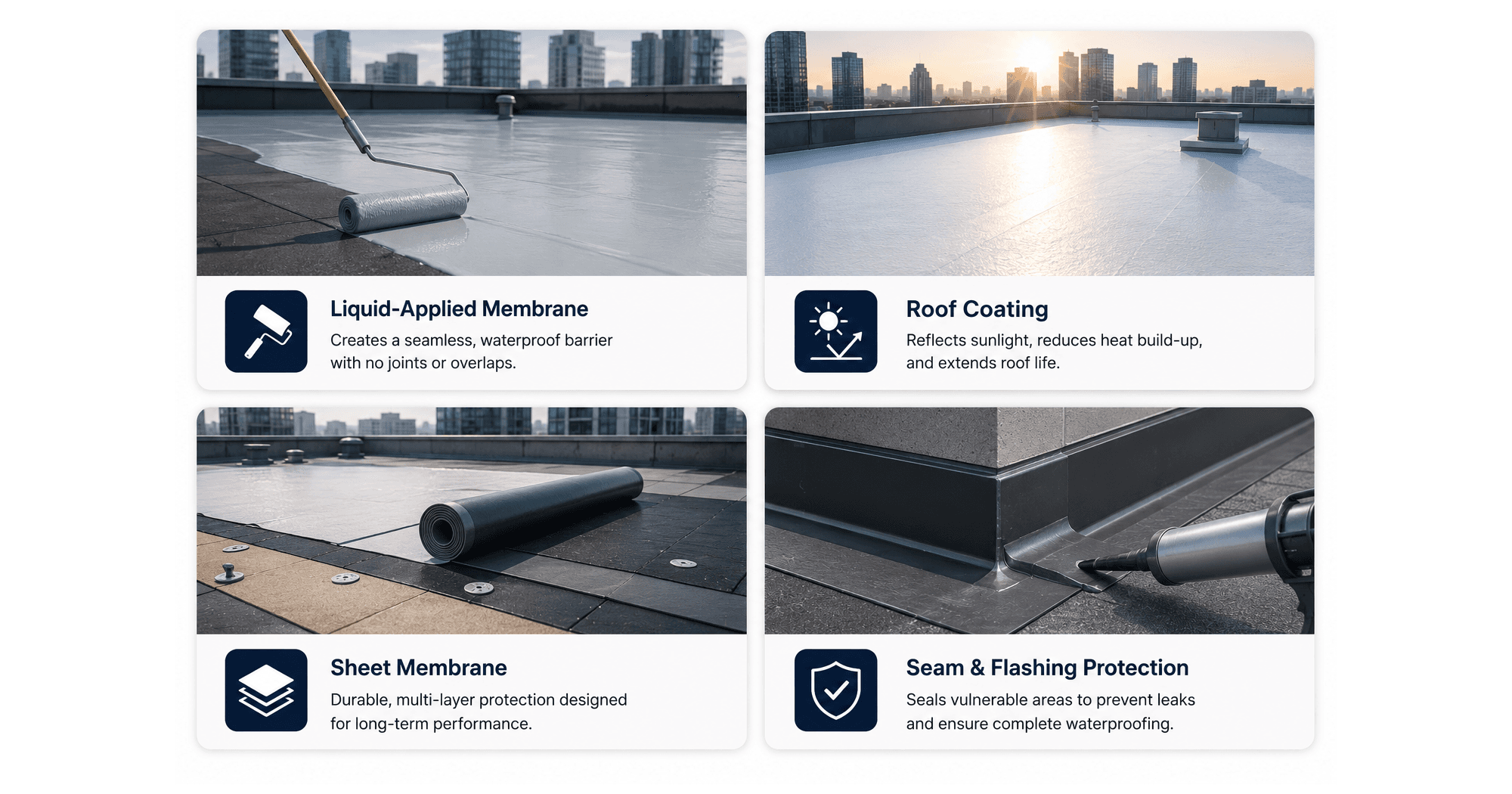
There is no single "best" waterproofing product — the right choice depends on the roof's material, condition, slope, drainage, and how the building is used. A qualified contractor evaluates all of that before recommending a system. The main approaches used on commercial roofs include the following.
Liquid-Applied Waterproofing
Liquid-applied membranes are rolled, brushed, or sprayed on and cure into a single seamless layer. Because there are no seams, there are no pre-made weak points, which is a major advantage on roofs with complex shapes, many penetrations, or irregular details. The finished membrane is flexible, moves with the building through thermal cycling, and conforms tightly to curbs, drains, and transitions.
Commercial Roof Coatings
A commercial roof coating is a fluid-applied protective layer used to restore and extend the life of an existing roof. The common families are acrylic coatings, valued for reflectivity and cost-effectiveness; silicone coatings, which excel at resisting ponding water and UV; and elastomeric coatings, which stretch and recover with the roof's movement. Many of these coatings are highly reflective, lowering rooftop temperatures and easing the cooling load in a hot climate. Coatings are especially well suited to roof restoration and maintenance applications where the underlying roof is still sound but needs renewed protection.
Waterproof Membranes
Sheet membrane systems are manufactured in rolls and installed over the roof. The common types are EPDM (a durable synthetic rubber), TPO (a reflective thermoplastic), PVC (strong and chemical-resistant), and modified bitumen (an asphalt-based system installed in layers). Membrane systems can be appropriate when a roof needs a robust, proven surface and the seams can be properly welded or adhered — though those seams are exactly the details that later require attention.
Seam and Joint Waterproofing
Because seams and joints are the most failure-prone areas of a commercial roof, they often receive dedicated reinforcement — sealants, tapes, or reinforcing fabrics embedded in a liquid membrane — to lock them against water intrusion.
Flashing and Penetration Waterproofing
Every drain, vent, pipe, skylight, and HVAC curb interrupts the roof surface and needs its own watertight detail. Flashing and penetration waterproofing seals these transitions so water cannot track down the sides of a penetration and into the building.
Drainage and Ponding Water Solutions
Waterproofing is only as good as the roof's ability to shed water. Addressing drainage — clearing or adding drains, installing tapered insulation to create slope, or correcting low spots — eliminates the standing water that undermines every other part of the system.
Together these commercial roof waterproofing systems and solutions form a layered defense, and the most durable results usually combine several of them into one engineered approach.
Commercial Roof Waterproofing vs. Roof Coating
Property owners often use "waterproofing" and "roof coating" interchangeably, but they are not the same thing, and understanding the difference helps you choose correctly.
| Feature | Roof Coating | Roof Waterproofing |
|---|---|---|
| Main purpose | Protect and extend the existing roof surface | Prevent water intrusion into the building |
| Application | Applied over the existing roof | Depends on the system selected |
| Seam protection | Yes, depending on the system | Strong, dedicated focus |
| Leak prevention | Can help | The primary objective |
| Best application | Roof restoration and protection | Water intrusion prevention |
In short, a coating is chiefly about restoring and protecting a roof that is still in decent shape, while waterproofing is chiefly about keeping water out. The two frequently work together — a coating applied as part of a waterproofing system delivers both. The appropriate solution depends on the roof's existing condition, its material, its drainage, and the extent of any damage, which is why a professional assessment matters before committing to either.
Our Commercial Roof Waterproofing Process
At Basile Contractors, waterproofing follows a disciplined sequence so nothing is sealed over without first being understood and repaired. Our process moves through these stages:
First, a thorough roof inspection to document the roof's construction, age, and overall condition. Next, a moisture and damage assessment to find where water has already penetrated and how far it has traveled. We then identify leak sources precisely, so the work targets root causes rather than symptoms. Surface preparation follows — cleaning, drying, and priming the roof so the new system bonds properly. We complete any necessary crack, seam, and flashing repairs, closing the specific failure points that let water in. Then comes the waterproofing system application, installing the membrane or system selected for that roof. A protective roof coating is applied where appropriate to add reflectivity and extend service life. Finally, a final quality inspection verifies that every seam, penetration, and detail is sealed and the roof is watertight.
As a licensed South Florida roofing contractor, Basile provides commercial roof waterproofing services with the same attention to detail on a small warehouse as on a large multi-tenant property — and our commercial roof waterproofing contractors document the work at each stage so owners know exactly what was done and why.
Benefits of Commercial Roof Waterproofing
Waterproofing a commercial roof protects far more than the roof itself. A properly designed and installed system prevents water intrusion at the source and reduces roof leaks before they start. It protects the insulation and interior spaces from moisture, helps prevent structural damage to the deck and framing, and extends the roof's service life so you delay the far larger cost of replacement. It reduces ongoing maintenance and repair costs, protects the inventory, equipment, and tenants inside, and improves the building's overall protection against South Florida's weather. It helps maintain property value by keeping the building sound and marketable. And when reflective coatings are part of the system, it can improve energy performance by lowering rooftop temperatures and easing the cooling load. Taken together, commercial roof waterproofing is one of the highest-return investments a property owner can make in a building's long-term health.
Not sure which repair your building needs?
Walk the building with a licensed restoration contractor before you write a scope.
When Should You Choose Roof Waterproofing Instead of Roof Replacement?
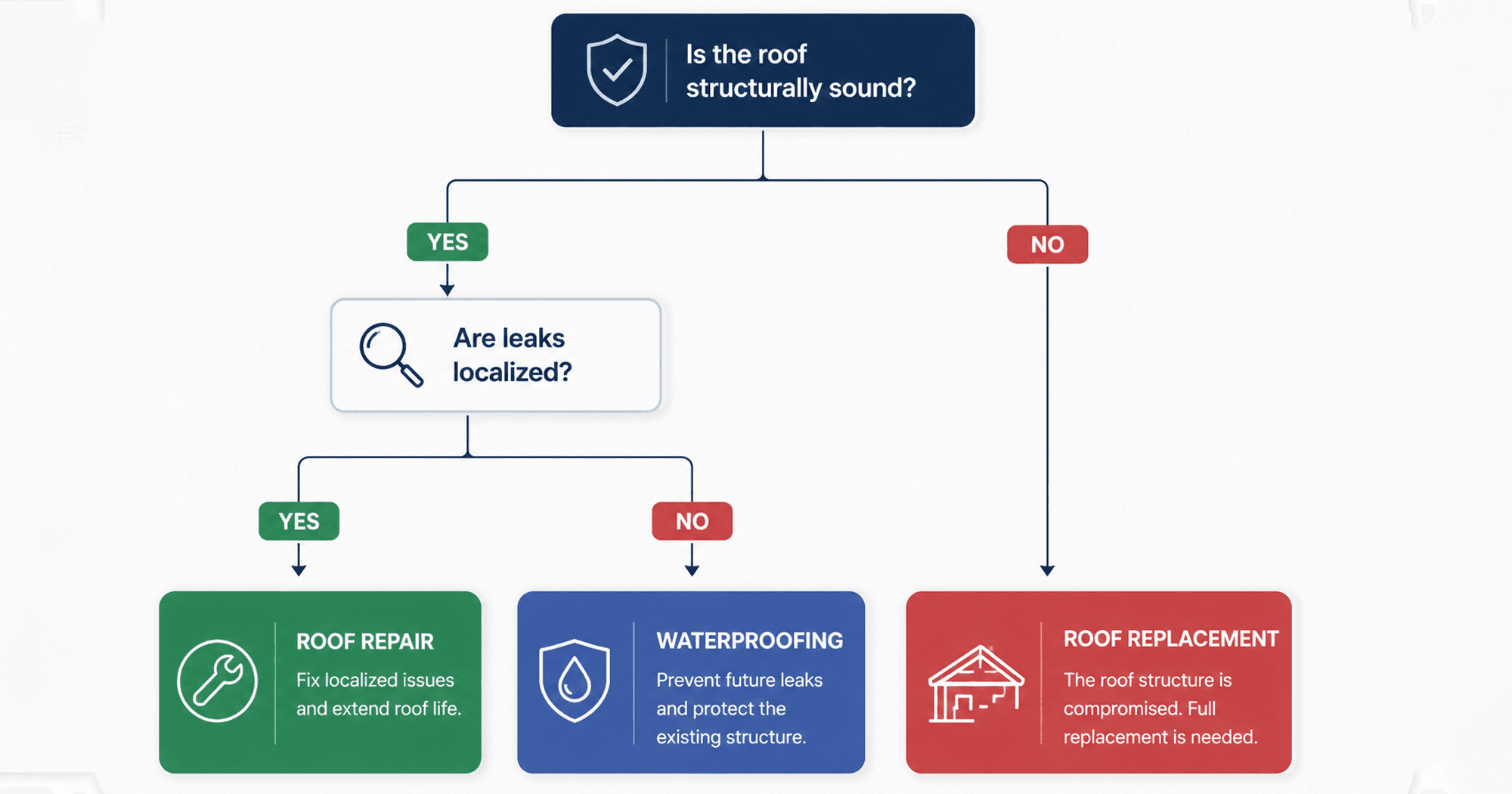
Replacing a commercial roof is a major capital expense, and it is not always necessary. Waterproofing or coating is often the smarter choice when the roof is structurally sound, the damage is localized rather than widespread, the roof still has useful service life remaining, the leaks are traced to seams, cracks, or surface deterioration that can be sealed, and the owner's goal is to extend the roof's life cost-effectively. In those situations waterproofing restores performance for a fraction of replacement cost.
Replacement becomes the more appropriate path when there is extensive structural deterioration, severe or system-wide membrane failure, repeated major leaks that resist repair, widespread water damage that has compromised the deck and insulation, or a roof that has simply reached the end of its service life. A professional inspection is what tells you which category your roof falls into — and a reputable contractor will tell you honestly when waterproofing is not enough.
Commercial Roof Leak Repair vs. Waterproofing
It helps to be clear about the difference between fixing a leak and waterproofing a roof. Commercial roof leak repair addresses an existing, identified problem — a specific tear, open seam, or failed flashing detail that is letting water in right now. Waterproofing provides broader protection against future water intrusion across the whole roof, not just at the point that happens to be leaking today.
The two are related. Repairs are frequently part of a complete waterproofing project — you fix the active failures first, then seal the entire surface so new ones do not open up. The trap owners fall into is paying for repeated one-off repairs without ever addressing the underlying waterproofing condition. Each repair looks cheap in isolation, but the recurring cost — plus the interior damage between fixes — usually exceeds what a proper waterproofing system would have cost in the first place.
How Much Does Commercial Roof Waterproofing Cost?
There is no single price for commercial roof waterproofing because every roof is different. Cost is driven by a combination of factors, each of which can move the estimate up or down:
| Cost Factor | Impact on Price |
|---|---|
| Roof size | Larger roofs require more materials and labor |
| Roof material | Different systems require different preparation |
| Roof condition | Existing damage that must be repaired increases cost |
| Waterproofing system | Materials and application methods vary widely |
| Accessibility | Hard-to-reach roofs require additional labor |
| Drainage problems | Ponding water may require added corrective work |
| Existing coatings | Removal or special preparation may be required |
| Building height | Affects access, equipment, and safety requirements |
Because these variables interact, the only way to get an accurate number is a professional roof inspection. A reputable contractor evaluates the roof in person, identifies what actually needs to be done, and provides a written estimate — rather than quoting a per-square-foot figure sight unseen.
How Long Does Commercial Roof Waterproofing Last?
The lifespan of a waterproofing system depends on more than the product on the label. The main factors are the waterproofing system selected, the quality of the installation, the roof's condition going in, the level of weather and UV exposure, how well the roof is maintained, the effectiveness of its drainage, the amount of foot traffic it sees, and whether it receives regular inspections.
A well-chosen system that is properly installed and maintained protects a roof for many years, while a rushed installation over an unprepared surface can fail quickly regardless of the material's rated life. Rather than promise a universal number, a trustworthy contractor will explain the expected service life based on the specific system and any manufacturer warranty that applies to your roof.
Common Commercial Roof Waterproofing Mistakes
Many premature roof failures trace back to avoidable errors. The most common include the following.
Ignoring Small Leaks
A minor leak is rarely minor for long. Left alone, it spreads through insulation and decking and becomes a structural problem.
Applying Coatings Without Proper Preparation
A coating or membrane bonds only as well as the surface beneath it. Skipping cleaning, drying, and priming guarantees early failure no matter how good the product is.
Choosing the Wrong Waterproofing System
Matching the system to the roof's material, slope, and drainage is critical. The wrong system on the wrong roof will not perform, however well it is installed.
Ignoring Ponding Water
Sealing over standing water without fixing drainage traps the problem underneath and lets it keep working on the roof.
Using Inexperienced Contractors
Waterproofing is detail work. Poorly welded seams, sloppy flashing, and missed penetrations are exactly where leaks return.
Skipping Regular Roof Inspections
Without inspections, small problems stay invisible until they are large, expensive ones.
Delaying Necessary Roof Repairs
Putting off repairs to save money in the short term almost always costs more once water reaches the interior.
Best Practices for Long-Term Commercial Roof Protection
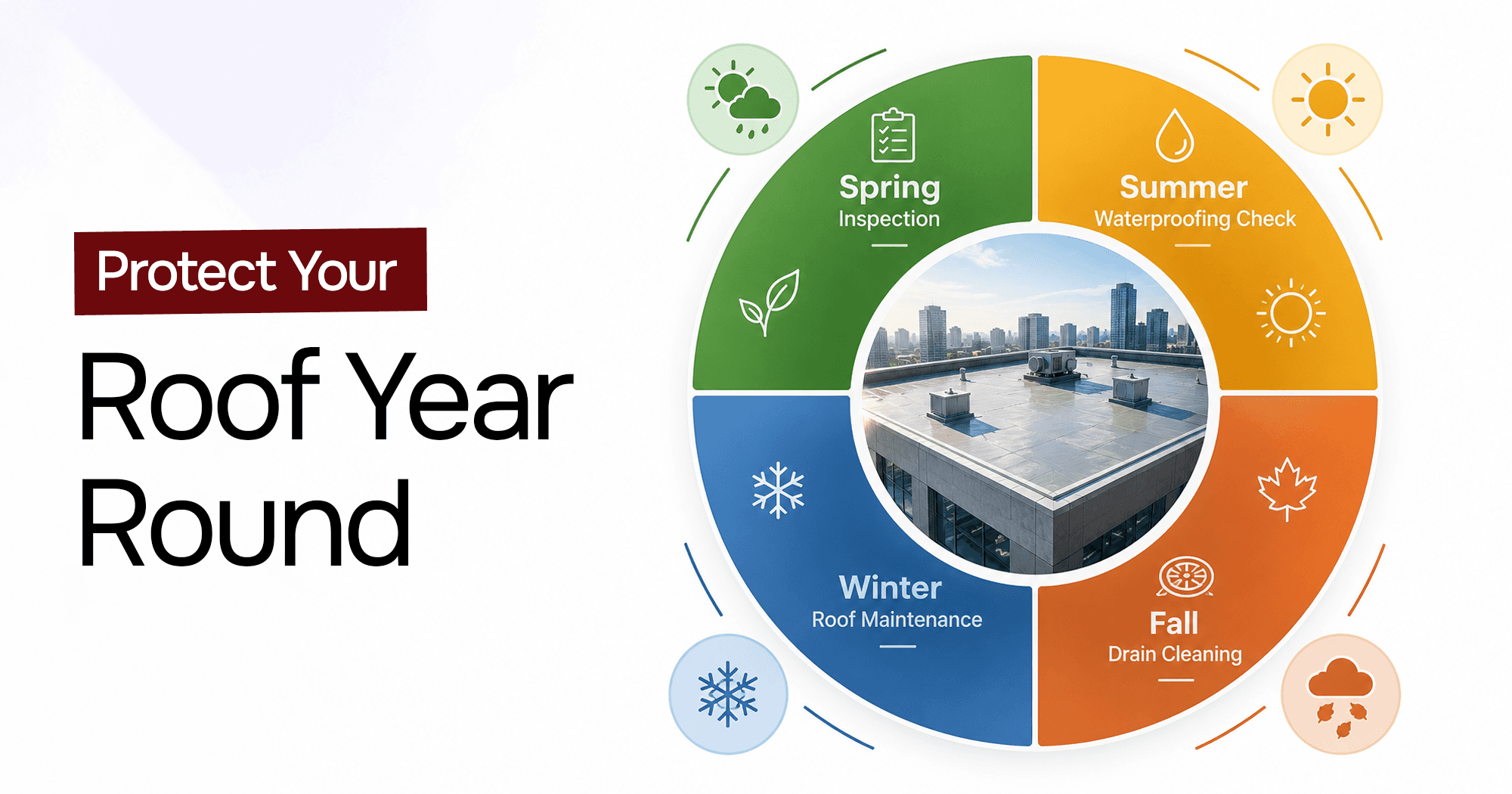
Waterproofing is not a one-time event — it is protected and extended by good habits. The practices that keep a commercial roof watertight over the long run include the following.
Schedule Regular Roof Inspections
Have the roof professionally inspected on a regular schedule, and always after major storms, so problems are caught early.
Keep Roof Drains Clear
Clogged drains cause ponding. Keeping drains, scuppers, and gutters clear is one of the simplest, highest-value maintenance tasks.
Repair Leaks Promptly
Address any leak as soon as it appears, before it can spread into insulation and structure.
Inspect Flashing and Seams
Check the roof's most vulnerable details — flashing and seams — routinely, since these fail first.
Maintain Roof Coatings
Reapply or touch up coatings on schedule so the protective layer never wears thin enough to expose the roof.
Address Ponding Water
Correct drainage issues rather than living with standing water that quietly degrades the roof.
Follow a Preventive Maintenance Plan
A documented maintenance plan — inspections, cleaning, and timely repairs — is what turns a good waterproofing job into decades of protection.
Why Choose Basile Contractors for Commercial Roof Waterproofing?
Basile Contractors brings more than 25 years of experience protecting South Florida commercial and condominium properties. We are a licensed Florida roofing contractor (license #CCC1511747), fully insured and bonded, carrying both general liability and workers' compensation coverage. Our team is ICRI Certified, OSHA compliant, and manufacturer-certified, and we bring deep commercial roofing and waterproofing expertise to every project — from selecting the right system for a specific roof to executing the seam, flashing, and penetration details that determine whether waterproofing actually holds.
We use quality materials, follow strict safety compliance on every rooftop, and begin every engagement with a professional inspection rather than a generic quote. Because we work exclusively in South Florida, we understand precisely what this climate does to a commercial roof and design customized waterproofing solutions to match. As experienced commercial roof waterproofing contractors, Basile delivers commercial roof waterproofing services built to keep water out for the long term.
Service Areas
Basile Contractors provides commercial roof waterproofing across South Florida, serving Broward County and Miami-Dade County. Our service area includes Fort Lauderdale, Miami, Hollywood, Pompano Beach, Deerfield Beach, Pembroke Pines, Coral Springs, Davie, Plantation, and Miramar, along with the surrounding communities. If you own or manage a commercial property anywhere in Broward or Miami-Dade, our team can inspect your roof and recommend the right waterproofing approach.
Protect Your Commercial Roof Before the Next Leak
The most expensive roof problem is the one you wait on. If your building shows any of the warning signs in this guide — recurring leaks, ponding water, damaged seams, or interior stains — the time to act is before the next storm, not after. A professional roof inspection identifies exactly what your roof needs and matches it to the right waterproofing or coating solution.
Call Basile Contractors at (352) 657-8653 to schedule a commercial roof inspection and waterproofing consultation. We will assess your roof honestly and recommend the most cost-effective way to keep it watertight.
Conclusion
Commercial roof waterproofing is a core part of long-term building protection, especially in a climate as demanding as South Florida's. Water intrusion is not just a nuisance — it leads to leaks, interior damage, mold, and costly repairs that ripple far beyond the roof itself. The right roof coating or waterproofing system, applied to a roof that is a good candidate for it, seals those pathways and extends the life of the entire assembly.
The through-line is proactivity. Regular inspections and maintenance catch small problems before they become major ones, and a professional assessment is what determines the correct solution for your specific roof — waterproofing, coating, targeted repair, or, when the roof has truly reached its end, replacement. Whatever your roof needs, the smartest first step is an expert inspection. Contact Basile Contractors for a commercial roof inspection or waterproofing consultation and protect your building before the next leak starts.
Frequently asked questions
Updated: October 8, 2026