Balcony Waterproofing for Commercial Buildings: How to Prevent Leaks & Structural Damage
How commercial balcony waterproofing prevents leaks and structural damage — membranes, repair methods, installation, drainage, cost factors, and maintenance for Florida buildings.
By Luigi Basile
President
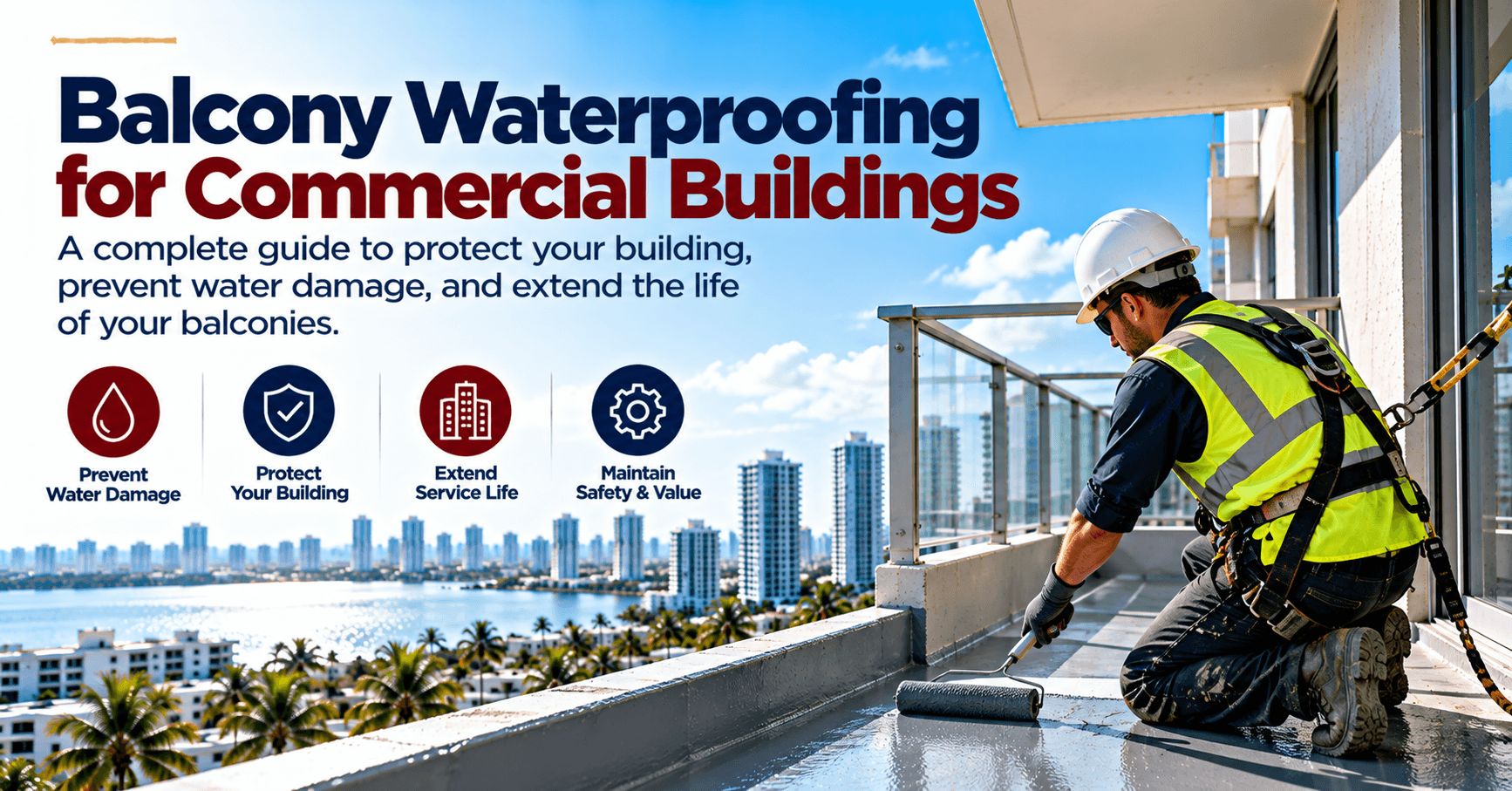
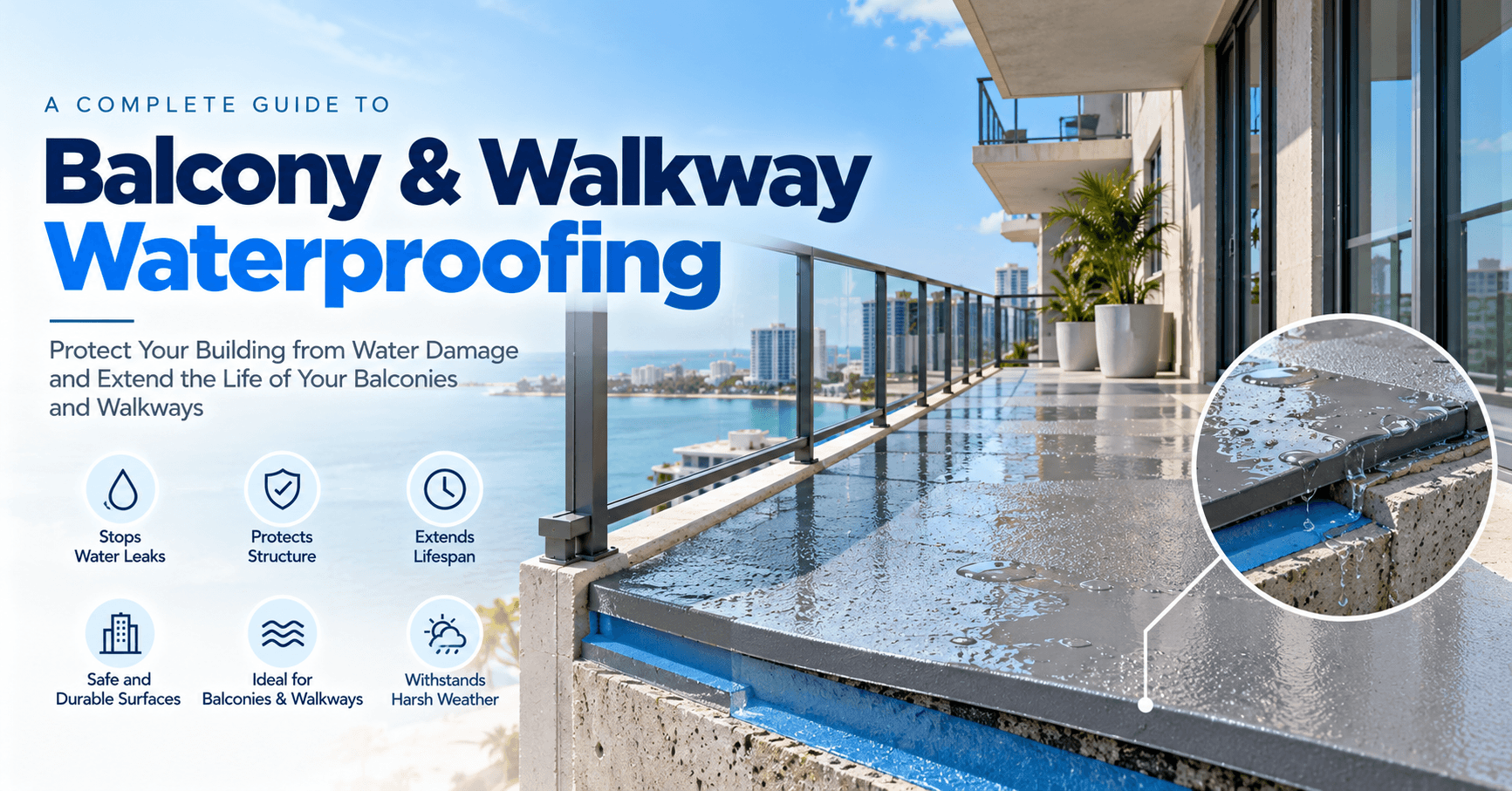
Balconies are among the most exposed and most vulnerable parts of any commercial building. They sit out in the weather with no roof over them, take the full force of rain, sun, and — in South Florida — coastal salt air, and they carry water directly over occupied space below. When a balcony's waterproofing fails, water does not just stain a ceiling; it works its way into the concrete slab, reaches the reinforcing steel, and sets off the corrosion-and-spalling cycle that turns a maintenance issue into a structural one. Balcony waterproofing is how commercial property owners, condominium associations, and property managers prevent that: creating a continuous barrier that keeps water out of the balcony assembly and protects the concrete and structure beneath. This guide explains what balcony waterproofing is, why commercial balconies leak, the waterproofing systems available, how the work is done, what it costs, and when to bring in a professional.
The principle that runs through it all is that waterproofing is a system, not a coating — and it only works when the concrete beneath it is sound. Applying waterproofing over deteriorated concrete or an unresolved leak hides the problem briefly and then fails. Sound balcony waterproofing follows a logical chain: inspect, repair the underlying damage, prepare the surface, correct drainage, install the system, and maintain it.
What Is Balcony Waterproofing?
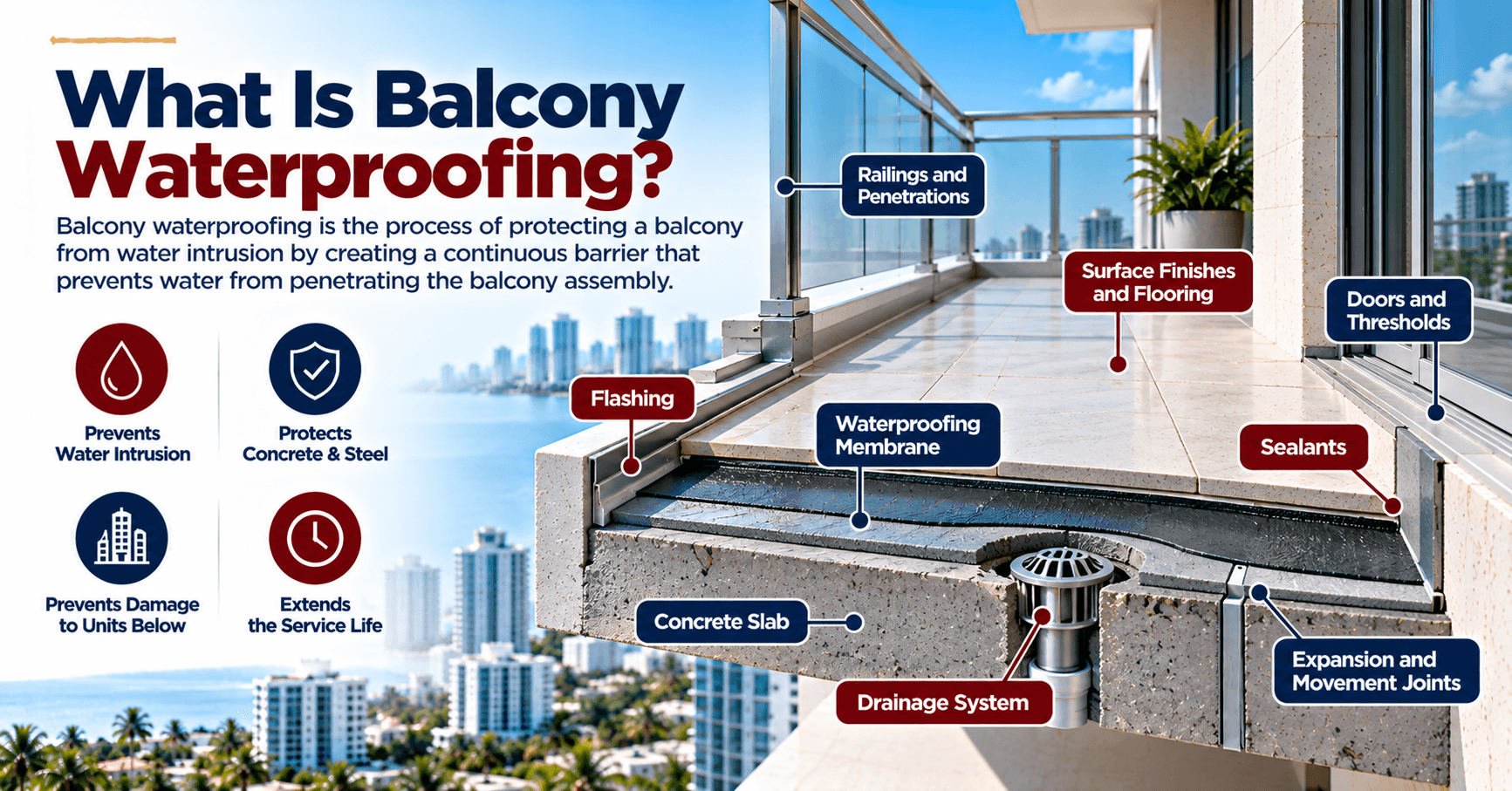
Balcony waterproofing is the process of protecting a balcony from water intrusion by creating a continuous barrier that prevents water from penetrating the balcony assembly. It matters because balconies are horizontal, exposed surfaces that collect water, and any water that gets into the slab can damage the concrete, the reinforcing steel, and the spaces below. Waterproofing is more than simply applying a coating — a decorative or protective coating alone is not a waterproofing system. True waterproofing works together with drainage, flashing, joints, sealants, and surface finishes to move water off the balcony and keep it out of the structure.
A commercial balcony is an assembly of interacting components: the concrete slab, the waterproofing membrane, the drainage system, flashing, sealants, expansion and movement joints, railings and penetrations, doors and thresholds, surface finishes, and the balcony flooring. Waterproofing is particularly important for commercial and multi-story buildings, where a single failed balcony can leak into units below, affect multiple components, and, if ignored, contribute to structural deterioration across the building.
Why Do Commercial Balconies Leak?
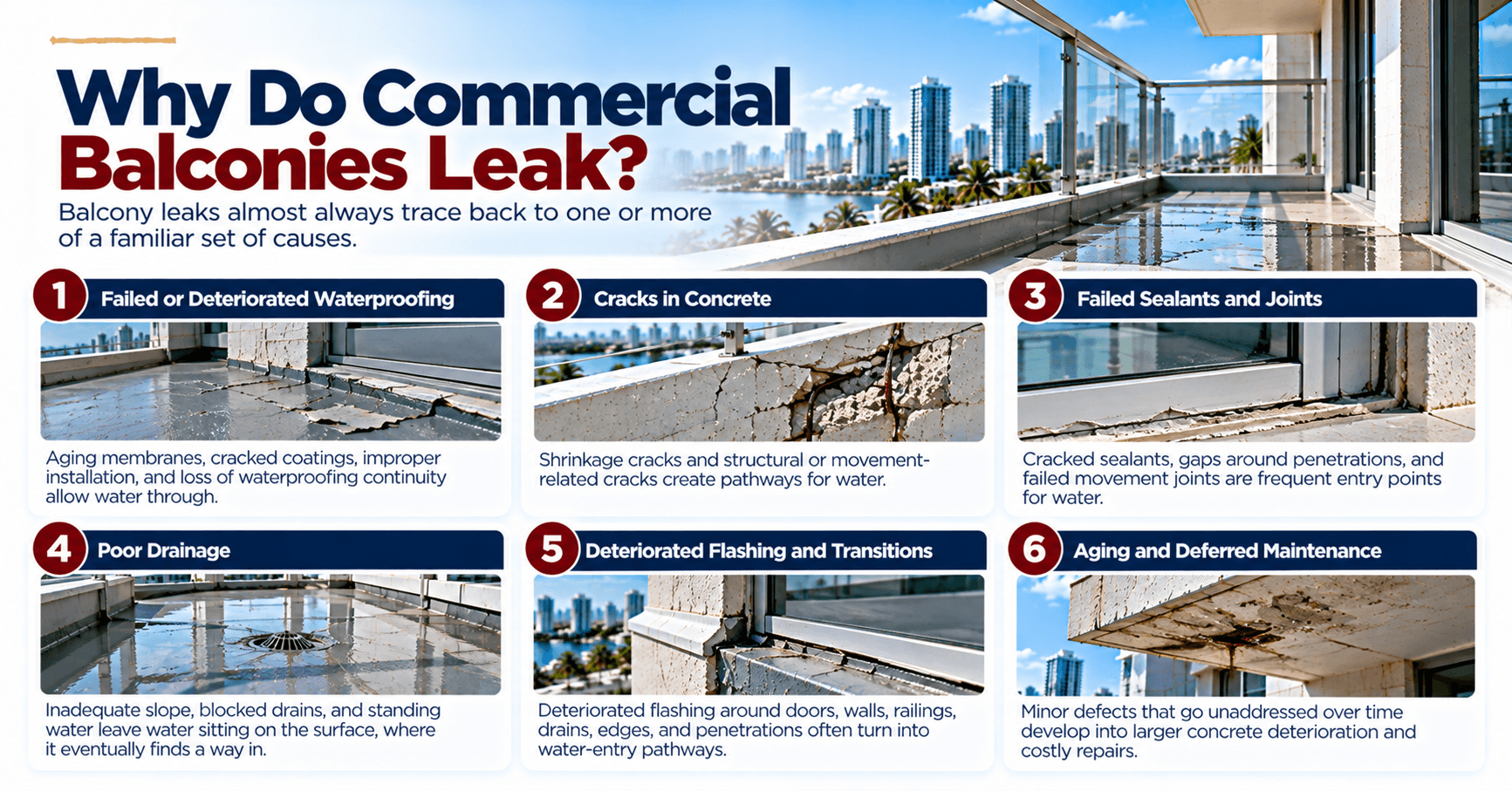
Balcony leaks almost always trace back to one or more of a familiar set of causes.
Failed or Deteriorated Waterproofing
Aging membranes, cracked coatings, membrane deterioration, improper installation, and any loss of waterproofing continuity all allow water through. Waterproofing is not permanent, and once it degrades, the balcony is exposed.
Cracks in Concrete
Shrinkage cracks and structural or movement-related cracks both create pathways for water. Because a crack can be a symptom of something larger, the cause of the cracking should be determined before waterproofing over it.
Failed Sealants and Joints
Cracked sealants, gaps around penetrations, failed movement joints, and deteriorated window and door perimeter sealants are frequent, easily overlooked entry points for water.
Poor Drainage
Inadequate slope, blocked drains, standing water, and improper drainage paths leave water sitting on the balcony surface, where it eventually finds a way in. Drainage problems defeat even good waterproofing.
Deteriorated Flashing and Transitions
The vulnerable transitions around doors, walls, railings, drains, edges, and penetrations are where waterproofing systems most often fail. Deteriorated flashing at these points turns them into water-entry pathways.
Aging and Deferred Maintenance
Finally, minor waterproofing defects that go unaddressed develop into larger concrete deterioration over time. Deferred maintenance is what turns a small, inexpensive repair into a major balcony restoration.
What Happens When a Commercial Balcony Is Not Waterproofed?
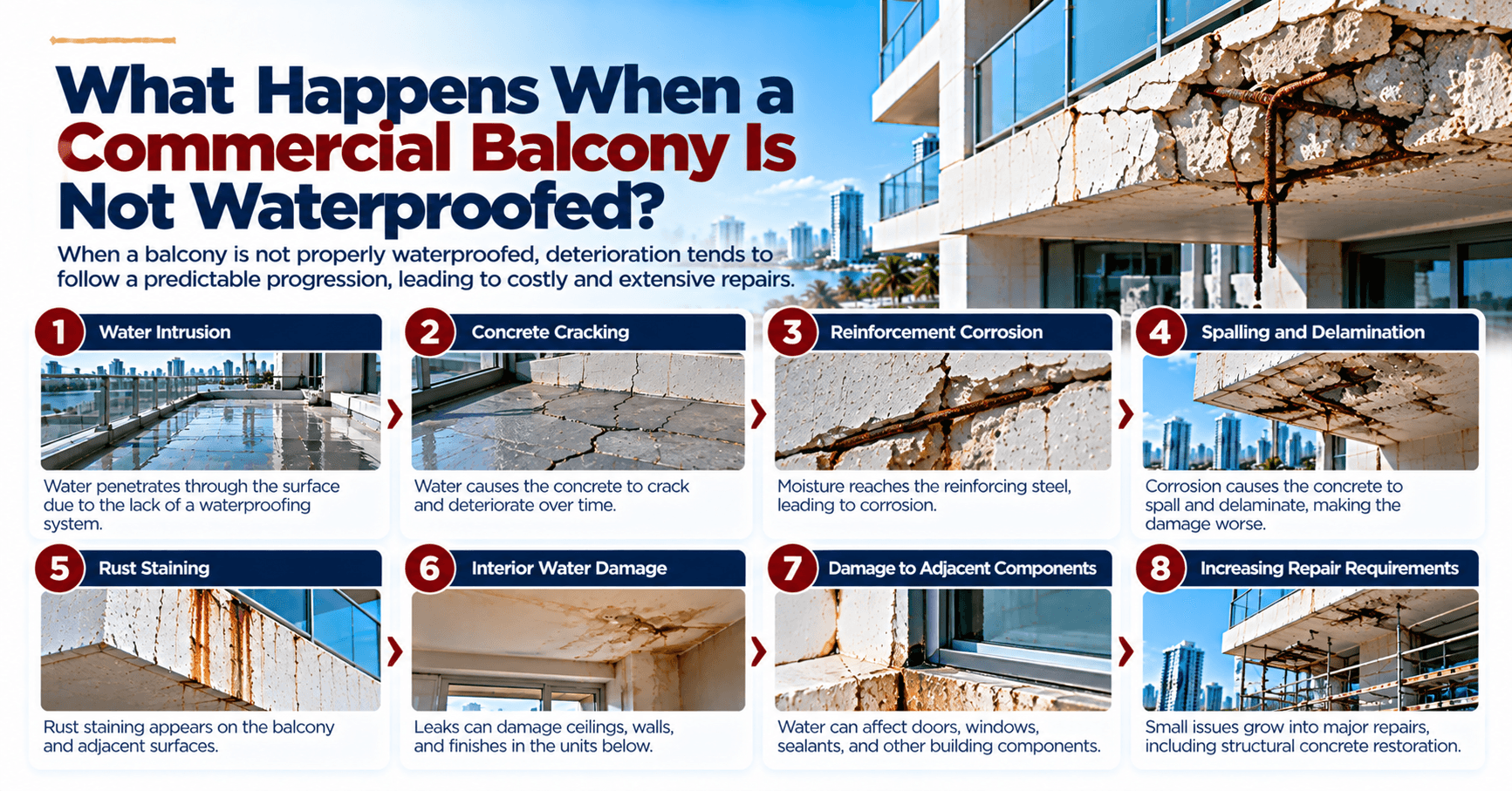
When a balcony is not properly waterproofed, deterioration tends to follow a predictable progression: water intrusion leads to concrete deterioration, which leads to reinforcement corrosion, which leads to spalling and more extensive repairs. Along the way, a building may see concrete cracking, concrete deterioration, reinforcing steel corrosion, rust staining, spalling, delamination, interior water damage, damage to adjacent building components, and steadily increasing repair requirements. What starts as a damp ceiling can end as structural concrete repair on the balcony slab. It is important to understand that once concrete deterioration is already present, waterproofing does not replace a structural assessment — the deterioration has to be evaluated and repaired, not simply sealed over.
Signs Your Commercial Balcony Needs Waterproofing
Balconies usually give warning before they fail completely.
Water Leaks or Interior Staining
Water appearing below balconies, ceiling stains, wall staining, damp areas, and recurring moisture after rain are the clearest signs that the waterproofing is no longer keeping water out.
Standing Water
Persistent ponding on a balcony indicates a drainage or slope problem, and standing water dramatically increases the chance of intrusion through any weakness.
Cracked or Deteriorated Coatings
Peeling, blistering, cracking, and loss of adhesion in the surface coating signal that the protective layer is failing and the assembly beneath may be exposed.
Concrete Cracks
Cracks in the balcony concrete create direct pathways for water to reach the slab and the reinforcement within it.
Rust Stains or Exposed Reinforcement
Rust staining and exposed reinforcing steel reveal that moisture has already reached the steel and corrosion is under way — a sign that water intrusion is well established.
Spalling or Delaminated Concrete
Visible spalling or delaminated concrete indicates that water intrusion has already contributed to deeper deterioration, and that repair, not just waterproofing, is likely needed.
Failed Sealants
Gaps, cracks, shrinkage, and separation of sealants from adjacent surfaces leave joints and transitions open to water and are a common source of commercial balcony leaks.
Balcony Waterproofing vs. Balcony Repair: What's the Difference?
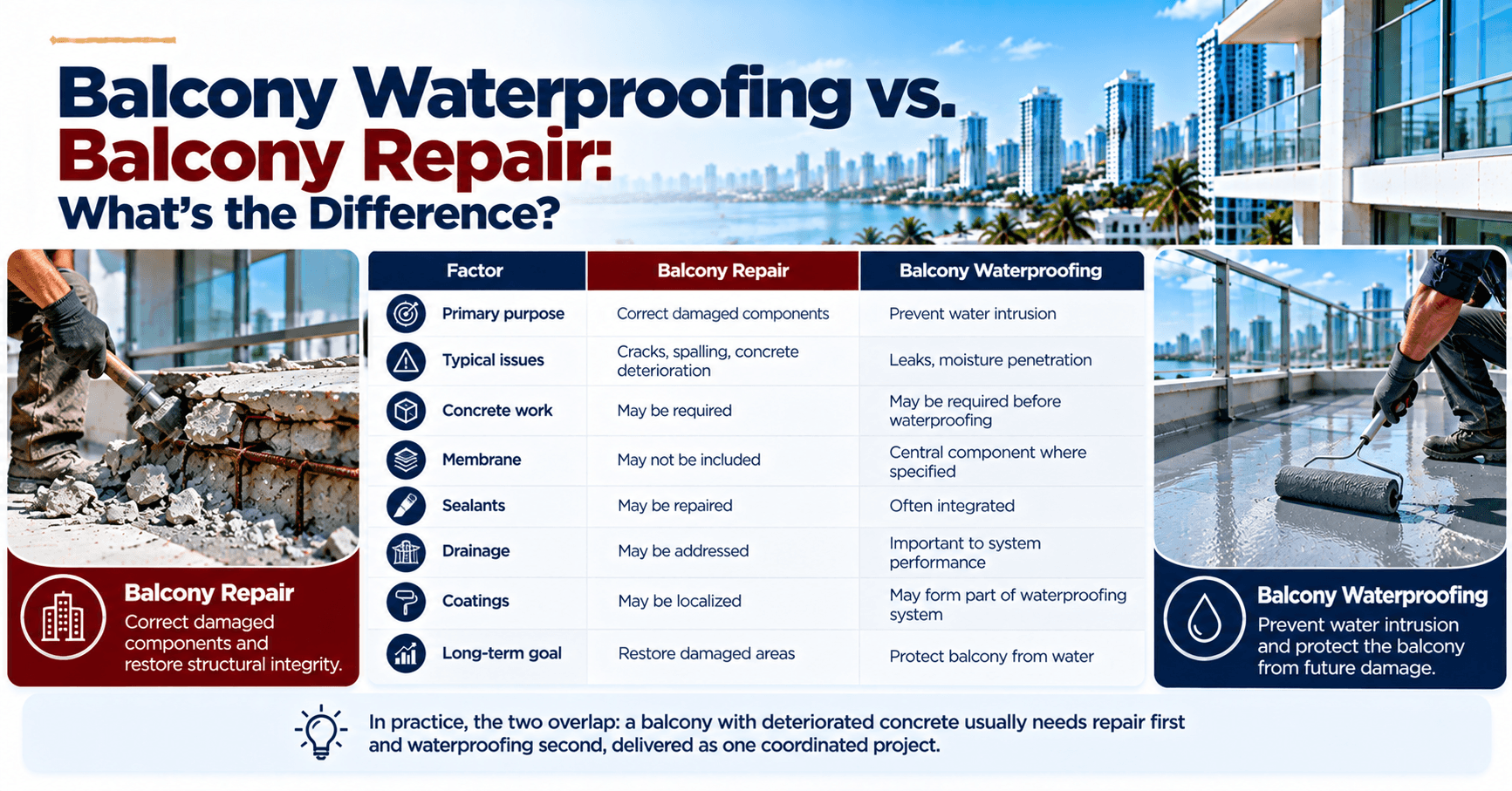
Balcony waterproofing and balcony repair are related but distinct, and the two often need to happen together.
| Factor | Balcony Repair | Balcony Waterproofing |
|---|---|---|
| Primary purpose | Correct damaged components | Prevent water intrusion |
| Typical issues | Cracks, spalling, concrete deterioration | Leaks, moisture penetration |
| Concrete work | May be required | May be required before waterproofing |
| Membrane | May not be included | Central component where specified |
| Sealants | May be repaired | Often integrated |
| Drainage | May be addressed | Important to system performance |
| Coatings | May be localized | May form part of waterproofing system |
| Long-term goal | Restore damaged areas | Protect balcony from water |
In practice, the two overlap: a balcony with deteriorated concrete usually needs repair first and waterproofing second, delivered as one coordinated project.
What Is a Balcony Waterproofing Membrane?
A balcony waterproofing membrane is the continuous, water-resistant barrier at the heart of most balcony waterproofing systems. It creates an unbroken layer that prevents water from reaching the concrete, and its performance depends heavily on proper substrate preparation and on compatibility with the existing balcony assembly. A membrane also has to be detailed correctly where it meets drains, edges, joints, and penetrations — the places most likely to leak. No single membrane type is universally best; the right choice depends on the substrate and the project.
| Membrane Type | Typical Characteristics |
|---|---|
| Liquid-applied | Applied to prepared surfaces for seamless coverage, with careful detailing around penetrations and defined curing requirements |
| Sheet-applied | Pre-manufactured membrane with seams and transitions that must be properly installed, suited to specific applications |
| Cementitious | Cement-based system appropriate for certain substrates and conditions, selected based on project requirements |
Liquid-Applied Waterproofing Systems
Liquid-applied systems are applied to prepared surfaces and cure into a seamless barrier, which makes them well suited to detailing around penetrations and irregular areas. They require proper surface preparation and curing to perform.
Sheet-Applied Membranes
Sheet-applied membranes are pre-manufactured products installed over the substrate, with particular attention paid to seams and transitions. They suit certain applications and require careful installation to maintain continuity.
Cementitious Waterproofing Systems
Cementitious, cement-based systems may be appropriate for certain substrates and conditions. As with all systems, selection depends on the substrate and the project requirements rather than a one-size-fits-all preference.
How to Waterproof a Balcony
Waterproofing a commercial balcony is a professional process, not a weekend project. It follows a clear sequence.
1. Inspect the Balcony
The existing waterproofing, concrete condition, cracks, spalling, drainage, slope, sealants, flashing, and penetrations are all assessed to establish what the balcony needs.
2. Identify and Repair Underlying Damage
Any underlying damage is repaired first — concrete repair, crack repair, spalling repair, reinforcement corrosion treatment, and remediation of a deteriorated substrate — so the waterproofing goes over sound material.
3. Prepare the Surface
The surface is then cleaned, loose materials removed, defects repaired, and the substrate brought to the condition the waterproofing system requires. Preparation is what allows the system to bond and last.
4. Address Drainage and Detailing
Drainage and detailing are corrected next — drain locations, balcony slope, edges, flashings, door thresholds, penetrations, and transitions — because the system can only perform if water is directed off the balcony.
5. Install the Waterproofing System
The waterproofing system is then installed to specification: primer where required, membrane application at the required thickness, and careful treatment of seams, corners, terminations, and penetrations.
6. Install Compatible Surface Protection
Compatible surface protection is applied over the membrane where specified — protective coatings, tile systems, pavers, or other approved balcony finishes — chosen to work with the waterproofing beneath.
7. Inspect and Maintain
Finally, a final inspection verifies the work, drainage is checked, and a maintenance schedule is established to protect the membrane, sealants, and drainage over time.
How Do You Waterproof a Balcony Floor?
Waterproofing a balcony floor specifically follows the same logic applied to the walking surface: inspect the existing floor, identify cracks and deterioration, remove unsuitable surface materials, repair the substrate, correct drainage and slope issues, install the appropriate waterproofing system, detail the edges and penetrations, apply compatible finish materials, and inspect the completed system. The exact method depends on the existing balcony construction and, importantly, on whether the waterproofing is located above or below the finished surface — an above-surface system and a below-tile system are installed and detailed differently. This is one of several reasons balcony floor waterproofing is best evaluated and performed by a professional.
How Much Does It Cost to Waterproof a Balcony?
There is no flat price for balcony waterproofing; cost varies considerably with the balcony's condition and the system used. The factors below drive the estimate.
| Cost Factor | Potential Impact |
|---|---|
| Balcony size | Larger areas require more materials and labor |
| Existing surface | Removal may increase project scope |
| Concrete condition | Repairs may be required before waterproofing |
| Waterproofing system | Different systems have different material and installation requirements |
| Surface preparation | Extensive preparation increases labor |
| Drainage | Drain or slope improvements can increase scope |
| Flashing | Damaged flashing may require replacement |
| Sealants | Extensive joint work adds labor |
| Accessibility | Difficult-to-access balconies can increase project complexity |
| Building height | May require specialized access equipment |
| Railings and penetrations | Additional detailing may be required |
| Finish flooring | New flooring adds to project scope |
| Repairs | Spalling or concrete deterioration can increase total cost |
Because these variables interact, an inspection is generally required before a reliable project estimate can be provided; a cost-per-square-foot figure quoted without seeing the balcony rarely reflects the real scope, especially where concrete repairs are involved.
What Factors Affect Commercial Balcony Waterproofing Costs?
On a commercial building with many balconies, cost is shaped by the number of balconies, building height, and balcony size; the existing waterproofing and any concrete deterioration; drainage and access; surface preparation; membrane selection; sealants, flashing, and railings; finish materials; required repairs; project phasing; and labor and materials. The practical takeaway is that addressing waterproofing problems early can sometimes substantially reduce the extent of future concrete restoration — because water kept out of the slab never gets the chance to corrode reinforcement and spall the concrete, which is far more expensive to repair than the waterproofing would have been.
Balcony Waterproofing and Concrete Spalling: What's the Connection?
Balcony waterproofing and concrete spalling are directly connected through a single mechanism: water intrusion leads to reinforcement corrosion, which causes concrete expansion and cracking, which results in spalling. On balconies, chloride exposure and moisture penetration reach the reinforcing steel, the steel corrodes and rusts, the rust expands and cracks the concrete, and the concrete delaminates and spalls. This is why waterproofing is so often part of a broader balcony restoration strategy when deterioration is already present — you repair the spalled concrete and treat the corrosion, then waterproof to stop the water that caused it in the first place. Waterproofing and concrete repair are two halves of the same solution on a deteriorated balcony.
Why Proper Balcony Drainage Matters
Even a high-quality waterproofing membrane performs poorly if water is not directed off the balcony. Proper drainage means positive drainage and adequate surface slope, correctly located and unblocked drains, no standing water, appropriate overflow considerations, sound drain-to-membrane transitions, and functioning edges and scuppers where applicable. Water that ponds on a balcony sits against every joint, edge, and penetration, testing the waterproofing continuously and finding any weakness. Getting drainage right is as important as the membrane itself, and it is a common reason waterproofing systems underperform when it is neglected.
How Long Does Balcony Waterproofing Last?
Service life varies, and no waterproofing system should be promised a fixed lifespan for every situation. How long a balcony waterproofing system lasts depends on the system itself, the quality of installation and surface preparation, UV and moisture exposure, coastal conditions, foot traffic, maintenance, drainage, sealant condition, and building movement. A well-chosen system, properly installed over a prepared and repaired substrate and maintained with regular inspections, protects a balcony for many years; a poorly installed one over standing water and deteriorated concrete fails far sooner. Regular inspections and maintenance are what allow deterioration to be caught and addressed before a major failure occurs.
How to Maintain a Waterproofed Commercial Balcony
Maintaining a waterproofed balcony is a matter of routine attention. A good program includes routine visual inspections, drain cleaning, crack monitoring, membrane and sealant inspections, flashing checks, coating inspections, standing-water checks, concrete condition monitoring, and prompt repair of minor defects. The distinction worth keeping in mind is between maintenance and waterproofing replacement: maintenance preserves and extends the life of an existing system by catching and correcting small problems, while replacement becomes necessary when the system has reached the end of its service life or failed. Consistent maintenance is what postpones replacement and prevents leaks in the meantime.
When Does Balcony Waterproofing Require Concrete Repair?
Waterproofing should never simply cover deteriorated concrete. Concrete repair is required before waterproofing when a balcony shows spalling, delamination, exposed reinforcement, rust staining, significant cracking, deteriorated concrete edges, failed previous repairs, or structural deterioration. In these cases the damaged concrete must be appropriately evaluated and repaired — and the reinforcement treated where corroded — before the waterproofing system is installed. Sealing over deteriorating concrete traps the problem beneath the membrane and guarantees the waterproofing will fail along with the concrete it was meant to protect.
Choosing a Commercial Balcony Waterproofing Contractor
The contractor you choose determines whether a balcony waterproofing system performs for years or leaks within months. When evaluating a balcony waterproofing contractor in Florida, property owners and boards should weigh several areas.
Experience With Commercial Balconies
Look for experience with commercial buildings, multi-story properties, concrete balconies, waterproofing systems, concrete restoration, structural repairs, and coastal environments. Commercial balcony work has demands general contracting does not necessarily cover.
Knowledge of Waterproofing Systems
A capable contractor understands membrane systems, surface preparation, drainage, sealants, flashing, detailing, and compatible coatings — and can explain how they work together on a specific balcony.
Safety and Access Capabilities
Because balcony work happens at height, evaluate the contractor's capabilities for elevated work — lifts, scaffolding, swing stages, fall protection, and building access planning.
Proper Licensing and Insurance
Verify licensing, insurance, safety credentials, and relevant experience before work begins. These protect the property owner and indicate a professionally run operation.
Detailed Scope of Work
A proposal should clearly explain the existing conditions, repair areas, surface preparation, waterproofing system, drainage, sealants, coatings, access, timeline, and maintenance recommendations. A clear, detailed scope is a strong indicator of competence.
Common Balcony Waterproofing Mistakes
Most premature waterproofing failures trace back to a handful of avoidable mistakes.
Applying Waterproofing Over Damaged Concrete
Sealing over spalling or deteriorated concrete traps the problem and guarantees the system will fail with the concrete beneath it.
Ignoring Existing Water Intrusion
Waterproofing without first finding and stopping an active leak leaves the underlying intrusion to keep causing damage.
Failing to Correct Drainage Problems
A membrane over poor drainage still leaves water ponding against every weakness, so drainage must be corrected as part of the work.
Poor Surface Preparation
Inadequate preparation prevents the system from bonding, leading to blistering, delamination, and early failure.
Ignoring Balcony Edges and Penetrations
Edges, drains, railings, and penetrations are where systems most often leak, so skipping their detailing undermines the whole installation.
Using Incompatible Materials
Materials that are not compatible with the substrate or with each other debond and fail; compatibility is essential across the system.
Treating Sealants as an Afterthought
Failed sealants at joints and transitions are a leading source of leaks, so they must be part of the system rather than an afterthought.
Choosing a System Based Only on Price
The cheapest system or bid often reflects a narrower scope or less suitable materials, and a failed balcony system is expensive to redo.
Failing to Maintain the Waterproofing System
Even a well-installed system fails early without maintenance; neglecting inspections and minor repairs shortens its life considerably.
How to Know When Your Commercial Balcony Needs Waterproofing
As a practical checklist, consider a professional balcony assessment if you see water leaks, interior water stains, or standing water; cracked coatings, peeling or blistering surfaces, or concrete cracks; rust staining, exposed reinforcement, spalling concrete, or delamination; failed sealants or deteriorated flashing; an aging waterproofing system or recurring leaks after repairs; poor balcony drainage; or coastal exposure. Visible damage does not automatically mean the entire balcony requires replacement — a professional assessment should determine the appropriate repair and waterproofing scope.
Why Professional Balcony Waterproofing Assessment Matters
A professional assessment is the foundation of any sound balcony waterproofing project. It identifies hidden water intrusion, determines the source of leaks, evaluates the concrete condition, and identifies drainage problems. It also assesses the existing waterproofing, determines the appropriate membrane or system, evaluates joints and transitions, plans surface preparation, identifies structural concerns, and develops a repair and maintenance strategy with an appropriate project scope. In short, the assessment turns a set of symptoms — a stain here, a crack there — into a clear, prioritized plan, which is why commercial balcony waterproofing should begin with a qualified professional evaluating the balcony rather than with assumptions about what it needs.
Not sure which repair your building needs?
Walk the building with a licensed restoration contractor before you write a scope.
Are Leaks Putting Your Commercial Balconies at Risk?
If your balconies are leaking, ponding water, showing cracked coatings, rust stains, or spalling concrete, a professional assessment can identify the source and the right solution before water reaches the structure. Basile Contractors helps commercial property owners, property managers, condominium associations, facility managers, building owners, and board members inspect, identify, repair, waterproof, and protect their balconies. Call (352) 657-8653 to schedule a commercial balcony waterproofing assessment.
See how our waterproofing service addresses these failures on occupied buildings.
Standards and further reading
Official standards and public sources on this topic:
- American Concrete Institute: repair of concrete, ACI's reference page on condition evaluation and repair, with the ACI 562 code and the ACI 546R guide.
- ICRI technical publications, the International Concrete Repair Institute's guidelines on surface preparation, corrosion repair and repair materials.
- WBDG: Integrity Testing for Roofing and Waterproofing Membranes, the methods used to test waterproofing membranes for leaks.
- Florida Statutes 553.899, the milestone inspection law for condominium and cooperative buildings of three or more stories.
Frequently asked questions
Updated: October 16, 2026