Commercial Concrete Restoration: Repair vs. Replacement for Aging Buildings
Should aging commercial concrete be repaired or replaced? How to judge condition, what facade and balcony restoration involve and what drives cost in South Florida.
When concrete on an aging commercial building starts to crack and spall, owners face a hard question: repair it, or replace it? The answer is not a matter of taste or budget alone. It depends on how much structural capacity remains, why the concrete is failing and whether a repair can fix the cause.
This guide explains the difference between concrete restoration, repair and replacement, how to judge which one a building needs, and what is specific to South Florida.
Why Commercial Concrete Restoration Matters
- It protects aging buildings from compounding damage.
- It keeps minor damage from becoming major damage.
- It maintains structural integrity.
- It protects property value.
- It extends the service life of concrete structures.
- It keeps conditions safe for occupants and visitors.
What Is Commercial Concrete Restoration?
Restoration vs. Repair
Concrete repair fixes a specific defect, such as a spall or a crack. Concrete restoration is broader. It repairs damage, treats the reinforcing steel, restores the surface and installs protection such as waterproofing and coatings so the damage does not return.
Structural vs. Cosmetic Restoration
Cosmetic work changes how concrete looks. Structural work restores its ability to carry load. Cosmetic patching over structural damage hides the problem without fixing it.
When Restoration Becomes Necessary
Restoration is needed when damage is widespread, recurring or associated with corroded steel. Aging buildings benefit from regular concrete inspections so that restoration can be planned instead of forced.
Common Causes of Concrete Deterioration
- Water intrusion and moisture.
- Corrosion of reinforcing steel. Rusting steel expands and breaks the concrete away.
- Cracking from movement, shrinkage or overload.
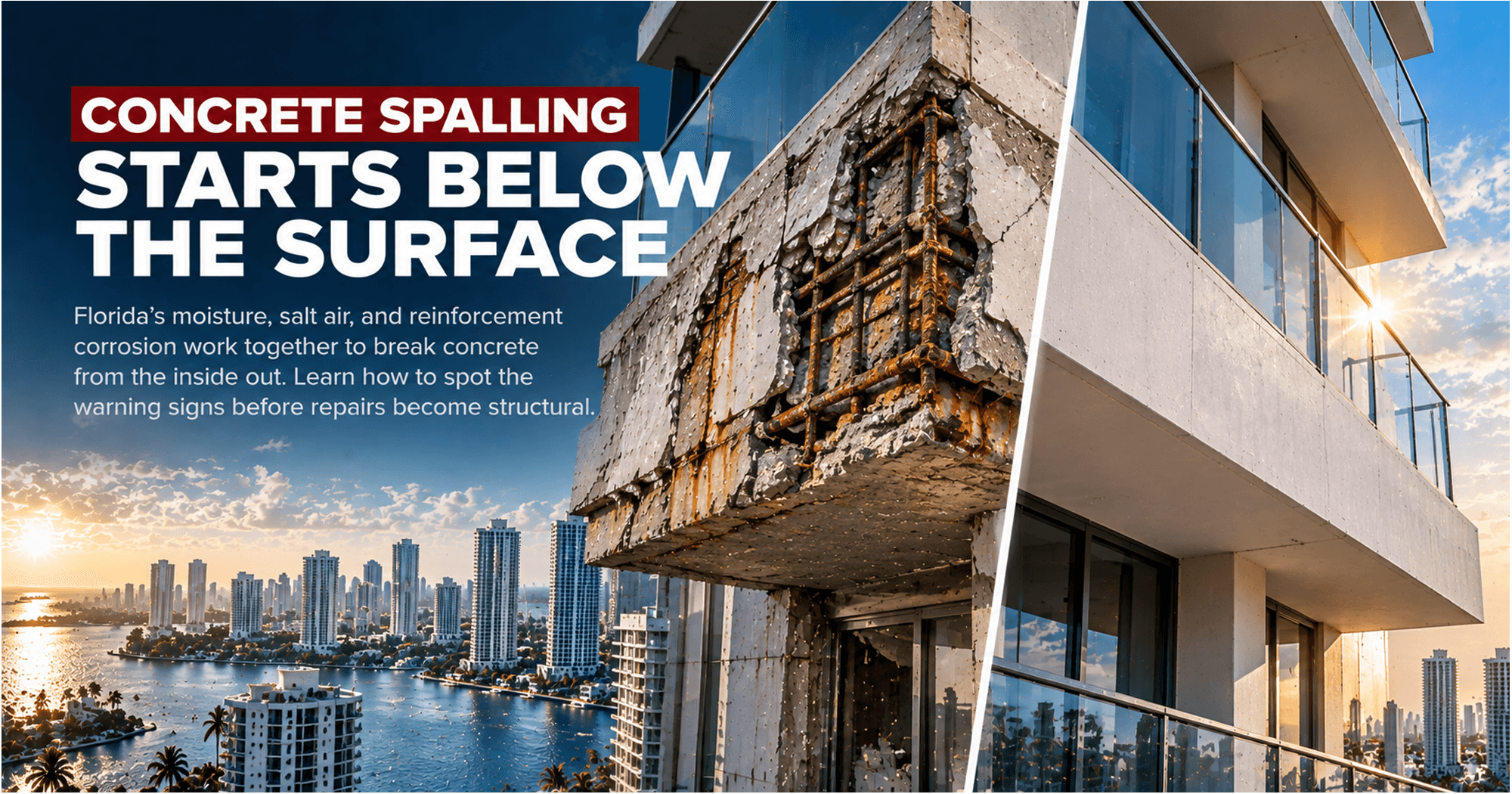
- Spalling, where pieces of concrete come off.
- Delamination, where layers separate below the surface.
- Original construction deficiencies, such as thin cover over steel.
- Weather and environmental exposure.
- Coastal salt and chlorides that accelerate steel corrosion.
- Lack of preventive maintenance.
Signs Your Commercial Building Needs Concrete Restoration
- Visible cracks.
- Spalling or flaking concrete.
- Exposed reinforcing steel.
- Rust staining.
- Hollow-sounding areas that suggest delamination.
- Water stains and moisture damage.
- Damaged balconies and concrete railings.
- Deteriorating facades.
- Repeated repairs in the same places.
Concrete Repair vs. Replacement
| Repair / restoration | Replacement | |
|---|---|---|
| What it is | Remove damaged concrete, treat steel, rebuild and protect | Remove and rebuild the element |
| When it fits | Damage is localized, structure is largely intact | Damage is extensive or capacity is compromised |
| Typical outcome | Extended service life with protection | New element with a fresh service life |
| Disruption | Usually lower | Usually higher |
| Decision basis | Professional assessment of condition and remaining life | Same, plus structural engineering input |
A professional assessment should come before the decision. Neither repair nor replacement is automatically cheaper over the long run.
When Should Aging Commercial Concrete Be Repaired?
- Surface-level cracks and minor damage.
- Limited spalling.
- Localized reinforcement corrosion.
- Small areas of delamination.
- Damage that has not compromised structural capacity.
Targeted repair keeps as much sound concrete in place as possible, limits disruption and, when combined with waterproofing, can restore many years of service.
When Should Commercial Concrete Be Replaced?
- Severe structural deterioration.
- Extensive reinforcement corrosion.
- Major delamination.
- Widespread spalling.
- Severely damaged structural components.
- Repairs that are no longer cost-effective.
Replacement is sometimes the more durable choice. It should be based on an engineer’s evaluation of remaining capacity, not on appearance. Decisions about structural elements belong to a licensed engineer, and the contractor builds to that scope.
Commercial Concrete Facade Restoration
- Why facades deteriorate: water entry, steel corrosion, movement and salt exposure.
- Signs of damage: cracks, spalling, rust stains, hollow areas, failed sealants.
- Repair methods: removing damaged concrete, treating or replacing steel, rebuilding with repair mortar, sealing cracks and joints.
- Moisture protection: waterproofing and coatings applied after repairs.
- When replacement is considered: when large areas have lost integrity or the system can no longer be made to perform.
Commercial Concrete Balcony Restoration
Balconies are exposed on several sides, carry load and are often the first place spalling shows. Common causes of damage include water on the slab surface, failed coatings, poor drainage and corroded steel.
- Cracks and spalling, especially at slab edges.
- Rusted or exposed reinforcement.
- Repair methods: concrete removal, steel treatment, patching and resurfacing.
- Waterproofing and drainage: coatings and drain details that keep water off the slab.
- When replacement may be required: when structural evaluation shows the slab cannot be adequately repaired.
Structural Concrete Repair for Commercial Buildings
Structural concrete repair deals with load-bearing elements such as columns, beams, slabs and decks, including parking structures. It requires professional evaluation because the structure’s capacity is involved. Non-structural damage, such as shallow surface spalls, can be repaired without altering structure, but the distinction should be made by a qualified professional.
Commercial Concrete Restoration Methods
- Crack repair: injection or sealing depending on the crack.
- Spall repair: removing unsound concrete and rebuilding the section.
- Patching.
- Reinforcement corrosion repair: cleaning, treating or replacing steel.
- Surface restoration and resurfacing.
- Waterproofing.
- Protective coatings.
- Joint and sealant repair.
Commercial Concrete Restoration Cost: What Affects Pricing?
Anyone offering a fixed price without seeing the building is guessing. The main factors are:
- Size of the damaged area.
- Severity, especially whether steel is corroded.
- Structural vs. cosmetic repair.
- Accessibility and building height.
- Required equipment and access systems.
- Waterproofing requirements.
- Number of areas needing work.
- Repair vs. replacement.
Concrete quantities are often confirmed as the work opens up, so unit pricing for repair items is common and fair. Proposals can vary because scopes differ, not because someone is wrong.
Concrete Restoration in South Florida
Concrete in Broward, Miami-Dade and Palm Beach counties lives in a harsh environment.
- High humidity and moisture.
- Heavy rainfall.
- Coastal salt exposure, which drives chlorides into concrete and corrodes steel.
- Hurricanes and severe storms.
- Water intrusion through joints, cracks and failed waterproofing.
Preventive maintenance matters more in coastal areas because the corrosion cycle starts earlier and moves faster.
The Concrete Restoration Inspection Process
- Initial visual inspection.
- Identify cracks and surface damage.
- Check for spalling and delamination, including sounding for hollow areas.
- Check for exposed reinforcement.
- Evaluate moisture and water intrusion.
- Determine extent of structural damage, with engineering input where needed.
- Develop a restoration plan.
- Decide on repair vs. replacement for each element.
Building Areas That May Require Concrete Restoration
Exterior facades, balconies, parking garages, concrete decks, columns and beams, stairs, retaining structures, loading areas, walkways and other structural components.
How to Choose a Concrete Restoration Contractor
- Commercial building experience.
- Structural concrete repair experience, working to an engineer’s scope.
- Facade and balcony restoration experience.
- Safety procedures and OSHA compliance.
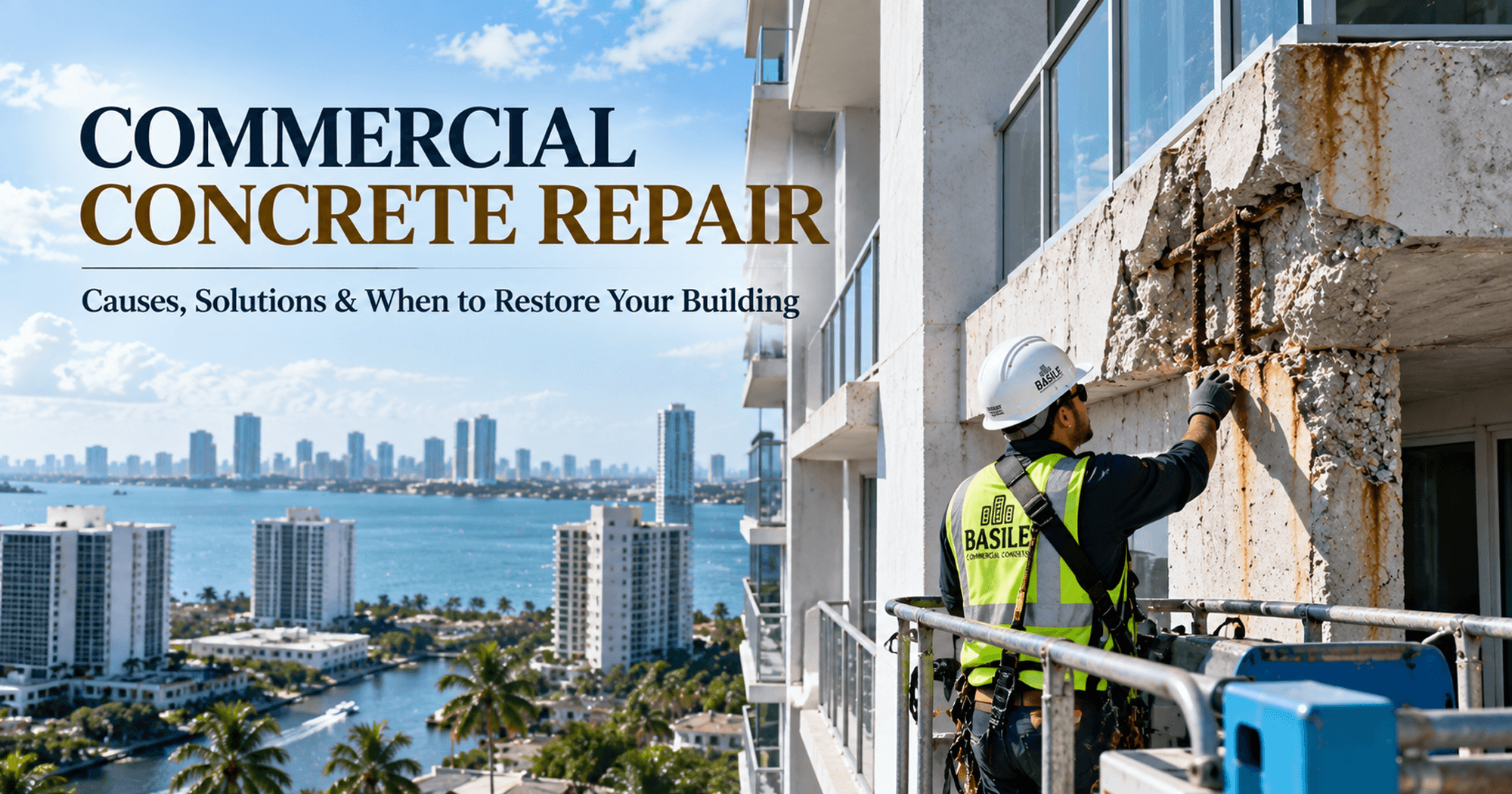
- Insurance and credentials. Basile holds Florida license CCC1511747, a roofing contractor class, and is insured and bonded. Its work is ICRI certified.
- Repair methods and equipment appropriate to the damage.
- A detailed inspection and scope of work.
- References from comparable projects.
- Clear pricing basis and timeline.
Common Concrete Restoration Mistakes
- Treating structural damage as cosmetic.
- Repairing cracks without finding the cause.
- Ignoring water intrusion.
- Ignoring reinforcement corrosion.
- Delaying repairs.
- Choosing a contractor on price alone.
- Replacing concrete that could have been repaired.
Concrete Restoration vs. Preventive Maintenance
Preventive maintenance is the cheapest way to extend concrete life: find problems early, keep waterproofing intact, inspect facades and balconies on a schedule and maintain coatings. Done consistently, it reduces the amount of restoration needed later.
A Practical Decision Guide
- Choose repair when damage is localized, structure is largely intact, corrosion is limited and the repair can address the cause.
- Consider replacement when damage is extensive, capacity is compromised, reinforcement deterioration is widespread or repeated repairs have failed.
- Get a professional assessment when damage affects structural components, cracks are growing, concrete is falling, steel is exposed, balconies are deteriorating or the extent of damage is unclear.
Schedule a Concrete Restoration Assessment
Concrete problems are cheapest to fix when they are found early. A professional assessment tells you what is repairable, what is not and what protection will make the repair last.
Repair and replacement serve different purposes. Basile offers a free written scope for commercial and high-rise buildings in Broward, Miami-Dade and Palm Beach counties.
Not sure which repair your building needs?
Walk the building with a licensed restoration contractor before you write a scope.