Building Facade Restoration in South Florida: Signs of Damage, Repair Methods & Costs
A complete guide to building facade restoration in South Florida — damage signs, facade repair methods, cost factors, waterproofing, maintenance, and when to bring in a professional.
By Luigi Basile
President
.png&w=3840&q=75&dpl=dpl_E5h9UCwvYQdejRUgRAfsUjDoxBZc)
A building's facade is the first thing people see and the first thing the weather attacks. In South Florida, where salt air, intense sun, heavy rain, and hurricanes work on exterior surfaces year-round, facades deteriorate faster than in most of the country — and when they do, the damage rarely stays cosmetic for long. Building facade restoration is how commercial property owners, condominium associations, and property managers get ahead of that deterioration: inspecting the facade, identifying the underlying causes of damage, repairing concrete and stucco, replacing failed sealants, waterproofing vulnerable areas, and protecting the result. This guide explains what facade restoration involves, why South Florida buildings face unique challenges, how to recognize the signs of facade damage, which repair methods are used, what drives the cost, and when to bring in a professional facade contractor.
The consistent principle throughout is that facade restoration should address the underlying cause of deterioration, not just cover the visible damage. A patched spall or a fresh coat of paint over an unresolved water problem looks better briefly and then fails again — often worse than before. Effective restoration follows a logical chain: inspect, assess, repair, waterproof, coat, and maintain.
What Is Building Facade Restoration?
Building facade restoration is the process of repairing and renewing a building's exterior face to return it to sound, protective, and attractive condition. A facade is not a single surface but a system of components working together: concrete, stucco, exterior coatings, sealants, expansion joints, windows and glazing, balconies, parapets, flashings, and exterior architectural elements. When these components deteriorate, the facade loses its ability to protect the building and can allow water and further damage into the structure behind it.
It helps to distinguish restoration from related work. Maintenance preserves a facade in good condition; facade repair corrects specific, isolated defects; restoration is a broader effort that addresses multiple deterioration issues across the facade and restores its overall performance; and replacement swaps out components that can no longer be repaired economically. Facade condition matters because deterioration does not stay on the surface — cracks and failed joints admit water, water reaches concrete and reinforcing steel, and localized problems spread. That is why good restoration addresses the underlying cause rather than simply covering visible damage.
Why Do Building Facades Deteriorate in South Florida?
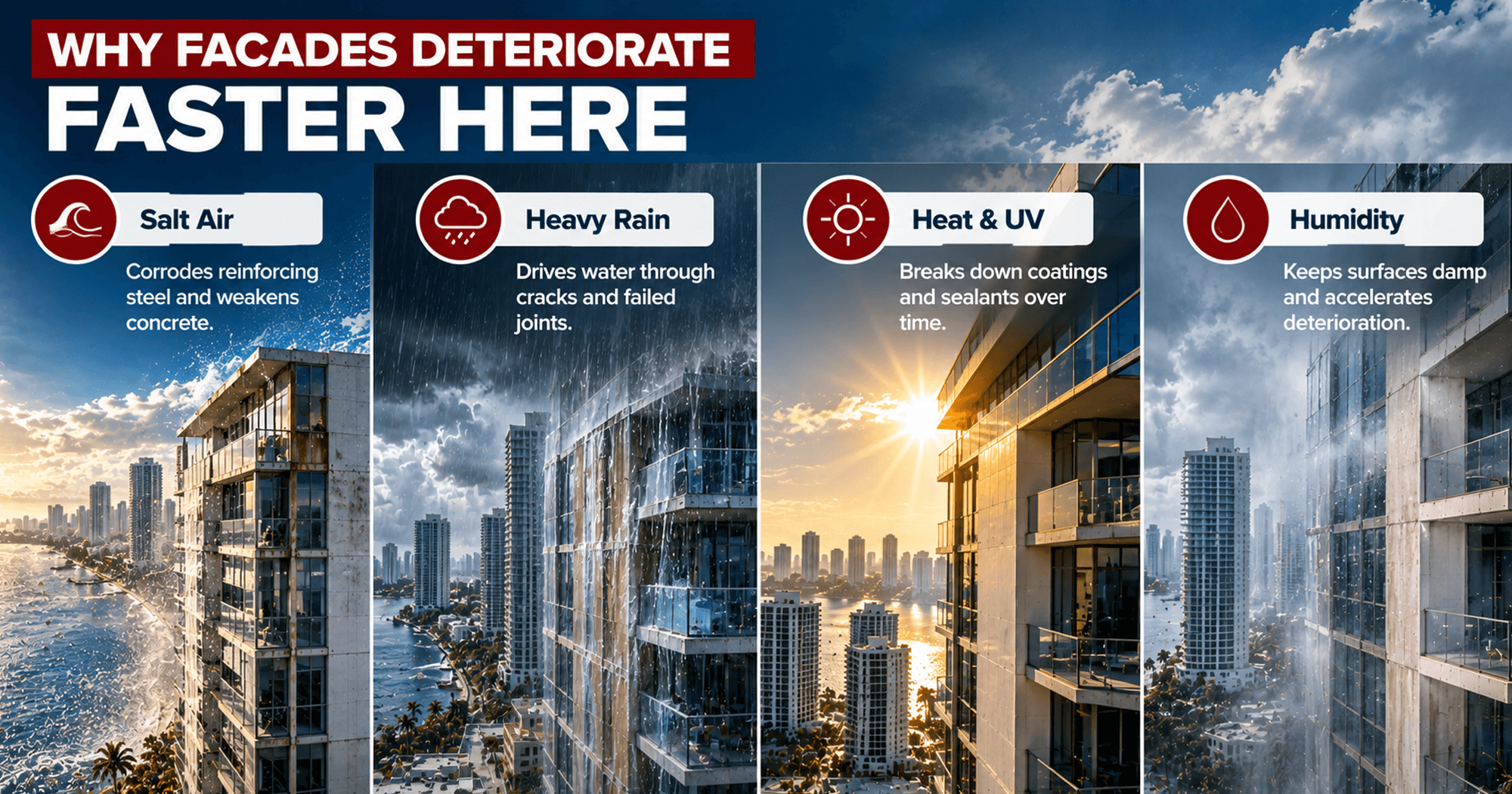
South Florida's environment is uniquely hard on building facades. Several forces work together to accelerate deterioration here.
Salt Air and Coastal Exposure
Near the coast, chlorides in salt air penetrate concrete and reach embedded reinforcing steel, driving corrosion. As the steel corrodes it expands, cracking and spalling the surrounding concrete — a primary cause of facade deterioration on coastal buildings throughout the region.
Heavy Rain and Water Intrusion
Frequent, heavy rainfall drives water against and into the facade. Failed sealants, cracks, poor drainage, and waterproofing failures give that water a path inside, where it accelerates deterioration and can reach interior spaces.
Heat and UV Exposure
Relentless sun and heat degrade exterior coatings and sealants, cause surface cracking, and weather the facade over time. Coatings chalk and fade, and sealants lose their flexibility and pull away from joints.
Humidity and Moisture
Persistent humidity keeps facades damp, contributing to concrete deterioration and, where conditions allow, mold or algae on surfaces. Sustained moisture accelerates the breakdown of nearly every facade material.
Age and Deferred Maintenance
Finally, time and neglect compound everything else. Small defects — a hairline crack, a failing sealant joint — are minor when caught early, but when building facade maintenance is delayed, they grow into the larger, costlier restoration problems that could have been prevented.
Common Signs Your Building Needs Facade Repair
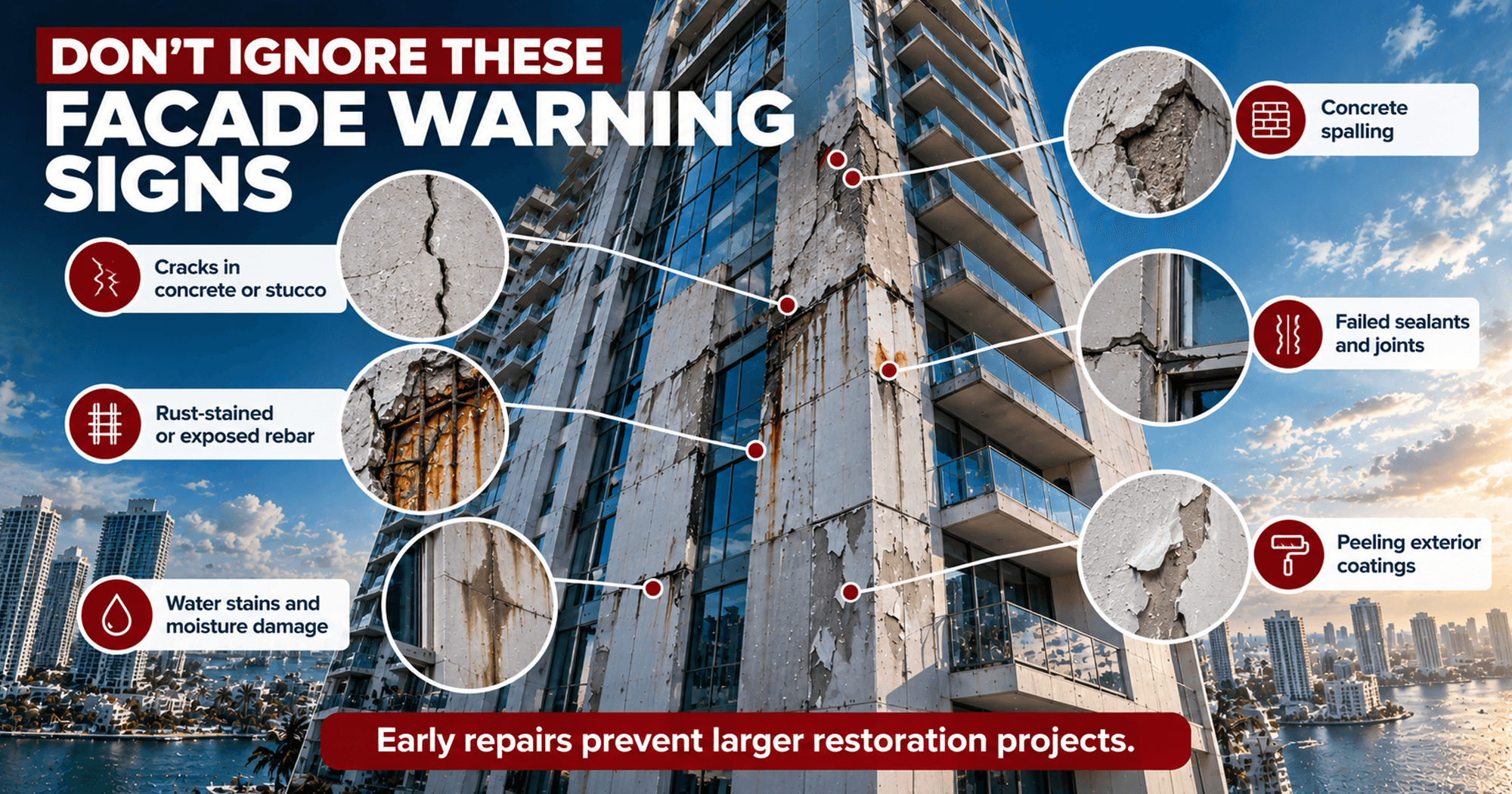
Facades usually signal trouble before it becomes severe. These are the warning signs property owners and boards should watch for.
Cracks in Concrete or Stucco
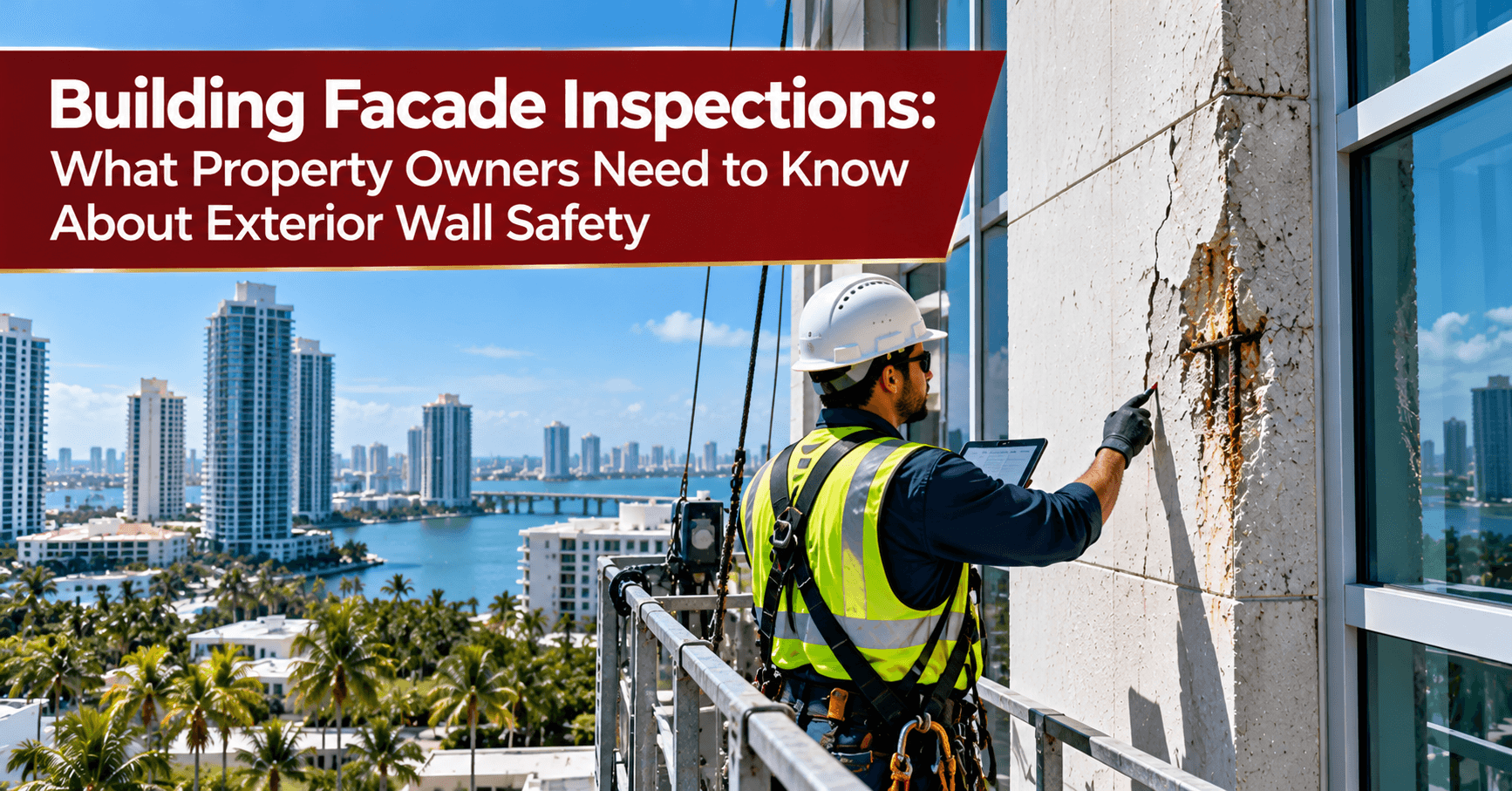
Cracks range from fine hairline cracks to larger structural-looking cracks, and they may run horizontally or vertically or cluster around windows and other openings. Cracks that continue to expand over time are of particular concern and warrant professional assessment.
Concrete Spalling
Spalling is when concrete chips, flakes, or breaks away from the surface, often exposing the reinforcing steel beneath. It commonly results from corroding reinforcement expanding within the concrete, and because the corrosion continues underneath, spalling should not simply be patched cosmetically — the underlying cause has to be addressed.
Exposed or Corroded Reinforcing Steel
Visible or rust-stained reinforcing steel is a clear signal of deeper concrete deterioration. Once steel is exposed, corrosion accelerates, and the affected area needs proper repair rather than a surface cover-up.
Water Stains and Moisture Damage
Interior water stains, exterior staining, and evidence of failed joints all point to water finding pathways through the facade. Tracing those pathways to their source is essential to stopping the damage.
Failed Sealants and Joints
Cracked, missing, or shrunken sealant and failed expansion joints leave direct openings for water. Because joints are designed to seal transitions and accommodate movement, their failure is a frequent and important cause of facade water intrusion.
Peeling or Failing Coatings
Peeling, blistering, or failing coatings are often more than a cosmetic issue — they can reveal underlying moisture or substrate problems that the coating can no longer conceal. Failing coatings deserve investigation, not just recoating.
Loose or Delaminated Concrete
Loose or delaminated concrete can fall, creating a safety concern in addition to signaling deterioration. Any loose material on a facade should be professionally assessed promptly.
Facade Restoration vs. Facade Repair: What's the Difference?
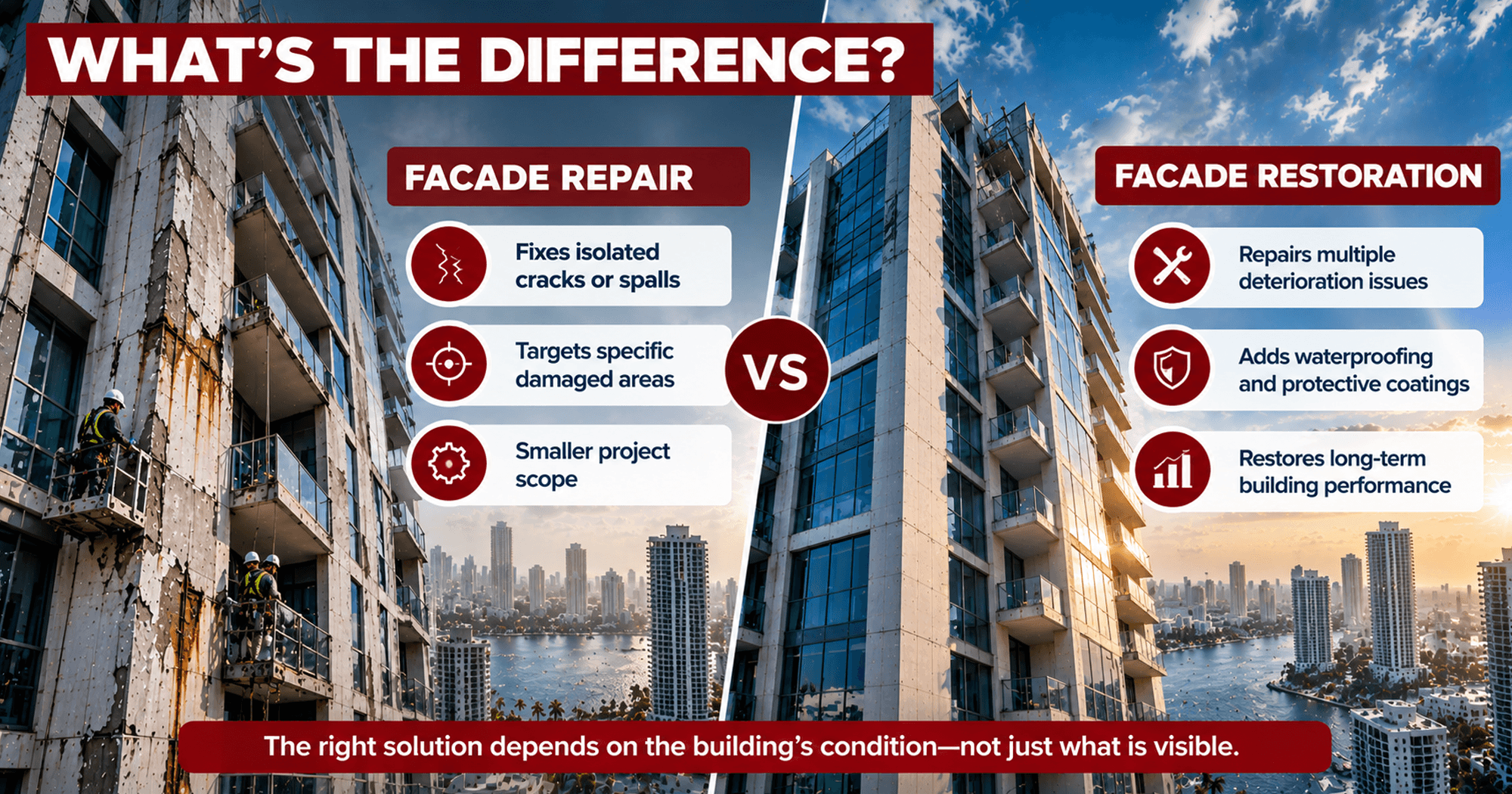
Property owners often use "repair" and "restoration" interchangeably, but they describe different scopes of work. A building may begin with isolated facade repairs and later need a broader restoration program as deterioration spreads.
| Factor | Facade Repair | Facade Restoration |
|---|---|---|
| Scope | Targeted defects | Broader building facade |
| Typical work | Cracks, spalls, sealants | Multiple deterioration issues |
| Objective | Correct specific problems | Restore and protect facade |
| Waterproofing | May be included | Often integrated |
| Coatings | May be localized | Often part of overall system |
| Inspection | Focused assessment | Comprehensive assessment |
| Maintenance | Required afterward | Required afterward |
The right approach depends on the building's condition. Isolated damage may call for focused repairs, while widespread deterioration usually warrants a comprehensive restoration that repairs, waterproofs, and protects the facade as a system.
What Is Included in Building Facade Restoration?
In South Florida, high-rise facade restoration usually combines concrete repair, stucco and crack repair, sealant and joint replacement, waterproofing and protective coatings. Most projects start from a milestone inspection or county recertification report, and the order is fixed: structural repairs first, waterproofing next, coatings last. A typical scope includes:
- Investigation: a close-up survey that sounds the concrete, maps cracks, spalls and leaks, and turns the engineer's findings into repair quantities.
- Concrete repair: removing delaminated concrete, cleaning or replacing corroded reinforcing steel, and rebuilding balcony edges, slab soffits, columns and beams.
- Stucco and crack repair: cutting out failed stucco, repairing the substrate and treating cracks before they carry water.
- Sealants and joints: replacing failed sealant at window perimeters, control joints and expansion joints.
- Waterproofing: balcony and walkway membranes, with drainage and slope corrected where water ponds.
- Coatings: surface preparation and an elastomeric or protective coating system over the finished repairs.
- Close-out: final review with the engineer of record, photo documentation and a maintenance plan.
Not every building needs every item. The inspection report and the engineer's repair specification set the scope. On the 60-storey Porsche Design Tower in Sunny Isles Beach, for example, our work was stucco repair, sealant replacement and painting, carried out on rope access. See more on our projects page.
The Building Facade Restoration Process
Professional facade restoration follows a structured process from inspection through documentation.
1. Initial Building Inspection
The facade is inspected for overall condition — concrete, stucco, cracking, spalling, sealants, water intrusion, coatings, windows and glazing, and hard-to-access areas that often hide the worst deterioration.
2. Detailed Facade Assessment
The inspection findings are mapped: damaged areas are located and documented, severity is graded, and the potential underlying causes of the deterioration are identified so repairs can address them.
3. Develop the Restoration Scope
From the assessment, a restoration scope is developed — prioritizing repairs, defining repair methods, selecting materials, establishing project phases, and preparing a detailed scope of work.
4. Access and Safety Planning
Facade work happens at height, so access and safety are planned carefully. Depending on building height, facade configuration, location, and project requirements, access may use rope access, swing stages, boom lifts, or scaffolding.
5. Concrete and Facade Repairs
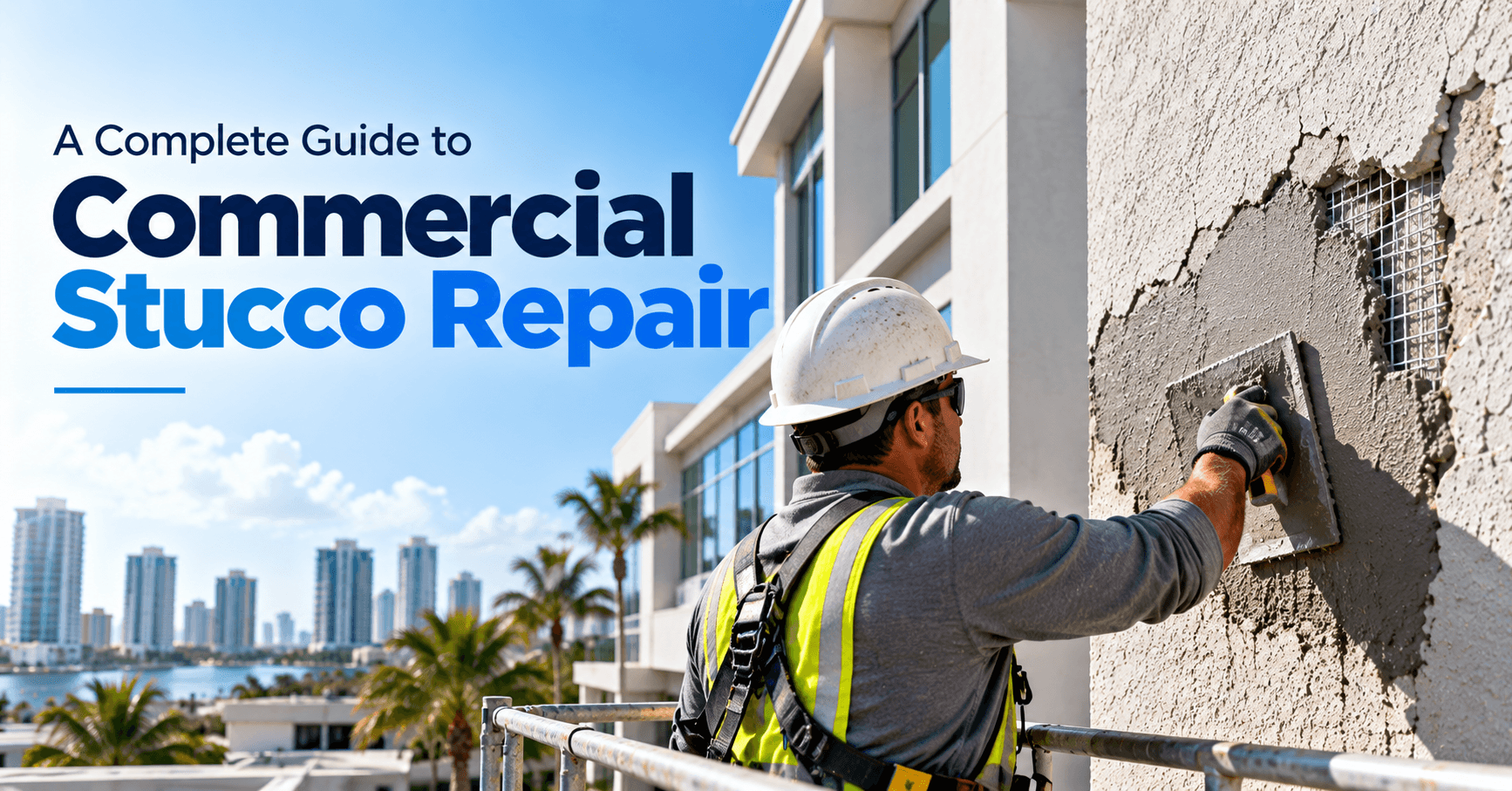
The physical repairs then proceed: removing deteriorated material, treating corrosion where required, repairing concrete, performing stucco and crack repairs, and preparing surfaces for what follows.
6. Waterproofing and Sealant Work
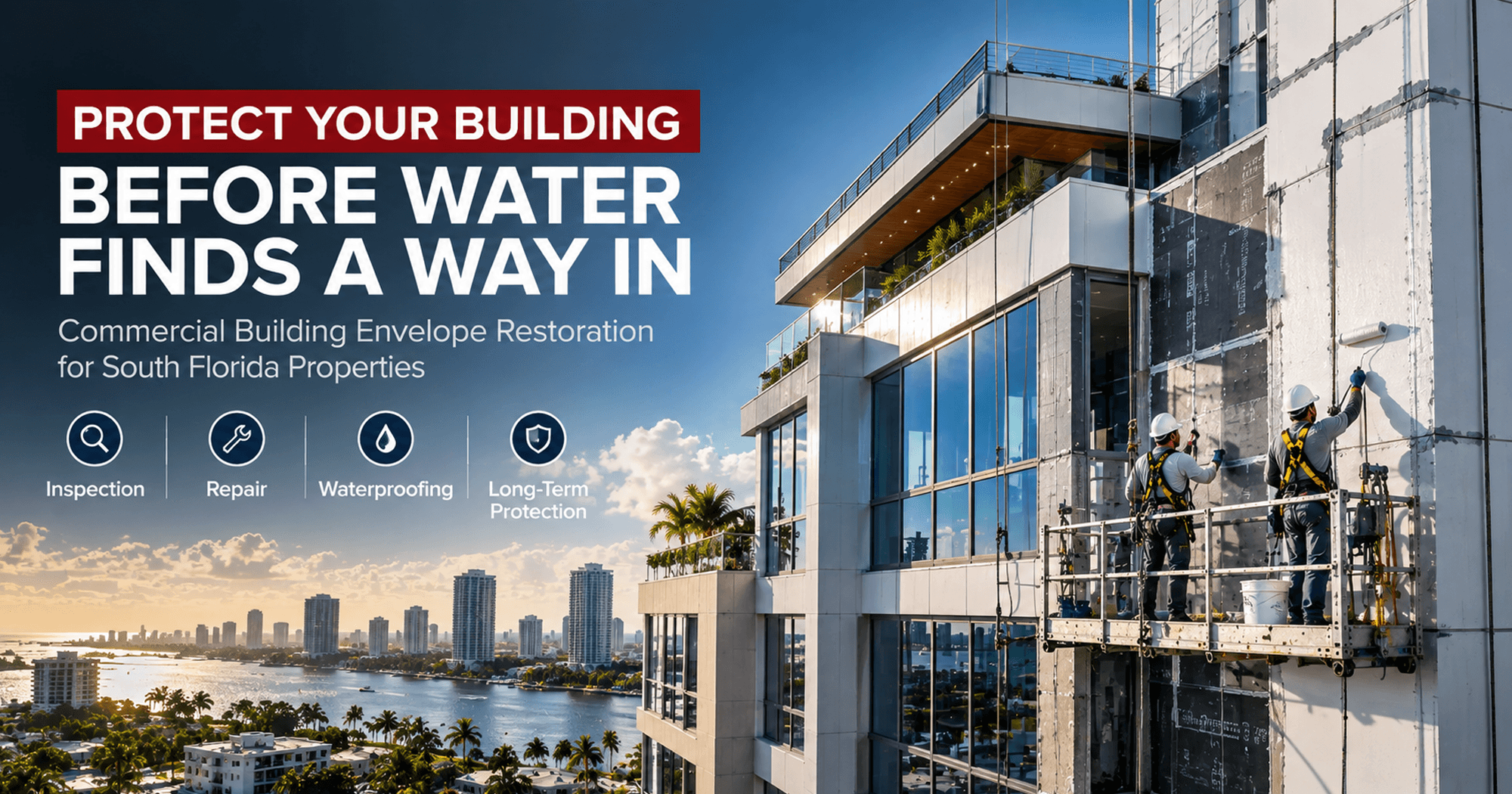
Vulnerable areas are then sealed and waterproofed — joints, cracks, penetrations, window perimeters, and other transitions and water-entry points — to keep water out of the repaired facade.
7. Coatings and Protective Finishes
With repairs and waterproofing complete, protective finishes are applied following manufacturer requirements: surface preparation, primer where required, protective coatings, and finish coats that protect and unify the facade.
8. Final Inspection and Documentation
Finally, the completed work is inspected — repairs, coating coverage, sealants, and waterproofing are verified, any remaining issues noted — and the project is documented along with maintenance recommendations.
Common Building Facade Repair Methods
No single method fits every building; the approach depends on the material, cause, and extent of damage.
Concrete Repair
Concrete facade repair typically involves removing deteriorated concrete, treating the exposed reinforcement, applying a patch repair, and restoring the surface — addressing the corrosion that caused the damage rather than only the surface.
Crack Repair
Cracks are addressed differently depending on their size, location, cause, movement, and exposure to water, since a static hairline crack and an active moving crack call for different treatments.
Stucco Repair
Stucco repair means removing damaged stucco, preparing the substrate, applying a compatible repair material, and matching the surrounding finish so the repair blends in.
Sealant Replacement
Failed sealants at joints, window perimeters, expansion joints, and movement joints are removed and replaced so those joints once again seal against water and accommodate building movement.
Waterproofing
After the underlying facade defects are repaired, waterproofing helps prevent future water intrusion, protecting the repairs and the concrete behind them.
Protective Coatings
Protective coatings provide weather, UV, and moisture protection along with appearance, and must be compatible with the existing substrates to perform as intended.
When Do Facade Problems Require Commercial Structural Repairs?
Not every facade defect is structural — but some deterioration signals deeper concerns. Warning signs that facade problems may involve commercial building structural repairs include significant concrete deterioration, exposed or corroded reinforcement, large cracks, severe spalling, delamination, deterioration around structural elements, repeated repair failures, and water-related deterioration affecting structural components. When these appear, the situation extends beyond routine facade work into commercial structural repairs, and it should be evaluated by appropriately qualified professionals before repairs proceed. Distinguishing a cosmetic defect from a structural one is exactly what a professional assessment is for.
How Much Does Building Facade Restoration Cost?
Facade restoration pricing varies substantially from building to building — there is no meaningful flat rate. The factors below drive the estimate.
| Cost Factor | Potential Impact |
|---|---|
| Building size | Larger facade areas require more labor and material |
| Facade condition | More deterioration increases repair scope |
| Building height | May increase access complexity |
| Access method | Rope access, swing stage, lifts, or scaffolding vary in complexity |
| Concrete deterioration | More repairs increase labor and materials |
| Waterproofing | Additional waterproofing work increases scope |
| Coatings | Material and application requirements affect cost |
| Sealants | Extensive joint replacement adds labor |
| Surface preparation | More preparation can increase project time |
| Accessibility | Difficult areas can increase project complexity |
| Engineering requirements | Additional assessment or design may affect scope |
| Project phasing | Phased work can change overall project costs |
Because these variables interact so heavily, a facade inspection is generally necessary before a reliable restoration estimate can be provided; a quote given sight unseen is unlikely to reflect the building's actual condition.
What Factors Affect the Cost of Facade Repair?
For more targeted facade repair — as opposed to a full restoration — cost still depends on many of the same variables: the number of damaged areas and the severity of deterioration, building height and access requirements, concrete condition, the extent of water intrusion, sealant and coating condition, the required surface preparation, labor, materials, and project duration. The important takeaway is that isolated repairs are generally far less involved than building-wide restoration, and repairing problems early can sometimes prevent a much larger restoration scope later. Deferring repairs tends to move a building from the "repair" column toward the "restoration" column.
Building Facade Restoration vs. Replacement
Restoration does not necessarily mean replacing the entire facade; often it means repairing and protecting what is there. Whether individual components should be restored or replaced depends on the extent of deterioration, the remaining service life of the materials, the structural condition, repairability, material compatibility, the degree of water intrusion, the cost of continued repairs, and the building's long-term goals. In many cases, targeted repair and restoration extend the facade's life effectively; in others — where components are at the end of their useful life or repeated repairs have failed — replacement of specific elements is the sounder investment. Inspection findings, not assumptions, should drive the decision.
Why Waterproofing Is Important After Facade Repairs
Waterproofing is what makes facade repairs last. The logical sequence is repair, then waterproofing, then protective coating, then maintenance — each step protecting the one before it. After concrete and facade defects are repaired, waterproofing prevents water intrusion, protects the repaired concrete, seals joints, and protects vulnerable transitions. Without it, water finds its way back into the facade and the same deterioration recurs. Integrated waterproofing reduces recurring deterioration and significantly extends the useful life of the restoration work, which is why professional restoration treats it as an essential step rather than an optional add-on.
How Building Facade Maintenance Prevents Major Restoration Problems
The most cost-effective facade strategy is preventive building facade maintenance. A maintenance program includes routine facade inspections, crack monitoring, and inspections of sealants, coatings, and waterproofing, along with drainage checks, concrete condition monitoring, window and frame inspection, and the prompt repair of minor deterioration. The distinction is simple but important: maintenance preserves a facade in good condition, while restoration addresses deterioration that has already occurred. A building that is maintained consistently is far less likely to need a large, disruptive restoration, because small problems are caught and corrected before they spread.
How Often Should a Commercial Building Facade Be Inspected?
Florida sets a legal minimum for many buildings: a state milestone inspection at 30 years and every 10 years after that for condominiums and co-ops of three or more stories, and county inspections on a 10-year cycle in Miami-Dade and Broward that cover commercial buildings too. For a coastal high-rise that is not enough on its own. We recommend a visual check at least once a year and after every major storm, and a close-up professional facade survey about every five years.
Our facade inspection guide has the full table by building type and county, with links to the statute and the county programs.
Choosing a Commercial Facade Contractor in South Florida
The contractor you choose has as much impact on the outcome as the repair methods themselves. When evaluating a commercial facade contractor, property owners and boards should look closely at a few areas.
Relevant Restoration Experience
Look for demonstrated experience with commercial and high-rise buildings and with the specific work involved — concrete restoration, facade repair, waterproofing, and coatings. Facade restoration has demands that general contracting experience does not necessarily cover.
Safety and Access Capabilities
Because facade work happens at height, evaluate the contractor's OSHA-compliant safety practices and their access capabilities — rope access, swing stages, and lifts — as well as how they plan building access for the specific project.
Proper Licensing and Insurance
Verify licensing, insurance, bonding, and safety credentials before work begins. These protect the property owner and signal a professionally run operation.
Detailed Scope of Work
Finally, evaluate whether proposals clearly explain the areas being repaired, the materials and repair methods, the access approach, the waterproofing and coatings, the timeline, and the documentation provided. A clear, detailed scope from a commercial facade contractor is a strong indicator of competence; a vague one is a warning.
Common Mistakes Property Owners Make With Facade Restoration
Facade problems are often made worse by avoidable mistakes.
Waiting Until Damage Becomes Obvious
By the time facade damage is unmistakable, deterioration is usually well advanced and more expensive to correct than it would have been earlier.
Painting Over Deteriorated Concrete
Coating over deteriorated or spalling concrete hides the problem without solving it, and the coating soon fails along with the concrete beneath it.
Treating Water Intrusion as Only a Cosmetic Problem
Water stains and leaks are symptoms of a real intrusion pathway; treating them as cosmetic leaves the underlying problem to keep causing damage.
Repairing Symptoms Instead of Causes
Patching a spall or crack without addressing why it formed — corrosion, movement, or water — leads to repeated failures in the same areas.
Choosing a Contractor Based Only on Lowest Price
The lowest bid often reflects a narrower scope or less experience, and facade work done poorly is expensive to redo.
Ignoring Sealants and Joints
Failed sealants and joints are a leading source of water intrusion, yet they are easy to overlook until water damage appears.
Skipping Regular Facade Maintenance
Deferring maintenance is what turns minor, inexpensive issues into major restoration projects.
Failing to Consider Building Access
Access planning affects safety, schedule, and cost; ignoring it until work begins leads to delays and complications.
How to Know When Your Building Needs Facade Restoration
As a practical checklist, consider facade restoration if your building shows visible cracking, spalling, delamination, exposed reinforcement, rust staining, failed sealants, water intrusion, peeling coatings, or deteriorated stucco — or if it has needed repeated repairs, has an aging facade, sits in a coastal location, or has had deferred maintenance. One visible issue does not necessarily mean the entire facade requires restoration; a professional assessment is what determines the appropriate scope and whether targeted repairs or a broader restoration is warranted.
Why Professional Facade Assessment Matters
A professional facade assessment is the foundation of every sound restoration decision. It identifies hidden deterioration, determines the repair scope, finds water-entry points, evaluates concrete condition, and establishes the appropriate repair methods and compatible materials. It also plans access, estimates project requirements, prioritizes urgent repairs, and informs a long-term maintenance strategy. In short, the assessment is what turns a collection of visible symptoms into a clear, prioritized plan — and it is why building facade restoration should always begin with a qualified commercial facade contractor evaluating the building rather than with assumptions about what it needs.
Not sure which repair your building needs?
Walk the building with a licensed restoration contractor before you write a scope.
Is Your Building Facade Showing Signs of Deterioration?
If your facade shows cracks, spalling, exposed reinforcement, rust staining, failed sealants, or water intrusion, a professional facade assessment can determine what is really happening and what your building needs. Basile Contractors helps commercial property owners, condominium associations, property managers, facility managers, and board members inspect, assess, repair, waterproof, and protect their building facades. Call (352) 657-8653 to schedule a South Florida building facade assessment.
Standards and further reading
Official standards and public sources on this topic:
- Florida Statutes 553.899, the milestone inspection law for condominium and cooperative buildings of three or more stories.
- Miami-Dade County building recertification, the county's periodic inspection program for residential and commercial buildings.
- ICRI technical publications, the International Concrete Repair Institute's guidelines on surface preparation, corrosion repair and repair materials.
- ASTM E2128, the standard guide for evaluating water leakage of building walls.
Frequently asked questions
Updated: October 8, 2026