Building Envelope Restoration: How to Protect Commercial Properties From Water Damage
How building envelope restoration protects commercial properties from water intrusion — covering inspection, repair, waterproofing, and preventive maintenance for South Florida buildings.
By Luigi Basile
President
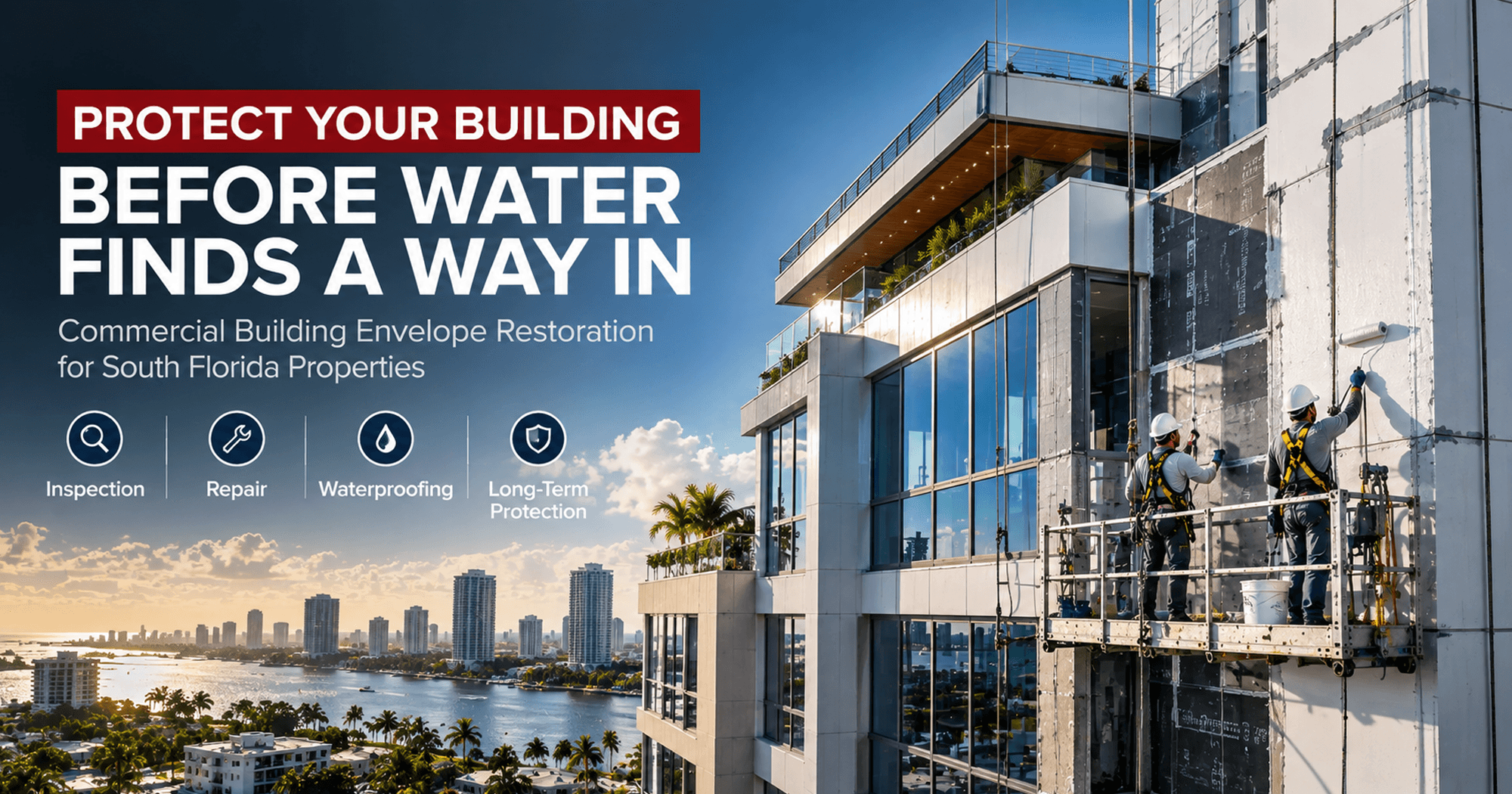
Water damage is one of the most expensive and disruptive problems a commercial building can face, and almost all of it starts at the building envelope — the exterior system that stands between the interior and the weather. When that system deteriorates, water finds its way in, and what began as a cracked sealant or a failed flashing detail can end as damaged interiors, deteriorated structure, and a major repair bill. Building envelope restoration is how commercial property owners get ahead of that: identifying where the envelope is failing, repairing or replacing the affected components, and restoring the building's ability to keep water out. This guide explains what building envelope restoration involves, why the envelope matters so much for commercial properties, what causes it to fail, and how professional restoration and maintenance protect a building over the long term.
The theme throughout is that water intrusion is rarely obvious at its source. A stain on an interior wall may originate several feet away, higher up the facade, and effective restoration depends on finding and correcting the real source rather than patching the symptom. That is why professional inspection sits at the center of every step that follows.
What Is Building Envelope Restoration?
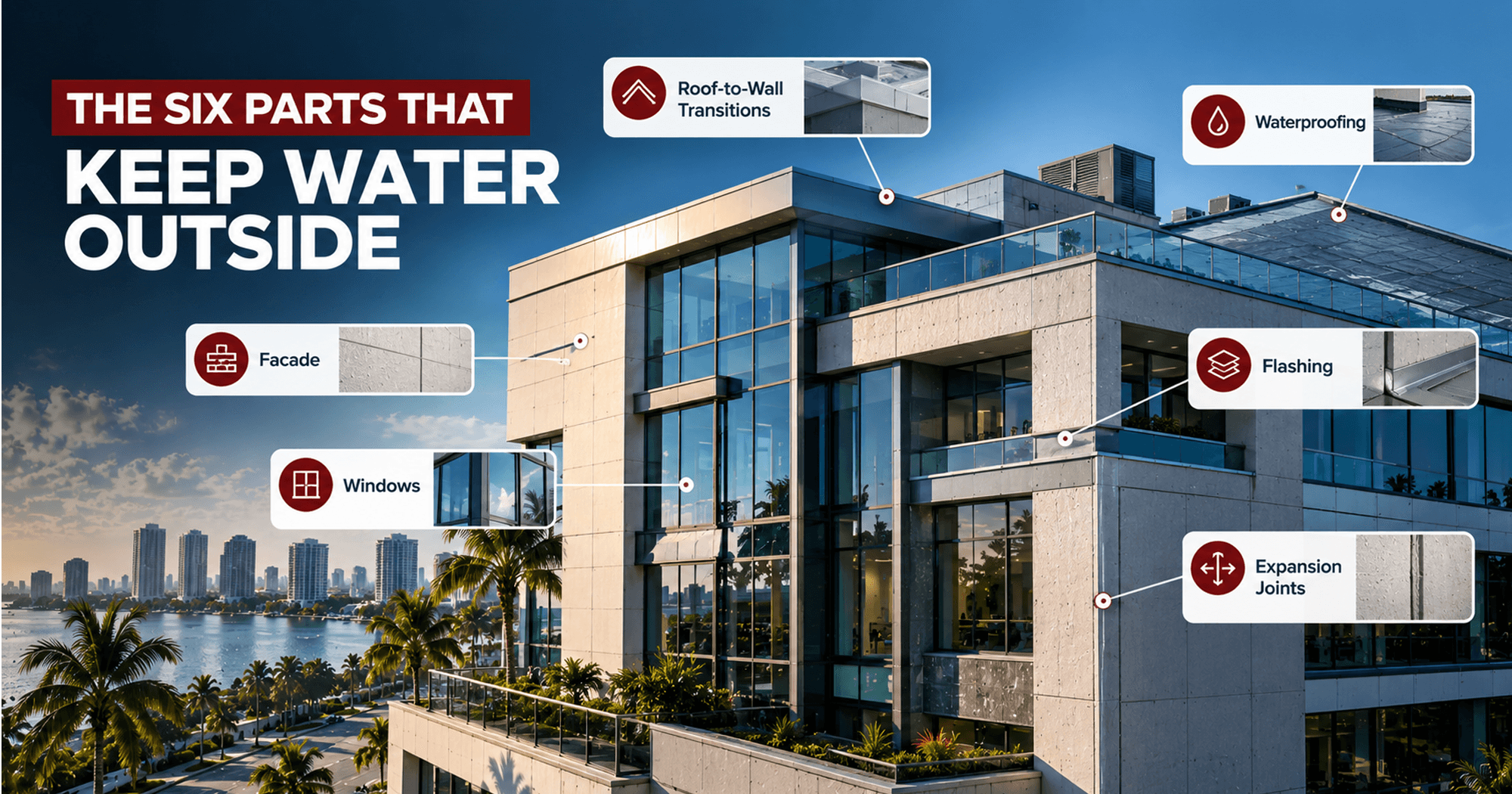
Building envelope restoration is the process of repairing and renewing the exterior systems that protect a building from the elements. The building envelope is the physical barrier that separates the interior environment from outside conditions, and it is made up of many interacting components: exterior walls, facades, masonry, concrete, windows, doors, roof-to-wall transitions, flashing, sealants, waterproofing systems, expansion joints, and exterior cladding.
Restoration involves identifying deterioration across those components and repairing or replacing what has failed in order to restore the building's water resistance, weather protection, structural performance where applicable, energy efficiency, and overall durability. Rather than a cosmetic refresh, building envelope restoration is a performance-driven process aimed at returning the exterior enclosure to sound, water-tight condition.
Why Is the Building Envelope Important for Commercial Properties?
The envelope is the building's shield against rain, wind, moisture, humidity, temperature swings, and UV exposure. In a coastal climate it also bears the load of wind-driven rain, tropical storms, and salt air. When every component is doing its job, the interior stays dry and protected; when the envelope fails, the consequences reach well beyond the exterior wall.
Prevents Water Intrusion
Properly functioning envelope components — intact sealants, sound masonry, working flashing, and effective waterproofing — keep water on the outside of the building where it belongs. This is the envelope's single most important function.
Protects Interior Spaces
When the envelope holds, it protects everything inside from moisture: walls, ceilings, flooring, interior finishes, equipment, and inventory. A single unresolved leak can damage all of these and interrupt building operations.
Helps Prevent Structural Deterioration
Prolonged moisture exposure can deteriorate building materials and, in some circumstances, contribute to the deterioration of structural components — for example, when water reaches embedded reinforcing steel in concrete. In those cases, envelope restoration overlaps with structural restoration, and the underlying condition should be evaluated by qualified professionals.
Supports Energy Efficiency
Damaged windows, failed seals, and deteriorated exterior systems allow unwanted air and moisture movement through the envelope. Restoring these components helps the building manage its interior environment more efficiently.
What Causes Building Envelope Damage?
Envelope deterioration usually comes from a combination of exposure, age, and deferred maintenance rather than a single event.
Water and Moisture Intrusion
Water is both a cause and a consequence of envelope failure. Roof leaks, wall leaks, failed flashing, damaged sealants, cracked masonry, and window leaks all admit moisture that accelerates further deterioration.
Aging Building Materials
Masonry, concrete, sealants, waterproofing membranes, and exterior coatings all have finite service lives. As they age, they lose the properties that made them water-resistant, and the envelope becomes progressively more vulnerable.
Sun, Heat, and Storm Exposure
In South Florida, envelope stress comes not from snow or freeze-thaw cycles but from intense UV, sustained heat, heavy rainfall, wind-driven rain, hurricanes, and coastal salt air. This combination degrades sealants and coatings, drives water into any weakness, and corrodes metal and reinforcement near the coast.
Poor Drainage
Blocked drainage systems, improper slopes, damaged gutters, and poorly designed water-management details cause water to pool and back up against the envelope instead of draining away, forcing moisture into the building.
Failed Sealants and Expansion Joints
Sealants and expansion joints are designed to accommodate movement and seal transitions, but they shrink, crack, and fail over time. Once they gap, they become direct pathways for water penetration.
Construction or Installation Defects
Improper installation of windows, flashing, cladding, waterproofing, or masonry systems can leave a building vulnerable from the start, allowing water intrusion even when materials are relatively new.
Lack of Preventive Maintenance
Perhaps the most common cause of all: small, easily fixed envelope problems that go unaddressed until they become large, expensive restoration projects. Neglect turns minor repairs into major ones.
Common Signs That a Building Needs Envelope Restoration
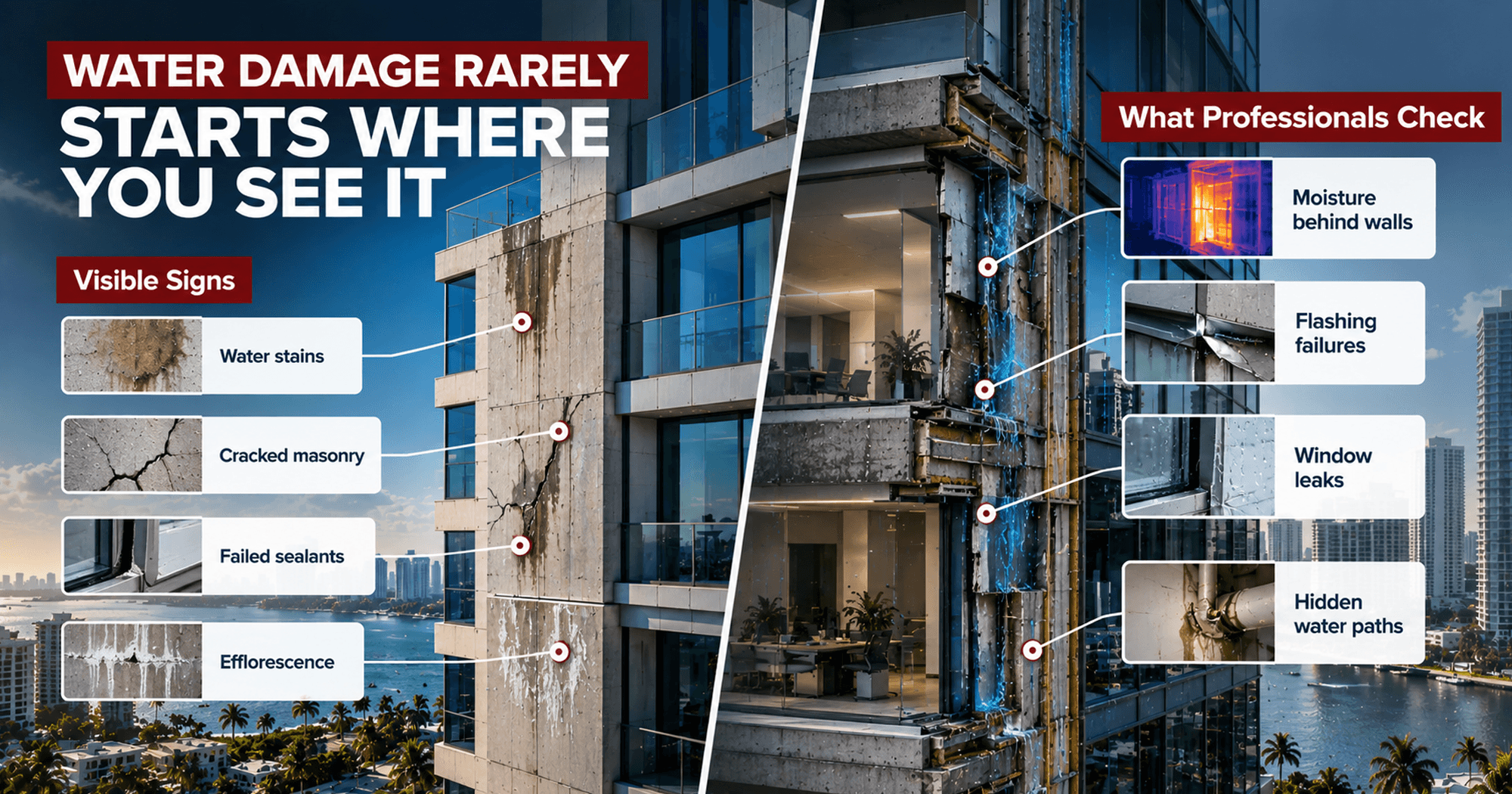
Certain symptoms indicate the envelope is no longer keeping water out. Watch for recurring water leaks, water stains, damp interior walls, mold or moisture-related deterioration, cracked masonry, cracked concrete, spalling, deteriorated mortar joints, failed caulking, damaged flashing, drafty windows, damaged exterior finishes, efflorescence, peeling paint or coatings, and visible facade deterioration.
Any one of these warrants attention, but it is important to understand that the visible symptom rarely reveals the actual source of water intrusion. A professional inspection is what connects the symptom to its cause so that building envelope repairs address the real problem rather than the surface evidence.
What Are the Most Common Building Envelope Repairs?
The appropriate repair depends on the material, the source of deterioration, the building design, and the extent of damage. The table below summarizes the most common building envelope repairs and what each addresses.
| Repair Type | What It Addresses |
|---|---|
| Masonry repair | Cracked masonry, deteriorated mortar, repointing, replacement of damaged units |
| Concrete repair | Cracks, spalling, surface deterioration, concrete patching |
| Sealant replacement | Failed joints around windows, doors, expansion joints, and exterior transitions |
| Flashing repair | Directing water away from vulnerable areas and transitions |
| Window and door repairs | Failed seals, water penetration, damaged frames, improper perimeter sealing |
| Waterproofing repairs | Below-grade areas, exterior walls, foundations, plaza decks, other vulnerable areas |
Masonry Repair
Masonry repair addresses cracked units and deteriorated mortar through repointing and, where needed, replacement of damaged masonry. Sound masonry and mortar joints are essential to keeping water out of a masonry facade.
Concrete Repair
Concrete repair addresses cracks, spalling, and surface deterioration through patching and restoration of the affected areas, ideally after the underlying cause — often moisture reaching reinforcement — has been identified.
Sealant Replacement
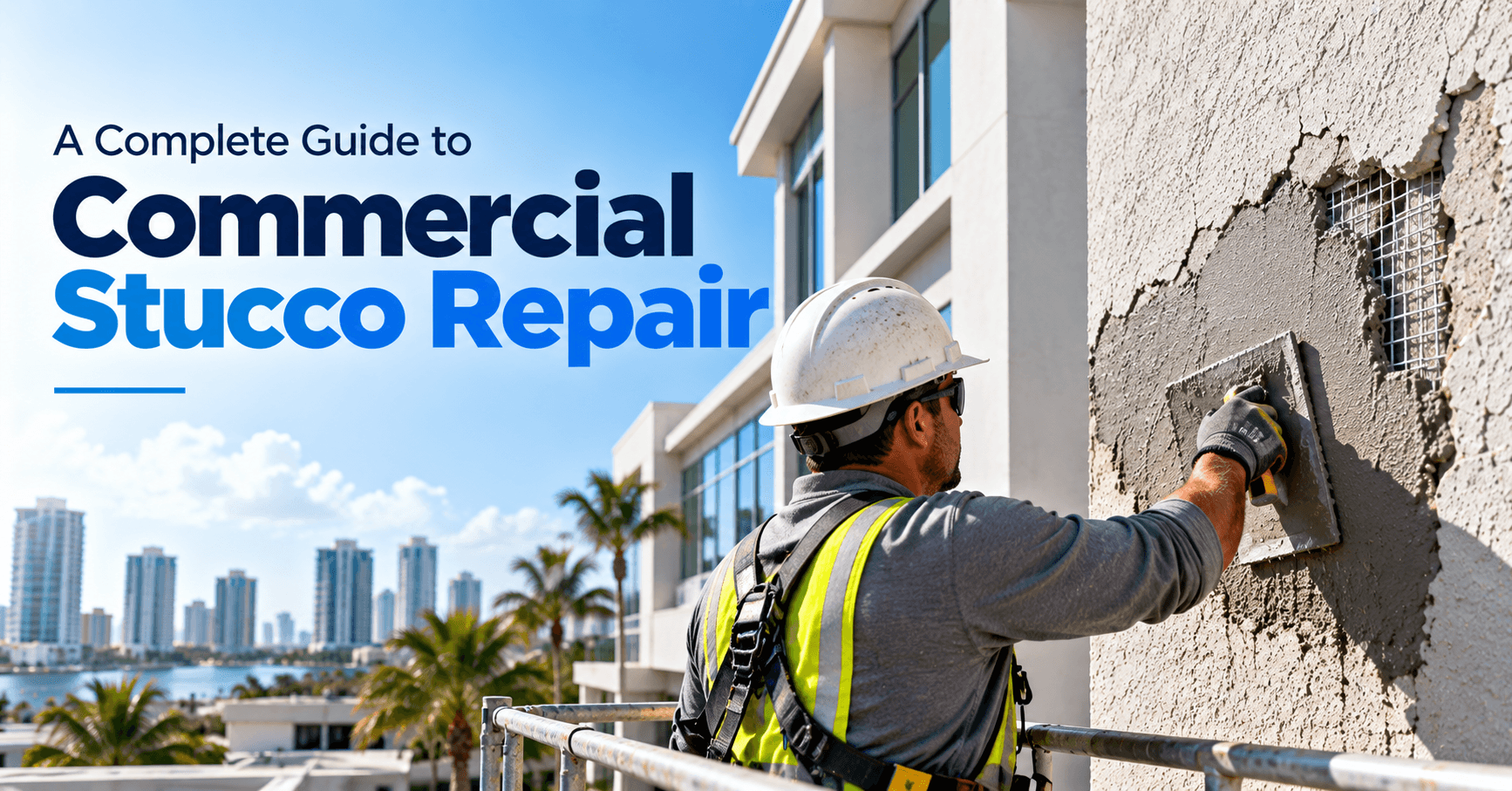
Failed sealants around windows, doors, expansion joints, and exterior transitions are removed and replaced so those joints once again seal against water and accommodate building movement.
Flashing Repair
Flashing directs water away from vulnerable transitions and openings. Damaged or improperly installed flashing is repaired or replaced to restore that protective function.
Window and Door Repairs
Windows and doors are common leak points. Repairs address failed seals, water penetration, damaged frames, and improper perimeter sealing that let water into the wall assembly.
Waterproofing Repairs
Waterproofing repairs protect the areas most exposed to moisture — below-grade walls, exterior walls, foundations, plaza decks, and other vulnerable areas — using appropriate coatings, membranes, and detailing.
How Does Building Envelope Restoration Work?
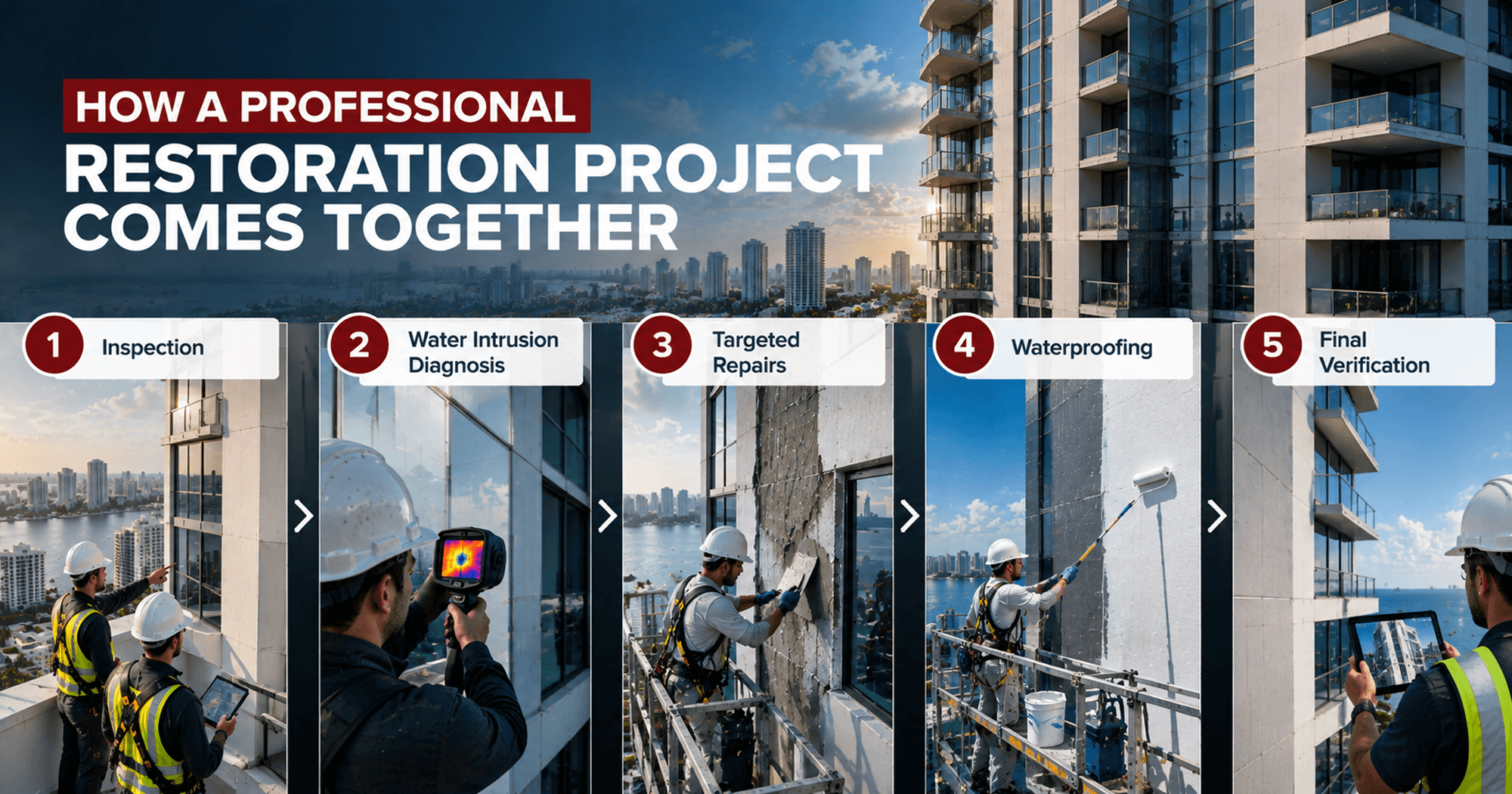
Professional restoration follows a clear, repeatable process from inspection through verification.
1. Initial Building Inspection
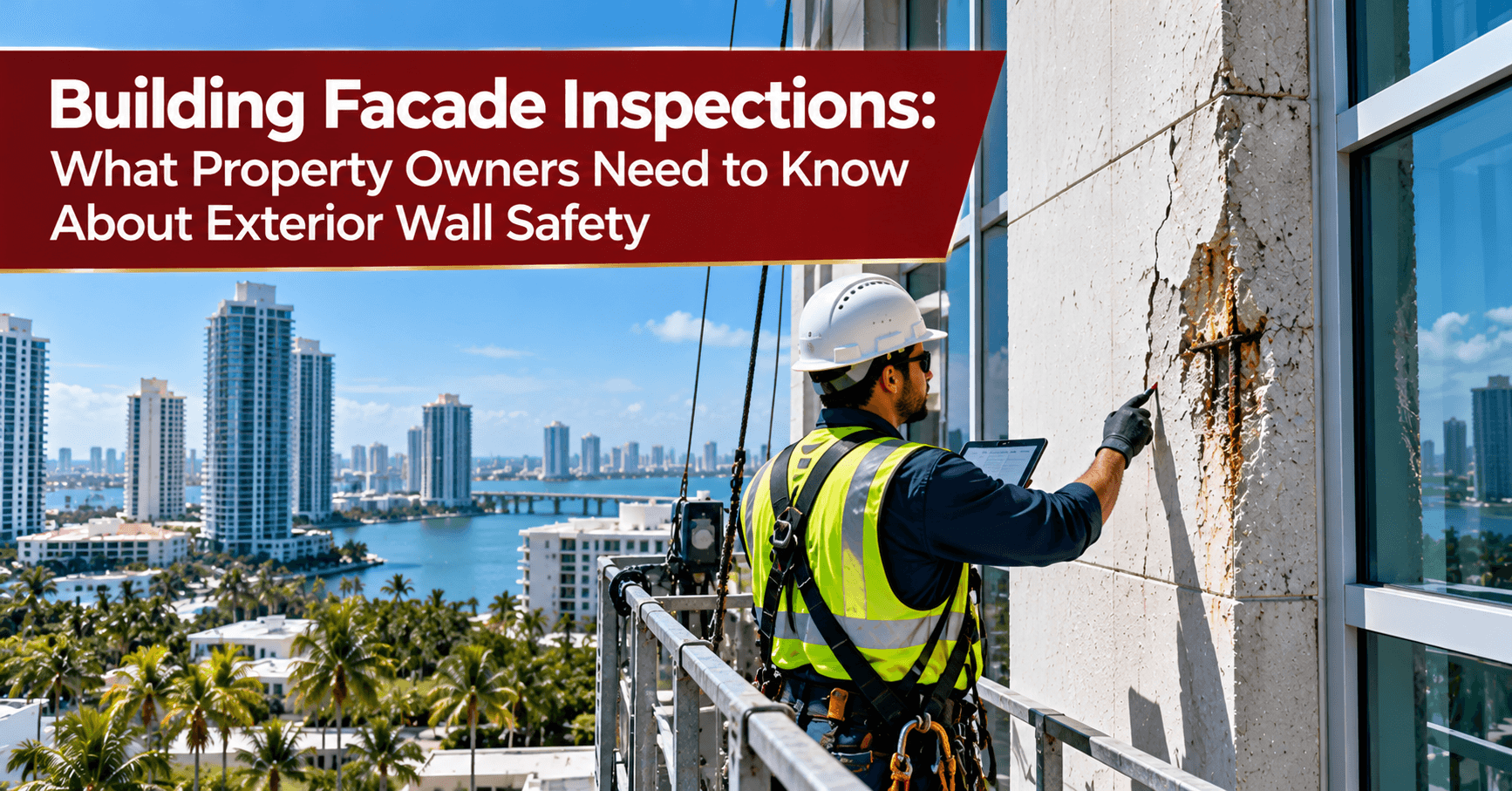
The building's exterior walls, facade, windows, doors, masonry, concrete, sealants, flashing, waterproofing, and drainage are assessed to establish the envelope's overall condition.
2. Identify Sources of Water Intrusion
Because the visible leak location may not be the actual entry point, this step uses moisture investigation, visual inspection, water testing where appropriate, and material assessment to trace water back to its true source.
3. Determine the Extent of Damage
The evaluation then establishes how far the damage reaches — surface deterioration, hidden moisture, material failure, and any potential structural concerns.
4. Develop a Restoration Plan
A restoration plan sets repair priorities, materials, restoration methods, safety considerations, project scheduling, and budget, tailored to the building and the findings.
5. Complete Building Envelope Repairs
Damaged components are then repaired or replaced — masonry, concrete, sealants, flashing, windows, and other elements — according to the plan.
6. Waterproof and Seal Vulnerable Areas
Vulnerable areas are waterproofed and sealed using sealants, flashing, waterproof coatings, membranes, and drainage improvements to restore the envelope's water resistance.
7. Inspect and Verify the Completed Work
Finally, quality control confirms that the repaired areas are functioning properly and that the envelope is once again keeping water out.
Building Envelope Restoration Services for Commercial Properties
Commercial property owners may need several related building envelope services, often in combination on a single project.
Commercial Facade Restoration
Facade restoration addresses masonry, concrete, stone, and exterior finishes to return the building's face to sound, water-resistant condition.
Waterproofing Services
Waterproofing services protect the building's most vulnerable areas against moisture intrusion, from below-grade walls to plaza decks and exterior surfaces.
Masonry Restoration
Masonry restoration includes repointing, masonry replacement, crack repair, and cleaning and restoration of masonry surfaces.
Concrete Restoration
Concrete restoration repairs deteriorated concrete while addressing the underlying causes — commonly moisture and reinforcement corrosion — so the repair lasts.
Window and Curtain Wall Repairs
These repairs address water penetration and failed exterior seals at windows and curtain wall systems, which are frequent sources of leaks in commercial buildings.
Sealant and Joint Restoration
Properly functioning joints are critical to water management, so sealant and joint restoration replaces failed sealants and expansion joints throughout the envelope.
Building Envelope Restoration vs. Building Restoration
Building envelope restoration and general building restoration are related but distinct. Envelope restoration focuses specifically on the exterior enclosure and its ability to keep water out; general building restoration can be broader, addressing overall building condition and potentially interior systems as well.
| Factor | Building Envelope Restoration | General Building Restoration |
|---|---|---|
| Primary focus | Exterior enclosure | Broader building systems |
| Main concern | Weather and water protection | Overall building condition |
| Typical components | Facade, masonry, windows, sealants, flashing | Exterior and potentially interior components |
| Water intrusion | Major focus | May be one component |
| Structural concerns | May be involved | Can be broader |
| Scope | Often focused on exterior envelope | Potentially building-wide |
Envelope restoration is frequently one component of a broader building restoration project, and the two are often delivered together by the same building restoration services provider.
When Does Building Envelope Damage Become a Structural Concern?
Most envelope deterioration is a water-management and materials problem, not a structural one — and not every facade crack indicates structural failure. However, some conditions warrant structural evaluation: significant concrete spalling, severe cracking, corrosion-related deterioration, major masonry displacement, structural movement, and deteriorated supporting components. When any of these appear, the situation moves into the realm of structural restoration and should be evaluated by appropriately qualified professionals before repairs proceed.
Building Envelope Restoration in South Florida
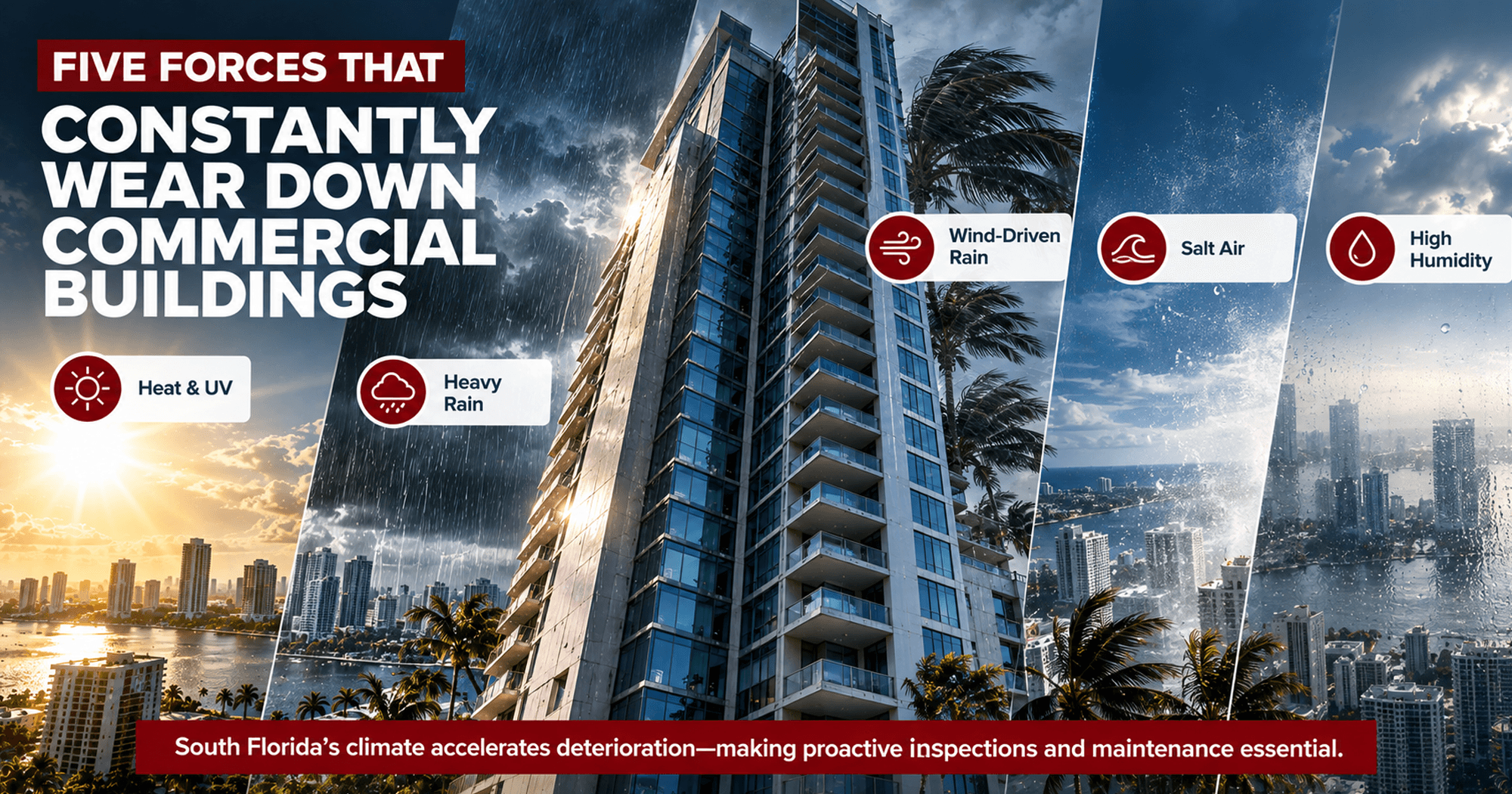
South Florida presents a distinctive set of challenges for commercial building envelopes. The region combines an aging building stock, extensive masonry and concrete facades, dense urban environments, and a large inventory of high-rise buildings with difficult access. Rather than the freeze-thaw damage that drives deterioration in northern climates, South Florida envelopes contend with intense sun and heat, heavy rainfall, wind-driven rain, hurricanes, and corrosive coastal salt air.
That climate makes proactive inspection and maintenance especially important here. Water intrusion problems develop quickly under sustained heat and humidity, storm season tests every weakness in the envelope, and high-rise facades require specialized access to inspect and repair safely. For commercial properties across Broward, Miami-Dade, and Palm Beach, professional building envelope restoration services are a practical safeguard against the region's demanding conditions.
How Water Damage Can Affect Commercial Buildings
When water intrusion goes unresolved, the consequences compound across the building.
Interior Damage
Water reaches drywall, ceilings, flooring, paint, and interior finishes, causing visible damage that often requires its own repairs on top of the envelope work.
Material Deterioration
Persistent moisture deteriorates masonry, concrete, metal components, wood, and insulation, weakening the very materials the envelope is meant to protect.
Mold and Moisture Problems
Sustained moisture creates conditions favorable to mold growth, which raises indoor-environment concerns and can further disrupt building use.
Business Disruption
Water damage forces closed areas, generates tenant complaints, interrupts operations, and drives repair costs — all of which affect the property's income and reputation.
Higher Long-Term Restoration Costs
Above all, water damage grows more expensive the longer it is ignored. Addressing minor envelope problems early reduces the risk of the extensive, costly restoration that neglected problems eventually require.
Preventive Maintenance for Commercial Building Envelopes
Restoration is not a one-time event. Protecting a commercial envelope over the long term depends on ongoing preventive maintenance.
Schedule Regular Inspections
Periodic professional assessments — with frequency based on building age, materials, location, exposure, and existing conditions — catch developing problems before they escalate.
Monitor Sealants and Joints
Sealants and joints should be checked regularly for cracking, gaps, shrinkage, and deterioration, since they are among the first components to fail.
Maintain Drainage Systems
Gutters, drains, scuppers, downspouts, and drainage paths should be kept clear and functioning so water moves away from the envelope rather than against it.
Address Small Repairs Early
Cracks, failed sealants, damaged flashing, and minor leaks are inexpensive to fix early and expensive to fix late. Prompt attention to small repairs is the most cost-effective form of envelope protection.
How Much Does Building Envelope Restoration Cost?
There is no flat price for building envelope restoration; cost varies significantly with the building and the scope of work. The factors below drive the estimate.
| Cost Factor | Potential Impact |
|---|---|
| Building size | Larger buildings require more materials and labor |
| Envelope condition | Extensive deterioration increases scope |
| Material type | Masonry, concrete, stone, glass, and cladding require different approaches |
| Accessibility | Difficult or high-rise access can increase costs |
| Water damage | Hidden moisture can expand the restoration scope |
| Structural repairs | Structural deterioration can increase project complexity |
| Waterproofing | Additional waterproofing work can increase project costs |
| Labor | Specialized restoration work requires skilled labor |
| Project location | Local regulations and site conditions can affect costs |
| Emergency repairs | Urgent work may have higher costs |
Because these variables interact, a professional inspection is generally necessary before a meaningful project estimate can be provided.
How to Choose a Building Restoration Company
The right building restoration company makes the difference between a lasting repair and a recurring problem. Look for commercial restoration experience, building envelope expertise, masonry restoration experience, waterproofing expertise, and concrete repair capabilities, along with experience working on older buildings. Just as important are qualified restoration professionals, documented safety procedures, proper insurance, references and case studies, a detailed inspection process, a clear project scope, written estimates, warranty information, and preventive maintenance capabilities. A building restoration corporation that can speak to all of these clearly is one worth trusting with the work.
Questions to Ask a Building Restoration Contractor
A few pointed questions reveal whether a contractor truly understands envelope work: What is causing the water intrusion? Can you identify the source rather than only repair the visible damage? What areas of the building envelope require attention? Are there hidden moisture or structural concerns? What repair method do you recommend, and what materials will be used? How will the repaired area be waterproofed? How long will the restoration take, and how will building occupants be protected during the project? And what maintenance should be performed after restoration? Clear, specific answers signal genuine expertise.
Building Envelope Restoration vs. Replacement
Sometimes restoration is the right answer, and sometimes replacement is. Restoration may be appropriate when damage is localized, materials remain serviceable, water intrusion can be corrected, repairs can extend component life, and replacement would be unnecessarily disruptive. Replacement may be considered when components have reached the end of their useful life, damage is extensive, repeated repairs have proven ineffective, materials cannot be restored economically, or the existing system has fundamental performance problems. The decision should rest on inspection findings, lifecycle considerations, performance, and cost rather than on assumptions.
A Building Envelope Restoration Roadmap
Envelope restoration projects tend to move through the same six phases.
Phase 1: Inspection
Identify deterioration, water intrusion, vulnerable areas, and any potential structural concerns.
Phase 2: Diagnosis
Determine the underlying causes of the damage rather than only its symptoms.
Phase 3: Prioritization
Rank repairs based on safety, water intrusion, damage severity, cost, and urgency.
Phase 4: Restoration
Complete the work — envelope repairs, waterproofing, masonry restoration, concrete restoration, and sealant replacement.
Phase 5: Quality Control
Verify the completed repairs and confirm the envelope's water-management performance.
Phase 6: Preventive Maintenance
Establish a long-term inspection and maintenance schedule to protect the restored envelope.
Benefits of Professional Building Envelope Restoration Services
Professional building envelope restoration services deliver a reduced risk of water intrusion, protection of building materials, an extended building lifespan, and a reduced risk of expensive repairs. They also improve the building's exterior condition and moisture management, protect interior spaces, support property value, reduce business disruption, and enable better long-term maintenance planning. Taken together, these benefits make professional restoration a sound investment in the building's durability and performance.
Not sure which repair your building needs?
Walk the building with a licensed restoration contractor before you write a scope.
Is Your Commercial Building Showing Signs of Water Damage?
If your building is showing leaks, stains, cracked masonry, failed sealants, or deteriorating concrete, a professional building envelope assessment can identify what is really going on before it becomes a costly restoration project. An assessment can pinpoint sources of water intrusion, deteriorated building materials, failed sealants, masonry damage, concrete deterioration, waterproofing issues, potential structural concerns, priority repairs, and long-term maintenance needs. Call (352) 657-8653 to schedule a building envelope inspection or restoration assessment with Basile Contractors.
See how our waterproofing service addresses these failures on occupied buildings.
Standards and further reading
Official standards and public sources on this topic:
- WBDG: Moisture Management Concepts, the Whole Building Design Guide's overview of how water and moisture move through building enclosures.
- ASTM E2128, the standard guide for evaluating water leakage of building walls.
- ASTM E1105, the standard test method for field water-penetration testing of installed windows, doors and curtain walls.
- US EPA: Mold Remediation in Schools and Commercial Buildings, federal guidance on cleaning up mold after water intrusion.
Frequently asked questions
Updated: October 8, 2026
.png&w=3840&q=75&dpl=dpl_E5h9UCwvYQdejRUgRAfsUjDoxBZc)